









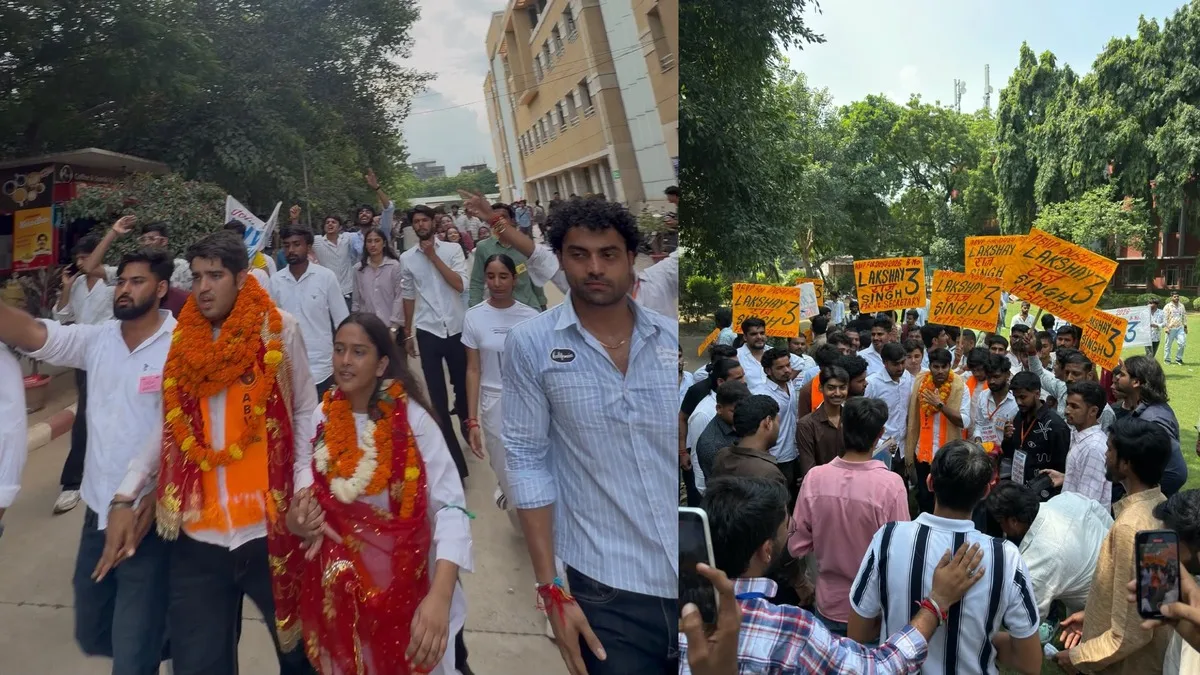
Paragraph 1: Introduction – The Electoral Surge and ABVP’s Unified Front
The electoral landscape of the Delhi University Students’ Union (DUSU) is currently witnessing an intense and transformative phase, characterized by a palpable surge of energy across the historical North and South campuses. As the university gears up for one of the most keenly contested student body elections in the country, the Akhil Bharatiya Vidyarthi Parishad (ABVP) has officially thrown its hat into the ring with a well-orchestrated campaign that is rapidly gaining momentum. Observers are noting a distinctly positive atmosphere and growing enthusiasm among students, who appear increasingly receptive to the narrative and organizational rigor of the ABVP. The panel announced by the student body presents a formidable array of candidates: Yash Dabas is contesting for the prestigious post of President, Ishu Maurya for Vice President, Riya Chhabri for the role of Secretary, and Lakshyaraj Singh for Joint Secretary. However, a pivotal element of their electoral strategy is the synchronized voting sequence—a uniform mandate of 7-3-3-3 for the entire panel. This sequence is not merely a tactical choice but a directive aimed at mobilizing the vast student voter base to cast their ballots in complete alignment, thereby ensuring that the votes are maximally consolidated to secure a clean sweep for the entire ABVP quartet. The campaign’s early days have already yielded a robust response, indicating that the grassroots worker network of ABVP, which remains deeply entrenched in the college environments, is effectively translating its organizational strength into visible on-ground traction. As candidates crisscross various faculties and hostels, the conversation is increasingly shifting toward tangible campus issues, with a focus on providing a clear, credible alternative to the fragmented opposition, thus setting the stage for a high-octane electoral duel in the coming days.
Paragraph 2: The ABVP’s Groundwork – Direct Engagement and Student-Centric Issues
At the very core of ABVP’s escalating popularity is a meticulously crafted, ground-level engagement strategy that starkly contrasts with the superficial and often digitally detached approach of its rivals. The ABVP candidates and their dedicated cadre of workers have launched an intensive campaign trail, traversing the length and breadth of Delhi University, visiting individual colleges, developing hostel outreach programs, and organizing localized meet-and-greets. This is not a traditional walk-through; it is an intricate listening tour designed to meticulously catalogue the genuine concerns, demands, and expectations of the diverse student body. The dialogue does not confine itself to generic platitudes but ventures deep into the specific predicaments plaguing students—ranging from the rationalization of examination reforms and the acute shortage of hostel accommodations to the urgent expansion of library facilities and the allocation of research funds. Key issues such as campus safety, sports infrastructure, and the efficient and transparent administration of scholarships are also being foregrounded in these interactions. By directly engaging with students in lecture theatres, canteens, and common rooms, the ABVP is effectively dissolving the barrier between the candidate and the electorate, humanizing the political process and demonstrating a willingness to prioritize immediate welfare over transient political gains. This direct approach serves a dual purpose: it ensures the party’s manifesto remains firmly rooted in empirical realities, while simultaneously allowing the students to see their potential representatives as accessible, capable, and committed advocates. The narrative of constructive dialogue, coupled with a robust action plan to resolve administrative bottlenecks, is resonating deeply with a student body weary of ideological grandstanding. This sustained on-ground presence, bolstered by a clear-eyed focus on solving practical problems, is methodically dismantling the opposition’s traditional monopoly on the “student-centric” label, firmly positioning the ABVP as the sole organization earnestly addressing the core determinants of daily campus life.
Paragraph 3: NSUI’s Internal Crisis, Ideological Contradictions, and Organizational Paralysis
In stark contrast to the disciplined and synchronized electoral march of the ABVP, the Congress-affiliated National Students’ Union of India (NSUI) finds itself ensnared in a web of profound internal conflicts, public embarrassments, and ideological inconsistency. As the DUSU election date looms ever closer, the carefully constructed facade of unity within NSUI has spectacularly crumbled, laying bare deep-seated factionalism, clashing leadership egos, and a glaring incapacity to maintain even basic coordination among its own leaders and rank-and-file workers. These internal disputes transcend the realm of minor organizational hiccups; they fundamentally interrogate the NSUI’s very competence to articulate and represent the complex, multifaceted aspirations of thousands of Delhi University students. If an organization cannot manage its own internal cohesion, align its leaders on a unified campaign strategy, or prevent public outbursts of dissent, its credibility in negotiating with university authorities or effectively advocating for student welfare appears inherently compromised. Furthermore, the political climate has been severely exacerbated by alleged incidents involving NSUI members burning the Constitution of India and, famously, the organisation’s own flag. These acts are profoundly contradictory to the democratic and constitutional ethos that student politics is supposed to uphold. For a body claiming to be a champion of constitutional values to engage in the desecration of the supreme legal document and its own organizational insignia is not merely a lapse in judgment—it is a damning indictment of their ideological confusion and a glaring lack of organizational discipline. Such behaviors resonate powerfully among the student voters, who increasingly view these stunts not as radical activism but as desperate, chaotic acts of political hooliganism stemming from a severe leadership vacuum. Consequently, this internal dysfunction is systematically alienating the crucial undecided voter bloc, muddying the NSUI’s campaign message, and severely jeopardizing their electoral prospects before a single ballot is cast.
Paragraph 4: The Divergent Tactics – Social Media Propaganda versus Issue-Based Campaigning
With their internal machinery mired in disarray, the Congress-NSUI alliance appears to be progressively retreating into a defensive strategy defined by an overwhelming reliance on social media propaganda, baseless political allegations, and manufactured sensationalism, rather than confronting the substantive policy debates that a serious student election demands. Instead of presenting a cogent, compelling agenda for academic improvement, fee rationalization, or infrastructural development, their campaign is increasingly characterized by viral soundbites, smear tactics aimed at opponents, and a relentless desire to create controversy as a means of projection. This digital-first approach creates a glaring disconnect between the narratives proliferating online and the stark realities experienced on the ground, essentially substituting genuine discourse with echo-chamber theatrics. The overt reliance on misleading information and inflammatory rhetoric reveals a deeper strategic flaw—it functions as a deliberate diversion tactic, attempting to obscure the party’s own organizational failures by casting aspersions on its rivals. By focusing predominantly on political witch-hunts and manufactured outrage, NSUI tacitly concedes its lack of a substantive policy vision, failing to articulate a credible roadmap for pressing issues like hostel fee hikes, academic calendar disruptions, and curbs on student safety. The distinguished student electorate of Delhi University, characterized by high political awareness and critical thinking, is becoming increasingly discerning of this desperation. They recognize the NSUI’s campaign for what it is: a hollow vessel devoid of constructive ideas for university development, masquerading as enthusiasm while offering only negativity. This strategy is proving profoundly counterproductive, as it fails to attract new supporters and actively demoralizes the existing rank and file, who watched their own party workers engage in the constitutional disrespect and flag-burning episodes. This stark juxtaposition—ABVP’s constructive, issue-based dialogue versus NSUI’s divisive, social media diatribe—has never been more pronounced in recent memory, promising to be a decisive, defining factor as students head to the polling booths.
Paragraph 5: The Official ABVP Statement – A Rhetorical Crisis Exploited and a Confident Mandate
This sharp divergence in organizational coherence and electoral methodology is precisely what ABVP Delhi State Secretary Shri Sarthak Sharma articulated with precision and confidence in a recent, pointed statement meant to crystallize the election’s central narrative. Sharma effectively dismantled the NSUI’s claim to representational legitimacy by posing a rhetorically devastating and logically unassailable question: if an organization cannot manage its own internal affairs, resolve its internal squabbles, or maintain discipline among its cadre, how can it possibly be trusted to manage the multifarious concerns of thousands of university students? At the heart of his address lay a decisive focus on the NSUI’s ongoing internal differences, which he highlighted as concrete evidence of organizational paralysis. He asserted that their conspicuous inability to coordinate a uniform campaign is not an aberration but rather a direct and predictable reflection of their fundamental incompetence. While NSUI chooses the “easier path” of allegations, misinformation, and social media propaganda, Sharma emphasized that the ABVP remains steadfastly entrenched in a solution-oriented approach, diligently working on issues that possess the direct capacity to elevate campus life. He underscored that students are not passive observers but meticulous evaluators, closely watching the conduct of both organizations—their discipline on campus, their respect for democratic processes, and the consistency of their actions vis-à-vis their rhetoric. Drawing on the tangible momentum witnessed through the vast collegial networks, he expressed unshakeable confidence in the electoral outcome, asserting unequivocally that the synchronized 7-3-3-3 voting sequence, diligently transmitted by the ABVP cadre to every nook and cranny of the university, will culminate in a comprehensive and overwhelmingly decisive victory for the entire panel. The clarity of his message—that persistent action on the ground will always outweigh fleeting propaganda online—serves as a resounding testament to the broader ideological battle between constructive student advocacy and glorified political chaos, appealing directly to voters who value reliability, integrity, and substantive progress.
Paragraph 6: Conclusion – The Electorate’s Verdict and a Projected Landslide for the ABVP Panel
As the critical day of voting approaches, the atmosphere within the sprawling expanse of Delhi University is electric, marking a moment of heightened discernment for the student body. The electorate represents a sophisticated and highly influential voting bloc that is evaluating candidates not merely on their superficial party affiliations but on their conduct during the campaign, the substantive merit of their proposals, and the overall integrity of their political maneuvers. Throughout this electoral cycle, the ABVP has methodically cultivated a narrative woven around reliability, proactive governance, and organizational integrity. Their meticulous orchestration of college visits, intimate student interactions, and unwavering advocacy for tangible improvements has solidified their reputation as the serious stakeholder in university administration capable of transforming campus life. Conversely, the NSUI’s descent into internal bickering, coupled with the alarming and deeply symbolic incidents involving the desecration of the Constitution and their party flag, has catastrophically tarnished their image as a responsible electoral contender. The glaring contradiction between their rhetorical reverence for the Constitution and their alleged actions on the ground has not escaped the eager attention of the voters, who view such actions as disqualifying. Consequently, the ground dynamics clearly point towards an emphatic and decisive mandate favoring the ABVP. The ‘7-3-3-3’ uniform voting pattern, propagated with near-mechanical precision by the ABVP’s vast worker network, is poised to yield a sweeping, landslide victory for the entire panel of Yash Dabas, Ishu Maurya, Riya Chhabri, and Lakshyaraj Singh. Ultimately, this election is shaping up to be a resounding referendum on two fundamentally divergent approaches to student politics: one rooted in constructive engagement, grassroots connectivity, and institutional credibility; the other characterized by opportunistic controversies, internal chaos, and a blatant disconnect from student concerns. The outcome will reaffirm a timeless political lesson—that the discerning students of Delhi University prioritize substantive campus welfare, organizational integrity, and reliable representation over hollow slogans, divisive stunts, and empty digital narratives. The decisive victory that ABVP confidently anticipates will not merely be a win for its four candidates but a resounding, historic endorsement of grassroots, issue-based student leadership that promises to elevate the standard of academic and extracurricular excellence across the university for years to come.


