


The Digital Firestorm: A Week of Viral Misinformation and the Battle for Truth in India
In an age where information travels at the speed of a click, the line between fact and fiction has become increasingly blurred, particularly within the volatile landscape of Indian politics and social discourse. This week has served as a stark reminder of the pervasive nature of misinformation, as a series of viral claims—ranging from a heinous crime in Bihar to a political rally in Madhya Pradesh and the enduring mystery of a Bollywood actor’s death—have been circulated widely across social media platforms. However, a closer examination by fact-checking organizations reveals a troubling pattern: many of these emotionally charged narratives are built on faulty foundations, relying on old, unrelated, or even artificially generated content to mislead the public. As these falsehoods threaten to shape public opinion and incite unrest, the critical work of verification has never been more essential. This report delves into the top fact checks of the week, dissecting the claims, exposing the truth, and underscoring the importance of vigilance in the digital age.
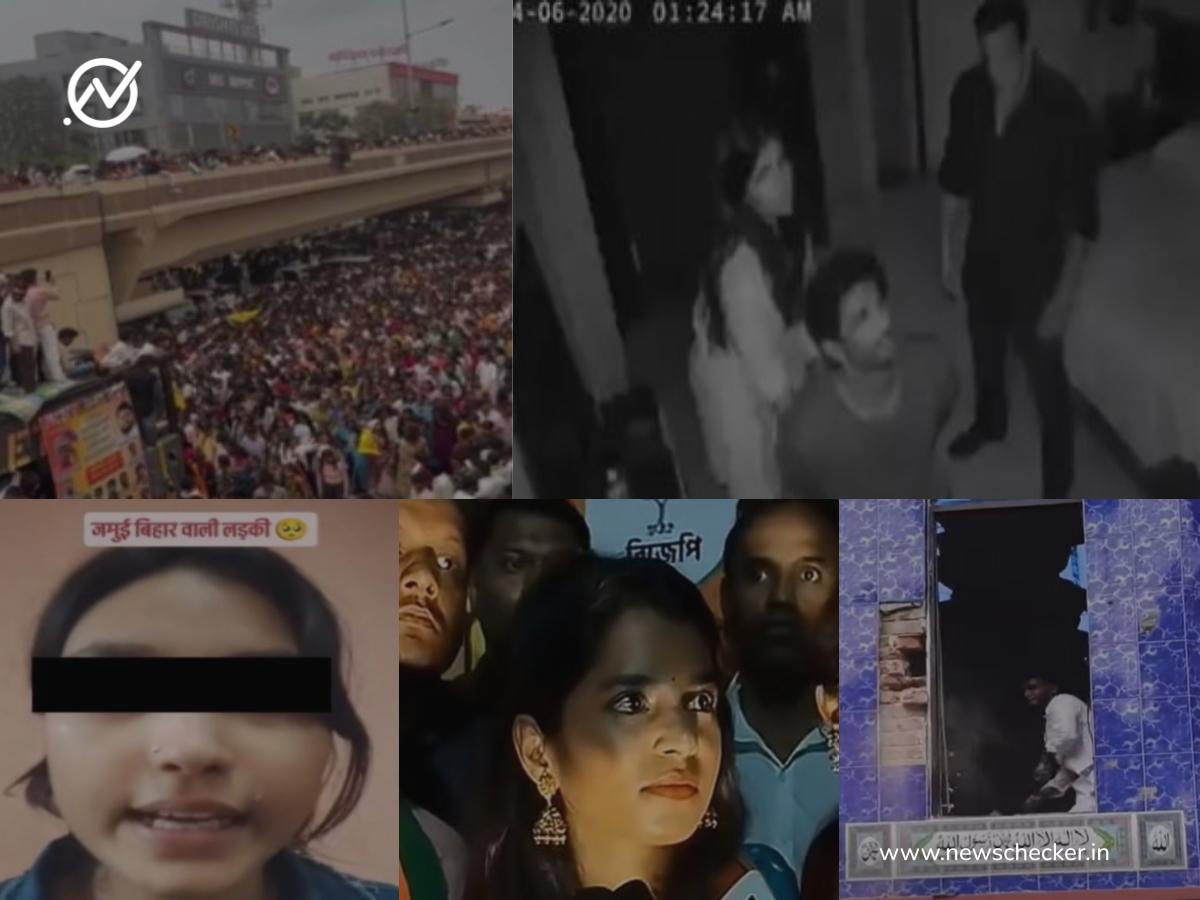
The first and most urgent case originates from the rural heartlands of Bihar, where a reported incident of molestation and harassment of a minor girl in the Jamui district has ignited widespread outrage and condemnation. The alleged incident, which reportedly occurred on September 19, 2026, involving a Class 10 student, quickly became a flashpoint for political point-scoring and public anger. In the chaotic aftermath, a heart-wrenching video of a young girl crying began to circulate on social media platforms, with users claiming that the footage showed the actual survivor of the Jamui attack. The video, shared with captions expressing fury and demanding justice, was presented as definitive visual evidence of the victim’s trauma. However, a meticulous investigation by the fact-checking team at Newschecker discovered that this claim was entirely false. The video, while undoubtedly depicting a distressed young girl, was unrelated to the Jamui incident. It was determined to be an old clip, stripped of its original context and repurposed to fit the narrative of the current tragedy. This act of digital misinformation is particularly insidious, as it not only exploits public sympathy for a serious crime but also risks misdirecting the investigation and causing further distress to the actual victim’s family by flooding the digital space with irrelevant material. The viral spread of this video highlights a grim reality: in the rush to express solidarity, users often fail to verify the authenticity of the very content they are sharing, inadvertently amplifying falsehoods.
Compounding the misinformation surrounding the Jamui case is a second viral clip that took a decidedly political turn. As the news of the molestation case spread, a video featuring Bharatiya Janata Party (BJP) MLA Maithali Thakur began circulating, seemingly showing her making a statement that “women are safe in Bihar.” The clip was shared by many as her direct reaction to the Jamui incident, implying a tone-deaf and defensive response from the ruling party in the face of a heinous crime. This framing was designed to generate anger against the political establishment, suggesting that they were out of touch with ground realities. However, the fact-checkers at Newschecker quickly traced the origins of this video and found that it was not a reaction to the recent events at all. The clip was from a media interaction that Thakur had given back in April 2026, months before the Jamui incident took place. By stripping the video of its original timestamp and context, those who shared it created a misleading causal link between Thakur’s earlier statement and the current tragedy. This case exemplifies a common tactic in the digital misinformation playbook: taking a real, verifiable clip and placing it in a false temporal context to create a politically damaging narrative. The act of recontextualizing an old statement to suggest a contemporary response is a deliberate attempt to manipulate public perception and score political points, undermining the credibility of public figures and distracting from the real issues at hand.
Beyond the borders of Bihar, the political arena in Madhya Pradesh also became a battleground for viral falsehoods. Following Congress leader Rahul Gandhi’s ‘Chhatron Ki Goonj’ event in Indore, a video began circulating online that allegedly showed a sea of humanity, a massive and enthusiastic crowd taking to the streets in support of the Congress leader. The visuals of a densely packed crowd were shared by supporters as proof of Gandhi’s immense popularity and the perceived failure of the ruling BJP to curtail his influence. The claim implied that the event had drawn a historic turnout. Nevertheless, the investigation by Newschecker revealed that this too was a case of mistaken identity. The video, although genuine footage of a large crowd, was not from Rahul Gandhi’s event in Indore. It was an old and unrelated clip that had been lying around the digital archives, waiting to be unearthed and repurposed for political propaganda. The video had no connection to the Indore rally whatsoever. This instance demonstrates the ease with which old visuals can be resurrected and given new life to serve present-day political agendas. The sharing of such unrelated footage as evidence of a rally’s success is a clear attempt to manufacture a narrative of political momentum and mass support, which can have a significant impact on public perception in the lead-up to crucial elections. The virality of this clip serves as a cautionary tale about the dangers of accepting visual evidence at face value without proper verification.
The misinformation, however, was not confined to political rallies and crime scenes; it also extended into the realm of communal tensions and religious sensitivities. In West Bengal, a video surfaced claiming to show the demolition of the 136-year-old Gauripur Jama Masjid, located near the Kolkata airport. The accompanying narrative was incendiary, asserting that religious extremists had destroyed the historic mosque to make way for the construction of a Ram temple. This claim, if true, would represent a severe escalation of communal strife and a direct attack on a place of worship. The video was shared by users who framed it as evidence of a growing intolerance and the marginalization of the Muslim community. However, a thorough fact-check by Newschecker found the claim to be unequivocally untrue. The video in question did not originate from West Bengal, nor did it depict the destruction of the Gauripur Jama Masjid. It was sourced from a different time and place, showing an unrelated demolition project. By attributing this foreign footage to a local, highly sensitive context, the sharers were not only spreading falsehoods but also deliberately attempting to inflame communal passions and create social discord. This dangerous form of misinformation has the potential to incite real-world violence and deepen societal fractures, making the swift and accurate debunking of such claims an urgent necessity for maintaining peace and harmony.
Finally, the ever-active rumor mill surrounding the tragic death of Bollywood actor Sushant Singh Rajput in 2020 was given another jolt with a new piece of “evidence.” Social media was abuzz with a purported leaked CCTV screenshot that appeared to show a person with a striking resemblance to Rajput kneeling on the floor, with two other individuals who looked like actors Salman Khan and Sanjay Dutt standing nearby. This image was presented as a breakthrough in the case, suggesting a conspiracy and casting suspicion on high-profile figures who had long been subjects of online speculation. The emotional weight attached to this case ensures that any new “evidence” is immediately seized upon by legions of conspiracy theorists and fans demanding justice. Yet, upon closer inspection, the fact-checkers at Newschecker determined that this image was not a real CCTV capture at all. It was a high-quality, AI-generated image (deepfake) designed to look like a grainy security camera still. The creation and dissemination of this digitally manipulated image represents a new frontier in misinformation, where artificial intelligence is used to fabricate convincing but entirely false visual “proof.” This not only disrespects the memory of the deceased but also muddies the waters of an already closed investigation, causing incalculable pain to the grieving family and continuing a cycle of baseless speculation.
In conclusion, the five cases fact-checked this week illustrate a deeply concerning ecosystem of misinformation that thrives on emotion, political bias, and communal prejudice. Whether it is an old video of a crying girl being passed off as a current crime victim, a stale political statement repurposed as a fresh reaction, unrelated crowd footage used to fabricate political momentum, foreign demolition clips used to stoke communal fires, or AI-generated images presented as crime scene evidence, the pattern is consistent: the truth is the first casualty in the digital attention economy. These instances are not mere innocent errors; they are often deliberate attempts to manipulate public opinion, influence electoral outcomes, and incite violence. As social media platforms continue to be the primary source of news for millions, the onus falls on both the platforms and individual users to exercise greater responsibility. The findings of fact-checkers serve as a crucial bulwark against this tide of falsehood, but their reach is often limited in comparison to the viral spread of the original lie. The fight against misinformation is an ongoing battle, and the evidence from this week alone shows that it is a war that requires constant vigilance, critical thinking, and a collective commitment to verifying before sharing, ensuring that digital spaces do not become factories of falsehood.