








Headline: Fact-Check: 2024 EVM Protest Video Falsely Shared as Recent Delhi Demonstration Against CEC Gyanesh Kumar
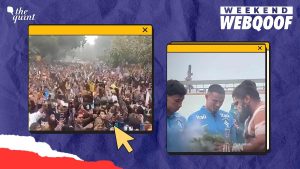
A video showing a massive crowd chanting “EVM hatao, desh bachao” has resurfaced on social media, prompting a wave of false claims during a politically charged period. The clip, which depicts a large assembly of protesters filling the streets and raising slogans against Electronic Voting Machines (EVMs), is being circulated with the assertion that it captures recent visuals from Delhi’s Jantar Mantar. According to the viral claim, the footage is from ongoing protests demanding the resignation of Chief Election Commissioner (CEC) Gyanesh Kumar, following the Election Commission’s announcement of a Special Intensive Revision (SIR) of electoral rolls. The videos, shared across platforms such as Twitter, Facebook, and WhatsApp, have been accompanied by captions linking the mass mobilization to growing public anger over alleged electoral irregularities. However, the claim is demonstrably false. A structured fact-check of the footage has clarified that the video is not from any recent demonstration in Delhi but rather dates back to January 2024, when activists gathered to campaign for a complete ban on EVMs. The misrepresentation of the video’s timeline has led to significant confusion, and it also underscores a broader challenge of misinformation in India’s digital and civic discourse.
The fact-check conducted by this publication traced the origins of the viral video and found that it was originally recorded in January 2024, several months before the current controversy surrounding CEC Gyanesh Kumar and the electoral roll revision process. The footage, which features a large crowd chanting against EVMs, was captured during a movement that was specifically organized to demand the abolition of Electronic Voting Machines. That movement had no connection to the current protests at Jantar Mantar, nor to the demands for the resignation of the Chief Election Commissioner. The misattribution appears to be a classic example of a context collapse, in which a visual from one protest is detached from its original circumstances and inserted into a new narrative. The fact-check noted that no element of the video’s background, signage, or timing matches the recent protests, and the only reason the two have been linked is the shared presence of anti-EVM slogans. In reality, the current protests are centered on specific concerns about the electoral rolls, not on a sweeping demand to remove EVMs from the electoral process altogether. Yet the viral nature of the video has led thousands of internet users to believe otherwise, and the false connection has been amplified by partisan social media pages and unverified accounts.
To fully understand the significance of this misinformation, one must examine the background of the recent protests against CEC Gyanesh Kumar. The demonstrators gathered at Delhi’s Jantar Mantar to express their discontent with the Election Commission’s decision to undertake a Special Intensive Revision (SIR) of electoral rolls in certain states. The SIR process was introduced to update and correct the voter list, identify duplicate entries, and ensure that deceased voters are removed, and eligible voters are added. However, critics and opposition groups have raised serious objections to the manner in which this revision has been carried out. They have alleged that the process disproportionately targets voters from specific communities, that it lacks transparency, and that it may lead to arbitrary deletions of legitimate voters from electoral rolls. These concerns have escalated into demands for the resignation of CEC Gyanesh Kumar, who assumed office at a time when the credibility of the Election Commission has come under renewed scrutiny. Protesters have accused the Commission of failing to uphold its constitutional duty of conducting free and fair elections, and have called for greater institutional accountability. The movement has drawn support from various civil society organizations, retired bureaucrats, and members of the political opposition, expanding its reach beyond any single group.
In contrast, the old video that has been falsely linked to these protests was born out of a different, albeit related, political battle. The demand to “Remove EVMs, save the nation” has been a persistent refrain in Indian politics, particularly among those who argue that electronic voting machines are susceptible to tampering and cannot be fully audited by the public. Over the years, this anti-EVM campaign has gained traction at various moments, often after elections, when losing parties have alleged malfunctions or manipulation. In January 2024, activists and opposition leaders organized a demonstration to push for a return to paper ballot voting, arguing that EVMs undermine the integrity of democracy. That event was recorded and widely shared at the time, but it was not associated with any particular revision of electoral rolls or with the leadership of the Election Commission. The fact that the same footage is now being circulated with a new and misleading context reveals a common technique used by creators of misinformation: recycling emotive imagery to generate a false sense of current crisis. The chant “EVM hatao, desh bachao” is powerful and polarizing, making it a convenient tool for those seeking to mobilize public opinion, regardless of the actual accuracy of the claim attached to it.
The circulation of this old footage as current news also highlights the deeper dangers of misinformation in a rapidly evolving information ecosystem. In a country with over a billion people and hundreds of millions of smartphone users, viral videos can spread faster than fact-checks and have the power to shape public perception before the truth emerges. When a video appears to show a massive crowd demanding change, it naturally evokes an emotional response, prompting viewers to share it widely as evidence of a groundswell of public opinion. This is especially true in the context of elections, where trust, legitimacy, and public confidence are paramount. The false link between the January 2024 anti-EVM protest and the recent Jantar Mantar demonstrations does more than just misdate a video; it distorts the actual narrative of ongoing political events. It makes it appear as though the current protests are far larger and more unified than they may be, and it conflates distinct demands, creating a skewed picture of the public mood. Fact-checkers and journalists have repeatedly warned about this phenomenon, urging the public to verify the source, date, and context of any visual content before sharing it. Social media platforms have also introduced tools to flag potentially misleading media, but these measures remain insufficient in the face of rapid, coordinated dissemination.
Ultimately, this incident serves as a crucial reminder for citizens, media consumers, and political actors to exercise caution and discernment in an age of information overload. The fact-check clearly establishes that the viral video of a crowd chanting “EVM hatao, desh bachao” has no relation to the current protests calling for the resignation of Chief Election Commissioner Gyanesh Kumar. While those protests are real and rooted in concerns about electoral roll revisions, the footage used to amplify them is outdated and misleading. Responsible journalism and active citizen verification are now indispensable tools in the fight against false narratives. Editors, newsrooms, and individual users all bear a shared responsibility to ensure that old videos are not repackaged as breaking news, and that legitimate public concerns are not undermined by fabricated associations. As the debate over the Election Commission’s actions continues, the public deserves an honest and accurate account of the events unfolding at Jantar Mantar and elsewhere. Misinformation, once seeded, is difficult to uproot; therefore, it is essential for every stakeholder to prioritize truth and integrity. The facts, as verified, remain clear: the video is old, the claim is false, and no amount of viral sharing can transform a January 2024 protest into a current one.


