







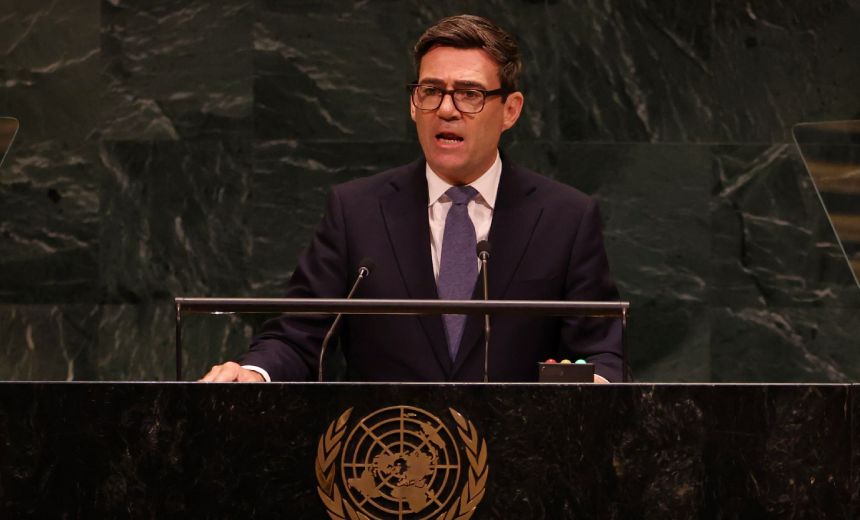
NEW YORK — In his first major address to the international community, British Prime Minister Andy Burnham accused Russia of waging an “industrial-scale assault” on the information environment and announced that the United Kingdom would establish a new state body to counter hostile disinformation. Addressing the UN General Assembly in New York on Sept. 22, 2026, the Labour leader said Moscow was spending an estimated $1.7 billion every year on a global apparatus of lies intended to create what he called “a narrative of decline, stoking division and sowing despair.” Burnham used the speech to mark a deliberate break from what he described as years of under-reaction by Western governments. “Russian agencies have used every means at their disposal to spread lies and disinformation and prey on people’s fears,” he said. “They’ve used bots and fake websites. Falsified newspaper articles. Forged the branding of 28 British organizations — including universities and the BBC. They’ve amplified far right narratives. And we have evidence that they tried to interfere with the 2019 general election.” He also warned that “we have seen cyberattacks on our companies and institutions” and that “artificial intelligence will multiply the threat.” In a pointed rebuke to previous official caution, Burnham said: “We have tiptoed around this for too long.”
To translate that warning into action, Burnham announced that he was tasking Britain’s security chiefs with creating a new National Centre for Information Defense. The center, he said, would “detect, attribute and disrupt these kinds of hostile state information attacks” and would “support and defend our democracy.” The announcement marked a significant escalation in the British state’s approach to foreign interference, moving beyond monitoring and exposure toward active disruption of hostile networks. But it also raised immediate questions about civil liberties and the potential for domestic overreach. The Kremlin responded within hours. Spokesman Dmitry Peskov reportedly said Wednesday that the British government was “stoking Russophobic sentiment and maintaining an atmosphere of total Russophobia,” a line reminiscent of Moscow’s reaction to the 2020 report from Parliament’s Intelligence and Security Committee, which had documented extensive Russian meddling in U.K. politics. Britain already has a National Security Online Information Team, originally established in 2019 as the Counter Disinformation Unit, which took a prominent role in challenging misinformation during the COVID-19 pandemic and later focused on Russian disinformation narratives around the war in Ukraine. The relationship between that existing unit and the new center had not yet been clarified, according to sources at the Cabinet Office, who said the center would work with intelligence agencies, government departments, law enforcement and social media companies.
Burnham singled out Moldova as a case study in both the danger of Russian interference and the possibility of resilience. The United Kingdom, he noted, had already helped Moldova last year to counter Russian influence operations. Moldova, a small post-Soviet country seeking European Union membership, faced an especially aggressive Russian effort; in 2023 it set up its own Centre for Strategic Communication and Combating Disinformation. After Moldova’s 2025 election, that center reported that Russia had used a multilingual network of websites — some impersonating legitimate news outlets — and fake social media accounts to circulate fabricated stories. In the end, the pro-European Party of Action and Solidarity won the ballot, suggesting that public awareness and institutional preparation can blunt even sophisticated interference. But the British government’s announcement was not met with universal applause. Big Brother Watch, a civil liberties group that had strongly criticized the earlier Counter Disinformation Unit’s work on coronavirus content, offered a cautious welcome while recalling instances in which the CDU and intelligence bodies had been involved in “recording, flagging and triggering the censorship of Britons’ lawful speech.” Its director, Silkie Carlo, called the government action against foreign hostile states’ disinformation campaigns correct, but said the public deserved assurances that such action would be “strictly limited to overseas threats.” She added: “We have already seen the mantle of countering ‘disinformation’ being abused by our government in attempts to malign and silence dissent.”
Government sources said the new center would be designed to strengthen local community cohesion as well as national security by preventing what they called “a distorted and untrue narrative about Britain” from taking hold in communities. That phrase appeared to be tied to the recent wave of far-right violence targeting asylum seekers and the organizations that support them, often fueled by online falsehoods about migration and crime. The center’s precise powers, legal framework and accountability mechanisms remained unclear, and no date was given for when it would begin operating. The vagueness invited political attack from the right. Nigel Farage, leader of the hard-right Reform Party, immediately compared the proposed body to George Orwell’s Ministry of Truth and claimed it would be used to “clamp down on free speech.” Reform politicians have themselves faced scrutiny over ties to Russian influence: Nathan Gill, a senior Reform figure, was jailed last year after being convicted of taking bribes to parrot Kremlin propaganda in speeches to the European Parliament. The Foreign Affairs Committee, by contrast, welcomed the announcement. The committee had called in March for a new National Counter Disinformation Center, comparable to Britain’s National Cyber Security Centre, and its chair, Labour MP Emily Thornberry, said the committee had been “extremely worried” about complacency in the British establishment. “We thought the response from Whitehall had been ‘talk to the hand because the face ain’t listening’, but it seems we were wrong. I’m absolutely delighted,” she said. Conservative committee member John Whittingdale noted that France and Sweden already have similar institutions and said parliamentarians would track the center’s progress and scrutinize its work.
Burnham’s indictment drew on years of research into the architecture of Russian influence operations. The Internet Research Agency, a St. Petersburg troll farm once controlled by the late Yevgeny Prigozhin, was an early center of gravity for the Kremlin’s online meddling. After Prigozhin’s failed mutiny and death in 2023, the agency was formally dissolved, but its functions were absorbed into a wider constellation of state-backed actors. The Foreign Affairs Committee’s March report identified official state channels and Kremlin-backed media outlets — including RT, Sputnik and African Initiative — as part of the arsenal. It also highlighted two covert networks with evocative codenames: Doppelgänger and Matryoshka. Doppelgänger, first unmasked in 2022 by EU DisinfoLab, manufactures exact copies of authentic news sites and uses them to push fabricated stories into social-media feeds. Matryoshka, also known as Operation Overload, was identified in late 2023 by France’s Viginum anti-disinformation agency. It operates through paid amplification on X, TikTok and Bluesky, using bots, fake accounts and coordinated engagement to make memes, articles and videos go viral without revealing their origin. Recent German media coverage said Matryoshka activity intensified before state elections in Germany in which the far-right, Kremlin-friendly Alternative for Germany party performed strongly. Earlier this month, the counter-disinformation group Antibot4navalny warned that Matryoshka was also spreading fake videos of U.S. celebrities criticizing Democrats, apparently in an attempt to sway the looming midterm elections.
The combination of openly promoted Kremlin media, hidden commercial troll farms, artificial intelligence and fast-evolving social-media platforms has made the information battlefield far more complex than the bot-driven campaigns of a decade ago. Burnham’s speech was a declaration that Britain intends to move from passive resilience to active defense, including rapid attribution and disruption of hostile digital operations. The new center is supposed to detect attacks quickly, show citizens who is behind them and take steps to limit their spread, a strategy that relies heavily on cooperation from social media companies and allied governments. It is also a political gamble. By placing Russia at the center of his UN debut, Burnham has aligned himself with the tougher line taken by many European capitals, but he has also opened himself to accusations of distracting from domestic problems and of building a censorship apparatus. His defenders insist the center will be carefully targeted at foreign actors; his critics on both the left and the right will hold him to that promise. With Moscow already dismissing the initiative as Russophobic, civil liberties groups demanding safeguards, and a skeptical opposition questioning its cost and scope, the success of the National Centre for Information Defense will depend on whether it can demonstrate tangible results without becoming a domestic surveillance tool. For now, Burnham has made clear that Britain has chosen to name the threat, confront it openly and build an institution designed for a long conflict that shows no sign of ending.


