


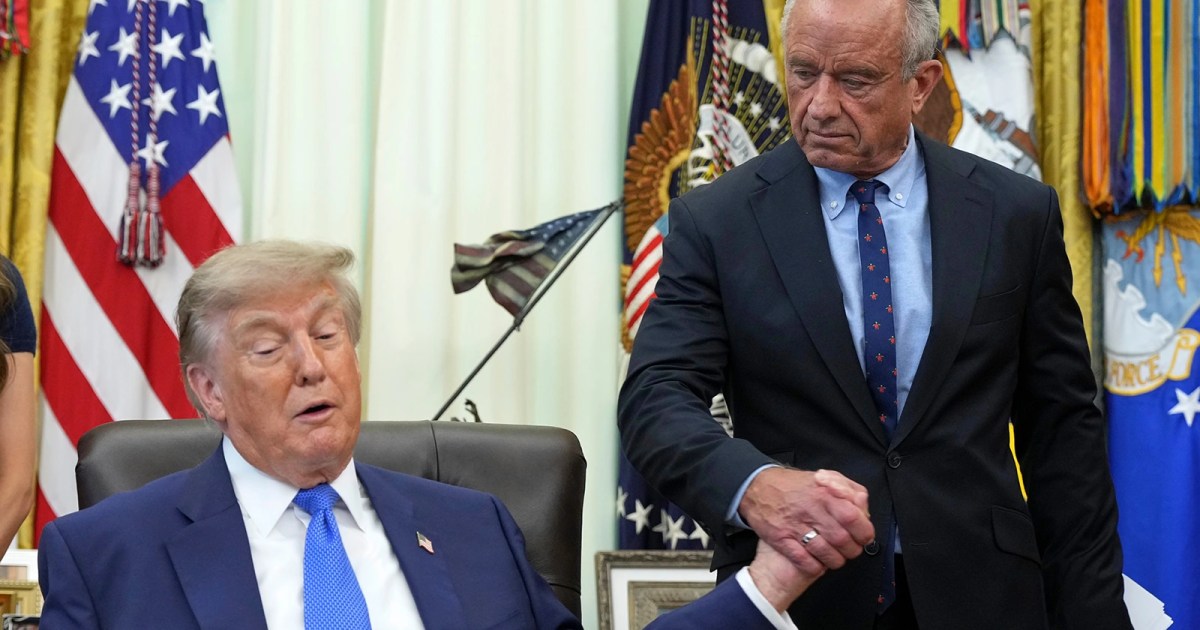
With just 12 weeks remaining before the midterm elections and six weeks before early voting begins in some states, President Donald Trump is not focused on the issues voters care most about. According to a detailed report from MS NOW’s MaddowBlog by Steve Benen, the president is instead consumed by a familiar set of personal obsessions: the condition of the Reflecting Pool, his unsupported theories about the 2020 election, and a vanity renovation project in the White House ballroom. None of those matters, Benen notes, is especially important to the American mainstream. So it came as little surprise when Trump turned this week to another of his longtime preoccupations: peddling misinformation about vaccines. The Wall Street Journal reported two weeks ago that Trump had privately lobbied Health and Human Services Secretary Robert F. Kennedy Jr. to investigate the long-debunked connection between vaccines and autism and to reduce the number of shots that federal guidelines recommend for children. On Monday, the president took related steps of his own, signing an executive order aimed at upending the childhood vaccine schedule. The order, as the report explains, recommends reducing the number of childhood immunizations to cover 11 diseases, down from the 18 that the Centers for Disease Control and Prevention had previously recommended. It is a dramatic shift, and it marks a moment when a sitting president has embraced anti-vaccine ideology as official policy. The report also notes that the political timing is difficult to ignore: with early voting approaching, Trump is choosing to spotlight an issue that energizes the Republican base but is far from the top of most Americans’ agenda.
Under the executive order, the routine childhood schedule would no longer include universal recommendations for hepatitis A and hepatitis B vaccines, the Covid-19 vaccine, or the flu vaccine. Those shots, the order says, would remain available for certain high-risk groups and “for shared clinical decision-making, ensuring that parents have all options available to them.” In other words, parents could still seek out the vaccines, but they would no longer be presented as the standard of care for every child. The order also recommends breaking apart the combined measles, mumps, and rubella vaccine, commonly known as MMR, into three separate injections. Those shots should generally be administered during separate office visits, according to the order, to “give parents more options regarding the timing and frequency of this vaccine administration.” The changes are not supported by the medical community. Decades of evidence show that combined vaccines are safe, that separating them does not reduce any risk, and that delaying immunizations leaves children vulnerable to serious infections for longer periods. The report is careful to note that it is an open question whether the executive order has any legal or substantive significance. As The New York Times has explained, vaccine recommendations in the United States are made by a committee of experts who advise the CDC, and are then adopted by the agency’s director. Only states can require vaccinations for children to enter school or day care. The order cannot, on its own, change state law. It can, however, carry enormous symbolic weight and add further confusion for parents.
The White House event where Trump signed the order lasted roughly 40 minutes, and it quickly became clear that the administration’s position was not rooted in science. At the start, Trump declared that he was unveiling “gold standard childhood vaccination recommendations.” But the report describes the event as a misinformation extravaganza. Trump claimed, with no documentation, that he had seen “proof” of “a vaccination thing” in which something “the size of a bottle of soda” gets “poured into a little child’s body.” The report notes that such an assertion is bananas. Trump then went further, suggesting that the measles, mumps, and rubella vaccine could be “quite lethal” when given as a single combined shot. A reporter immediately asked whether Trump had any evidence whatsoever to support that statement. “No,” Trump replied. “What I’ve heard is that there are some people that say it is that way.” The reply was revealing. Moments after calling his plan the gold standard, the president was admitting that his recommendations were based on random things he had heard from unnamed people. The report emphasizes that all of this was plainly at odds with the findings of actual scientists, physicians, and public health officials. It was also a reminder that Trump’s approach to medicine is to trust his own instincts and the voices he hears, not the collective evidence of the scientific community. For public health experts, the event was less a policy announcement than a frightening display of a president willing to put hearsay above fact.
The episode also brought into sharper focus a troubling reality about Trump’s relationship with medicine: he seems convinced he still has the credibility to advise Americans on their health, despite a long record of ignoring medical experts and floating dangerous ideas. The report points to a January interview with The Wall Street Journal in which Trump said he routinely ignores the advice of physicians on whether to take a daily aspirin, in part because he is “superstitious” and in part because he wants “nice, thin blood pouring through my heart.” That statement could be dismissed as an odd personal anecdote, but as the vaccine order shows, Trump is now translating his personal beliefs into federal policy. He is not merely sharing an opinion; he is using the powers of the presidency to encourage parents to reject standard vaccine schedules. The order was developed in concert with Kennedy, who has spent years promoting vaccine misinformation and who has questioned the safety of immunizations that have been used successfully for decades. Public health experts responded with alarm, pointing out that vaccines are among the most studied medical interventions in history. The supposed link between vaccines and autism has been thoroughly investigated and repeatedly disproven. Serious side effects exist, but they are extraordinarily rare. Yet none of that evidence was visible during the Oval Office event, where hearsay from unnamed “people” carried at least as much weight as research.
The political implications are hard to ignore. With the midterms approaching, Trump is not talking about the economy, health care costs, or other issues that independent and moderate voters consistently rank as high priorities. Instead, he is staking out territory on the most divisive elements of the culture war around public health. The report opens by noting that Trump may not be focused on the issues voters care most about, but he is clearly focused on the issues he cares most about. The vaccine order may energize his political base, but it could also create serious public health risks. If parents follow the new recommendations, children may be left without protection against hepatitis A, hepatitis B, Covid-19, and influenza. Separating the MMR vaccine into three visits means a child would not be fully protected against measles, mumps, and rubella for months longer than under the standard schedule. During that time, measles—a disease that can cause severe complications and death—could be contracted. The legal authority to require vaccination lies with the states, so the order may not immediately change school entry rules. But it could influence state legislatures and school boards to weaken requirements. It could also give hesitant parents a false excuse to skip shots their pediatricians recommend. The result, according to experts and the report, is a policy that substitutes ideology for evidence and could lead to preventable outbreaks across the country.
Ultimately, the report says, two things became clear during the 40-minute White House ceremony. The first was that the event was a misinformation extravaganza. The second was that Trump remains convinced he has the standing to advise Americans on medicine and science, in defiance of every lesson of the past several years. He called his plan the “gold standard,” but his own admission—that he had “heard” from “some people” that a vaccine might be lethal—revealed the truth. The order is based on anecdotes, not epidemiology; on suspicion, not science. The public health consensus has not changed. Vaccines save millions of lives each year. The decision to reduce the recommended schedule is not a neutral exercise in parental choice; it is a direct attack on the institutions that have spent decades building confidence in immunization. Whether the executive order has any legal effect remains an open question, and courts may eventually block it. But even if it does nothing more than add confusion, it will have served a harmful purpose. The report, written by Steve Benen, concludes that the president’s approach is at odds with everything scientists know. The danger is that millions of parents may listen to the president and make choices that put their children at risk. That is the consequence of giving the nation’s highest platform to misinformation, and it will be felt long after the election returns are counted.