




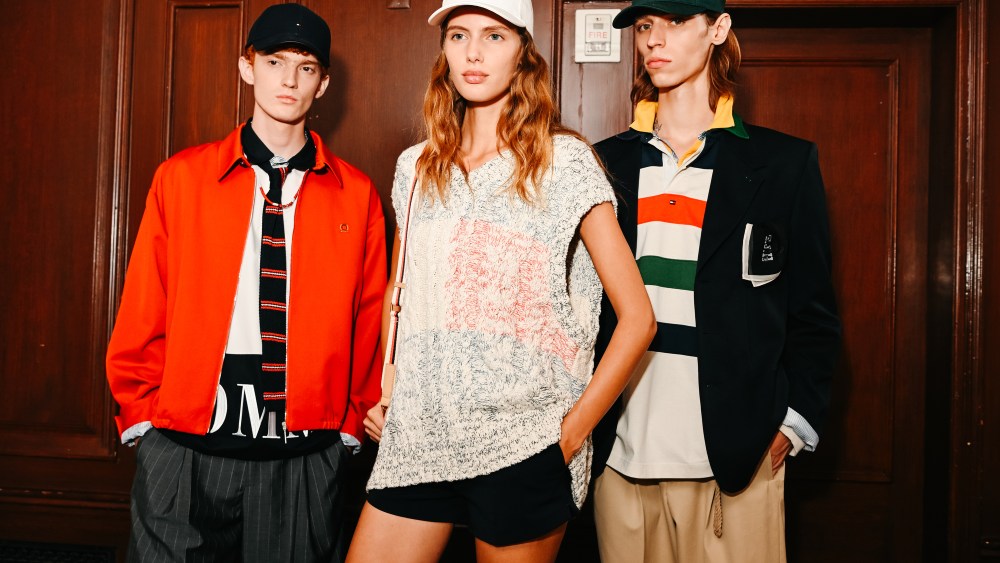
NEW YORK — Tommy Hilfiger emerged as the dominant force of New York Fashion Week with $58 million in Media Impact Value, according to data from Launchmetrics, the fashion analytics company. The label’s top ranking did not come from a single A-list moment, but from a deliberately engineered, multimarket ensemble of talent and content designed to travel across borders and platforms. Launchmetrics defines MIV as a metric that assigns a monetary value to every post, interaction and article in order to measure the impact of brand and market performance. This methodology monitors mentions and partnerships across print, media, social media and individual voices worldwide, including China, which has become an essential territory for luxury and fashion labels seeking global cultural relevance. The Hilfiger result underscores a fundamental shift in how fashion brands measure success during fashion month: the show itself is no longer the endpoint; it is a starting point for a much more complex, measurable ecosystem of social media amplification, influencer endorsements, celebrity attention and local cultural resonance.
The final ranking of winning labels highlights both the power of heritage American names and the fragmented attention economy of contemporary fashion. Calvin Klein took second place with $47 million in MIV, followed by Carolina Herrera in third with $20 million, Tory Burch in fourth with $19 million, and Michael Kors in fifth with $16 million. Cos finished sixth with $14 million, while Thom Browne, Christian Siriano, Khaite and Conner Ives rounded out the top ten with $10 million, $8.3 million, $6.9 million and $5.6 million, respectively. The spread of brands across established luxury houses, contemporary labels and emerging designers suggests that no single formula guarantees success. Instead, the common denominator for the week’s highest-performing brands was their ability to generate engagement that felt organic and culturally relevant. For Tommy Hilfiger, the sheer scale of its third-party validation was remarkable: the brand generated 5,500 placements following its show at The Plaza hotel, with an average MIV of $10,400 per placement. That kind of exponential content distribution, where every image, video and headline multiplies the brand’s presence, is becoming the true currency of fashion week.
A closer look at Hilfiger’s numbers reveals the strategic decisions behind the win. Out of the total $58 million in MIV, nearly 90 percent came from social media alone. The Media Voice contributed $35 million, while the celebrity, influencer and partner voices supplied the rest. What distinguishes Hilfiger’s approach is the deliberate geographic spread of its cast. Rather than concentrating on one celebrity market, the brand tapped talent across Korea, Italy, Colombia, Brazil, Germany and the United States. Korean stars Hyoyeon generated $672,000, Young K added $376,000, Yuri contributed $353,000, and Sooyoung added $328,000. Italian personality Biondo earned $432,000, while Colombian actor Carlos Torres produced $334,000, Brazilian influencer Jade Picon added $311,000, German actor Damian Hardung generated $293,000, and American actor Victoria Justice led the pack with $706,000. These figures reflect a micro-influencer approach at the celebrity level: audiences in each market received a familiar face, and those faces collectively told a single, unified brand story. Launchmetrics also reported that Hilfiger’s voice mix for the week was comprised of 60 percent Media, 15 percent Celebrity, 12 percent Influencer, 11 percent Owned Media and 1 percent Partner, a distribution that shows a heavy reliance on earned and third-party press but with enough social amplification to drive cultural relevance.
Tommy Hilfiger’s global chief marketing officer, Virginia Ritchie, credited the success to building a rich, immersive world rooted in four decades of brand DNA while remaining focused on how audiences engage today. “What made this season so powerful was the richness around one clear brand idea,” Ritchie said. “The Plaza, iconic models, global cultural voices, fashion and entertainment all layered together to create a moment that resonated far beyond the runway. Ultimately, media impact matters when cultural relevance builds desire for the brand.” Ritchie emphasized that there was a science to the storytelling, explaining that instead of relying on one hero moment, the brand created layers of talent, content and cultural moments that gave audiences multiple entry points into one consistent brand world. She also pointed to the growing importance of AI search as a new measure of media impact in 2026. “As consumers change how they search for and discover brands, we need to think just as deliberately about how Tommy shows up there,” she said. When asked about platforms, Ritchie noted that Instagram remains an incredible driver and central to the brand’s story, while TikTok had real cut-through this season. She highlighted a moment involving Patrick Schwarzenegger telling Kate Moss that the model walking past them was his wife, Abby Champion, as a natural, unmanufactured moment that resonated. Ritchie also singled out RedNote, the popular Chinese social media platform, as another standout around New York Fashion Week, showing how consistent brand storytelling can be adapted to local culture.
The broader New York Fashion Week picture reinforces this shift toward social-first storytelling. According to Launchmetrics, the Media Voice drove approximately 49 percent of total impact across major social platforms, while the Influencer Voice accounted for 28 percent of the week’s total MIV. Social media generated 90 percent of the event’s overall MIV, a staggering $416 million. Of that amount, Instagram generated 55 percent, TikTok generated 14 percent and YouTube generated 4 percent. Interesting structural differences emerged between platforms: on Instagram and YouTube, the Media Voice was the best-performing category, with the Influencer Voice in second place. But on TikTok, the Influencer Voice actually overtook the Media Voice by $10 million, a sign that creator-led authenticity and algorithmic virality are central to success on short-form video platforms. Another notable detail from the data: carousels proved to be the most effective format for Fashion Week coverage, delivering the highest value per placement and the strongest overall impact, with an average MIV of $123,000 per post. This suggests that audiences and algorithms alike reward content that is immersive, swipeable and rich in visual storytelling, offering multiple images and moments within a single post.
While New York Fashion Week has traditionally been driven by American celebrity impact, this season showed a notable shift toward global and Asia-Pacific talent. The event’s top celebrity voice was Heart Evangelista, the Filipino actress, global fashion influencer, TV host and visual artist, who generated $7.6 million in MIV. She was followed by South Korean actor Jung Hae-In at $2.3 million, and Hong Kong actress and model Lingling Kwong at $1.9 million. Other top celebrities included Paris Hilton at $2.5 million and Love Pattranite at $1 million. The data from Launchmetrics showed that celebrities from the Asia-Pacific region generated $19.2 million, representing 42 percent of all celebrity MIV, nearly matching the Americas at 48 percent. This marks a significant evolution for an event once considered the domain of Hollywood and American pop culture. However, the influencer landscape remains heavily American: 82 percent of total influencer-driven MIV came from the Americas. The top influencers were Mickey Blank at $6.9 million, Kay and Tay Dudley at $2.2 million, Kat Clark at $1.8 million, Kristy Sarah at $1.7 million, and Demitra Kalogeras at $1.6 million. Taken together, the data paints a picture of a fashion week that is no longer just about the runway or the front row. It is a multipolar media event where a Filipino actress, a Korean actor and an American TikToker can all move the needle, provided they are woven into a brand story that feels global, authentic and unmistakably relevant. Tommy Hilfiger’s ability to orchestrate that balance between local voices and a unified brand idea made it the clear winner of New York Fashion Week, and the metrics prove that its success was no accident.