


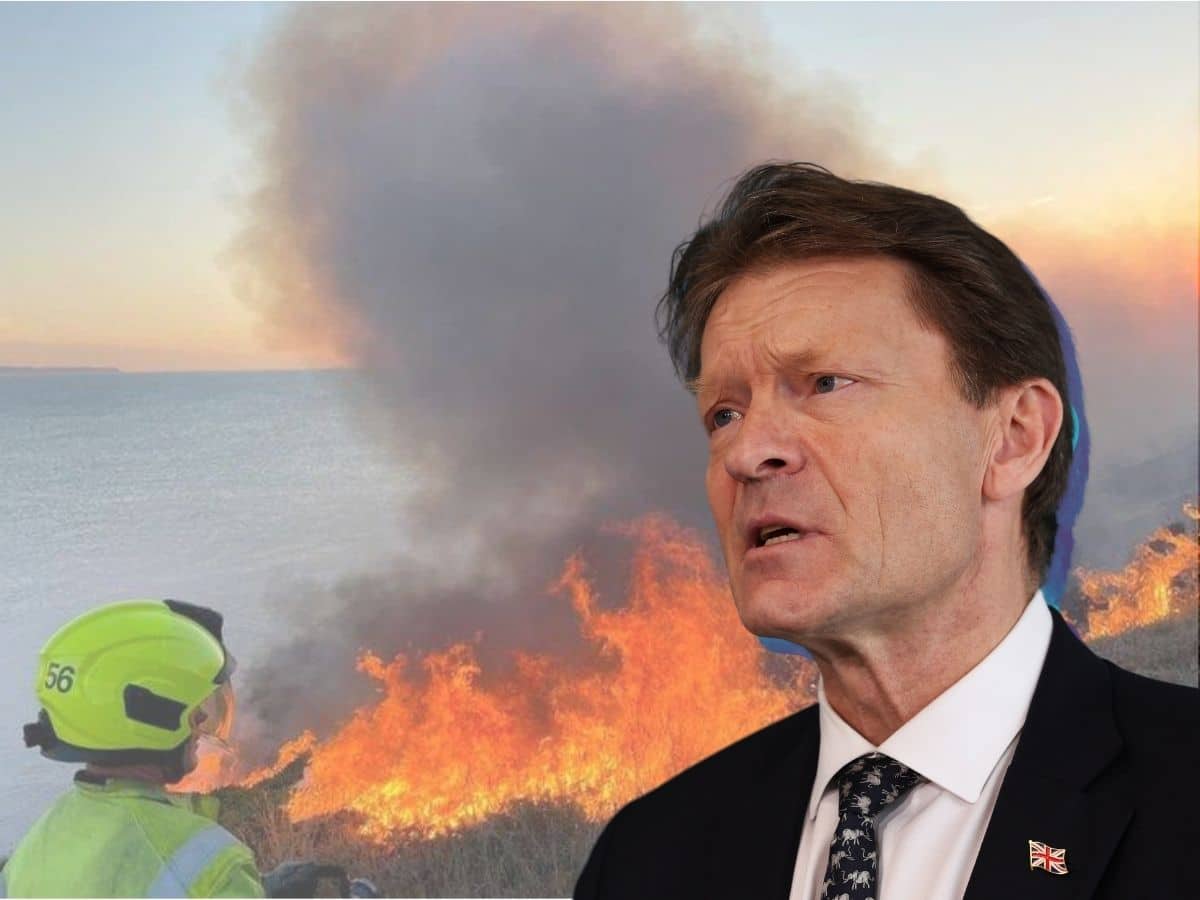
This summer will be remembered as one of the most brutal in British history: record-breaking temperatures, drought, wildfires consuming homes, railway lines buckling under the heat and trains derailing. Yet amid all of this, Reform UK deputy leader Richard Tice has repeatedly insisted that the public is being lied to about climate change, and he has now found a new avenue for pushing misinformation — one that has already been thoroughly debunked. The controversy began when Tice responded to Kathryn Porter, a self-described independent energy consultant, who suggested that the Office for National Statistics (ONS) had quietly stopped publishing data on cold-related deaths. The implication was that the government was suppressing inconvenient statistics because the fact that more people die from cold than heat undermines the case for net zero. But as Twitter user The Accidental Disruptor pointed out, this is nonsense. The ONS did not hide anything; it discontinued an old methodology after a formal review. The UK Health Security Agency now publishes official cold-mortality statistics alongside its heat-mortality statistics. As the rebuttal put it: “No. ONS discontinued an old methodology after review. UKHSA now publishes official cold-mortality statistics – alongside its heat-mortality statistics. So just a methodology change. Once again Tice proving that he’s clueless.” It is a simple, verifiable correction, but it goes to the heart of a pattern of climate denial that has become increasingly desperate as the evidence of a warming world becomes impossible to ignore.
To understand why Tice found this line of attack so attractive, it is necessary to look at Porter’s record. DeSmog, an investigative journalism organisation that tracks climate disinformation, has documented that Porter has a track record of publicly casting doubt on established science on human-caused climate change. She also has a long history of criticising renewable energy, which she characterises as “high-cost” and a risk to energy security on the website of her consultancy Watt-Logic. The DeSmog article referenced the fact that the BBC had Porter on as the sole “expert” to discuss renewables, without making clear that she works with businesses with projects across the electricity, gas and oil industries, as her own Twitter bio states. These professional links to fossil fuel interests were not identified on the Today programme, meaning millions of listeners were exposed to her opinions without understanding her background. Porter’s original tweet claimed that she had asked the ONS years ago why it had stopped publishing cold-mortality data and was told it was under review. But the ONS has long since finished that review, and the details are publicly available. The old methodology was discontinued because statisticians found it inadequate, not because politicians disliked what it showed. Porter nevertheless doubled down, declaring: “Clearly the fact more people die from cold than heat is inconvenient for net zero but it’s deeply cynical for the government to stop publishing data simply because they dislike what they say.” This statement deserves serious unpacking. The fact that cold kills more people than heat in Britain is hardly a revelation. Britain is a northern European country with wet, chilly winters; it is not known for extreme heat. So it would be surprising if the cold did not claim more lives than the heat. This tells us nothing about whether the climate is changing, and still less about the wisdom of renewable energy.
The data question itself is more boring than sinister. Governments and statistical agencies constantly update methodologies to improve accuracy, and the old ONS excess-winter-deaths measure was one such methodology. After a formal review, it was replaced by a more modern framework. The UK Health Security Agency now publishes official cold-mortality statistics alongside heat-mortality statistics. That means the data has not been disappeared at all; it is simply being calculated and presented in a different way, by a different agency, and with appropriate scientific rigour. To accuse the government of “deeply cynical” suppression is absurd. What would be the motive? A statistical agency that wanted to avoid inconvenient findings would not publish cold-mortality data at all, yet UKHSA does exactly that. The shift was a methodological housekeeping exercise, not a conspiracy. More broadly, the entire framing of cold-versus-heat deaths is a red herring. Scientists do not say climate change means every future death will be heat-related. They say that rising global temperatures will increase the frequency and severity of heatwaves, alter weather patterns, worsen droughts, intensify storms and create cascading risks to food, water and infrastructure. Even if cold deaths remain higher in the short term, the climate crisis still poses a catastrophic threat. As the original analysis noted, the balance could very well change in the future — and it would change even faster if climate deniers like Porter and Tice were to get their way. A net-zero transition is not about pretending hot weather is the only danger; it is about avoiding a cascade of climate breakdowns that would dwarf any single seasonal statistic.
While Tice and Porter were trading debunked statistics, the real world was providing a far more vivid lesson. On 13 August, in Stourbridge, wildfires engulfed homes in flames. Councillor Martin Abrams captured the moment in a post that swiftly went viral: “Horrific scenes coming out of Stourbridge as wildfires engulf homes in flames. Climate breakdown is happening right here, right now in the UK and is impacting on all our lives. At this point Andy Burnham just talking about disposable BBQs is akin to climate denialism…” The reference to Andy Burnham, the Greater Manchester mayor, points to a wider debate about how British politicians have responded to an unprecedented summer: too often focused on individual behaviour rather than the systemic causes and consequences of climate breakdown. For years, Britons watched wildfires in California, Australia and the Mediterranean and perhaps felt insulated by distance. No longer. This summer, the UK itself became a scene of burning houses, dried-up reservoirs, melting runways and railway lines buckling in the heat. Trains derailed, people were evacuated, and firefighters battled blazes on home soil. It is one thing to hear a climate scientist talk about projections; it is quite another to watch your neighbour’s roof collapse in flames. The psychological effect of this lived experience is powerful. It closes the gap between abstract risk and personal reality. And it is precisely why a spokesman for a party so closely tied to fossil fuel interests tweeting about ONS methodology looks so out of touch. Tice may hope to persuade his followers that the climate is a hoax, but the visuals from Stourbridge and other burning communities are worth more than a thousand misleading spreadsheets.
The British public appears to be drawing the obvious conclusion. A YouGov poll conducted after the record-breaking summer found that only 21% of Britons believe the threat posed by climate change has been exaggerated — the lowest level recorded in three years of tracking. Meanwhile, 67% said the threat has not been exaggerated, up four points from a survey taken in early June. The shift in opinion came after weeks of headlines about drought, wildfires and extreme heat. As YouGov’s own tweet explained, that record-breaking summer had a direct effect on public perception. This is not a nation in thrall to climate denial. It is a nation waking up to the reality that the climate crisis is not a future abstraction but a present emergency. The usual suspects — the Tices, the Porters, the fossil-fuel-funded think tanks — are being pushed to the margins. They can quibble about statistical methodologies, or argue that cold deaths exceed heat deaths, but their arguments are becoming less persuasive every time a heatwave shatters records. The public is not stupid. It can see that a warmer atmosphere means more energy in the weather system, more extreme events, and more pain for ordinary families. And it can see that the people denying this are very often the same people whose careers and profits depend on continued extraction and combustion of fossil fuels. That is why only a fifth of the country buys the exaggeration narrative. The days when a couple of tweeting contrarians could manufacture climate doubt are not over, but they are numbered.
There is also the uncomfortable question of who funds the climate denial machine. Reform UK, Tice’s party, has by its own account been buttressed by donations from wealthy individuals and businesses tied to the fossil-fuel economy. One viral response to Tice’s latest contribution summed up the broader suspicion: “Reform are an American psyop, funded by billionaire oil firms. They want Britain to remain a wealth extraction zone. Green sovereignly owned energy solves this, we produce our own energy that is owned by the people & ends our dependance on the fossil fuel cartel.” That language may be blunt, but it captures something important. When a party and its allies work obsessively to sow doubt about settled climate science and to undermine renewable energy, it is worth asking whose interests they are serving. The answer is not pensioners worried about their heating bills, nor ordinary households struggling with the cost of living. It is the oil and gas industry, which profits from continued dependency on fossil fuels. The strategy is as old as the tobacco lobby: manufacture uncertainty, attack inconvenient data, and wrap it all in the language of honesty and scepticism. But in the summer of 2026, with the UK literally on fire, that strategy is collapsing. Tice wants to talk about cold mortality; the public wants to talk about how to prevent their homes from burning down. Tice wants to defend the fossil fuel status quo; the public wants energy that is clean, affordable and sovereign. As the original article put it, perhaps the only excess death we should hope to see this winter is the death of Reform UK’s electability. That would be a statistic well worth celebrating.