


By Sarah Jones, CBC News Atlantic
August 12, 2026 1:00 PM AST
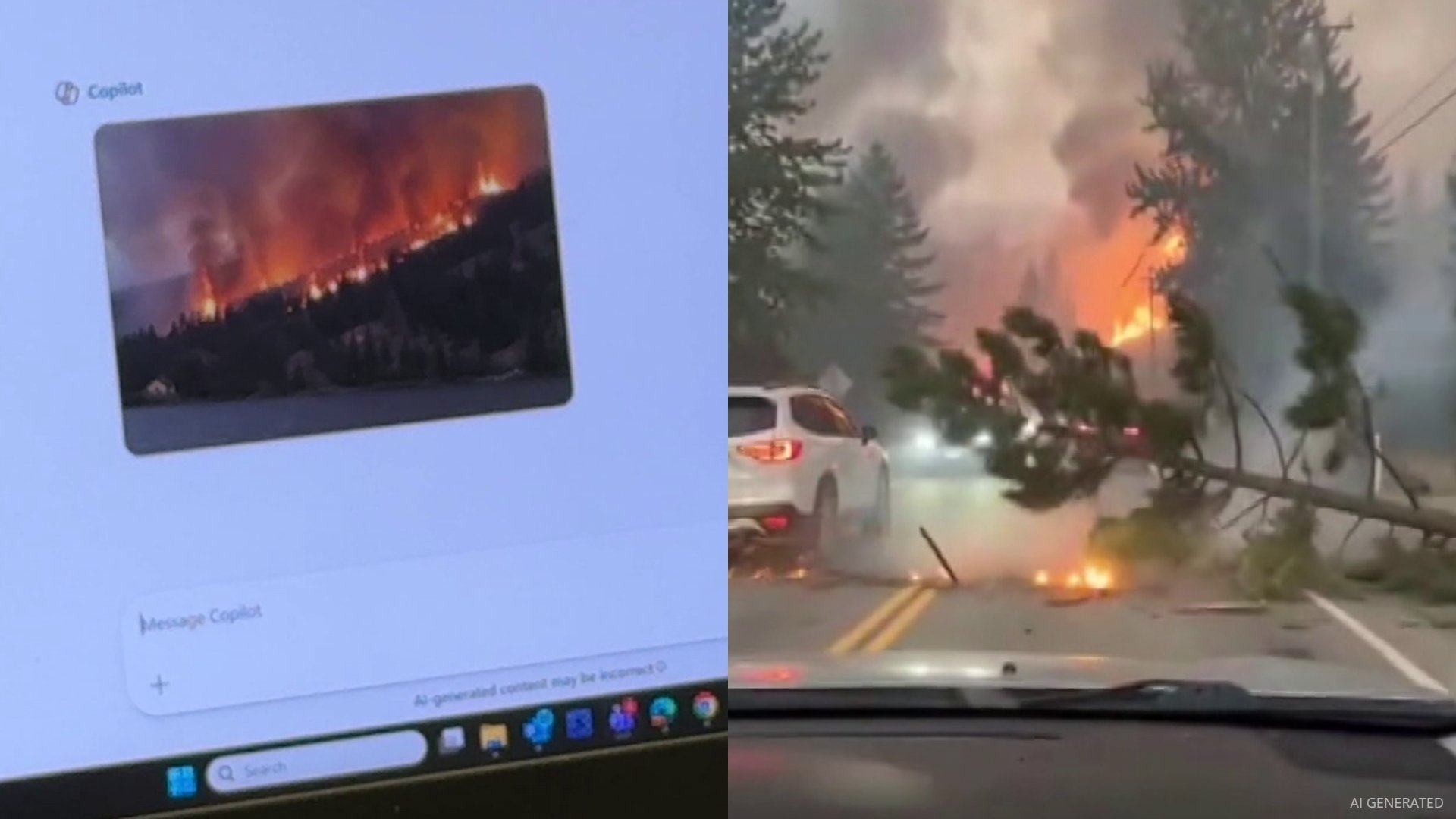
The temperature outside is a blistering 34 degrees Celsius, the sky an oppressive ochre from drifting smoke, and Elaine Mercer has just received what she believes is a fatal blow. A video circulating on Facebook, viewed over 120,000 times in just fifteen minutes, appears to show the municipality of Shelburne engulfed in an apocalyptic firestorm—charred figures stumbling through streets while the iconic lighthouse is consumed by a wall of flame. The caption reads: “IT HAS REACHED THE COAST. EVACUATE NOW. SHELBURNE IS GONE.” Her sister lives there. In a blind panic, the 67-year-old calls her, begging her to flee, to grab the family heirloom quilts, and to get to the Yarmouth ferry immediately. It takes an agonizing seventy minutes—seventy minutes of sheer terror and misplaced grief—before the provincial alert system sends a direct text message to her phone stating clearly: “This is a false alert. The video you are seeing is AI-generated and contains fabricated imagery. No threat exists to Shelburne.” This is the terrifying new reality of wildfire season in 2026, where the wildfire itself is now the secondary threat to the inferno of algorithmic misinformation spreading with meteorological speed across social media. As I, Sarah Jones, have spent the last three weeks investigating for our special report, we are facing an unprecedented informational paradox: the very tools designed to connect us are being weaponized to amplify chaos, and the fundamental trust we place in what we see with our own eyes has become the weakest link in our emergency response infrastructure.
The technological genesis of this scourge is almost impossibly accessible, which is precisely what makes it so dangerous. Gone are the days when generating realistic falsehoods required a sophisticated VFX studio. Today, open-source and commercially available generative models like Midjourney, OpenAI’s DALL-E 4, and Google’s Veo 3 can render photorealistic 4K video of raging wildfires with a single text prompt. These models have been trained on terabytes of actual disaster footage, news archives, and mapping data, meaning they possess an innate understanding of how smoke billows, how embers scatter, and how fire behaves against the texture of a pine forest. When a 26-year-old bedroom hoaxer in Toronto types “wide shot of Halifax skyline burning, cinematic quality, 1980s grain” the algorithm produces a video so synthetically perfect that it passes every casual human plausibility check. Even more sinister is the audio component. Deepfake technology has advanced to the point where a mere four seconds of a person’s voice can be used to generate an unlimited script. In one alarming case we uncovered, a cloned voice of a fictional municipal mayor was used to give a false “shelter in place” order that conflicted with a real evacuation, potentially leading residents into the path of an actual fire. The underlying algorithms of the major platforms—X, TikTok, Instagram, and Facebook—are engineered to prioritize engagement, and within that mathematical equation, fear, outrage, and terror are the highest-yield currencies. A verified warning from a fire captain gets perhaps hundreds of shares; a dramatic, AI-generated video of a burning suburban mall gets millions. The bots and Amplification networks we observed do not discriminate between real and false; they simply measure the emotional spike and push the content to the widest possible demographic feed.
The real-world consequences of these digital arsonists extend far beyond momentary panic, creating a tangible humanitarian and logistical nightmare for first responders. During our investigation, we sat down with Captain Robert Vance of the Halifax Regional Fire and Emergency, a man whose weathered hands and exhausted demeanor spoke to the grueling summer. He detailed a harrowing incident where an AI-generated map, claiming to show the exact minute-by-minute path of a fire front, was widely shared. It prompted what he called “a civilian exodus into a dangerous corridor” where trucks and families clogged the only access road for actual fire crews. “We are fighting two separate infernos out here,” Vance said, wiping ash from his brow. “We fight the physical fire, the real heat, and we fight the digital fire that is sending people into harm’s way. We had to pull three of our finest engines off actual suppression efforts just to escort panicked civilians out of a dead zone that existed only in someone’s imagination.” The psychological and economic toll is equally severe. We spoke with Dr. Henri Dubois, a trauma psychologist at the QEII Health Sciences Centre, who reported a 40% increase in acute stress and anxiety admissions tied directly to victims who either believed they had lost homes that were standing, or who endured the guilt of having abandoned vulnerable relatives based on false data. Economically, a single false alarm on August 5th caused a localized stock market dip in forestry and insurance sectors, and forced the cancellation of regional flights at the Halifax Stanfield International Airport for an hour as airlines received bomb-threat hoaxes chained to the same false narrative. The annual fire season budget, already stretched thin, is now being diverted to digital forensics and PR crisis management—funds that should be purchasing hoses and aircraft fuel are instead being used to pay for social media monitoring services.
The corporate and regulatory response from Silicon Valley remains a bewildering landscape of half-measures and profit-driven inertia. In 2025, Meta announced a complete pivot away from professional human fact-checkers in favor of “Community Notes,” a crowdsourced moderation system where users polygraph each other. In the context of a fast-moving disaster, this system is catastrophically slow; a note might appear hours after a piece of misinformation has achieved global saturation. We reached out to Meta, X, and TikTok for detailed responses about their content filtering latency rates during the current wildfire emergency. None provided a substantive reply, though a spokesperson for X indicated they are “constantly optimizing for civic integrity.” This is belied by our testing: we uploaded a clearly labeled synthetic video to three platforms and measured how long it took to be flagged. The average time was 45 minutes—a lifetime in an emergency. Furthermore, existing labeling mechanisms are trivial to bypass. While companies like Adobe and OpenAI have adopted the C2PA (Coalition for Content Provenance and Authenticity) cryptographic watermark standard, a study conducted by the Digital Society Lab at Dalhousie University found that 98% of circulating misinformation has had these watermarks stripped using free tools like ExifTool or simply by re-screencapturing the video, which erases metadata entirely. The legal framework offers little relief. While the EU’s AI Act has, as of August 1st, 2026, mandated strict transparency requirements for deepfakes, enforcement is sparse and American tech giants have resisted incorporating these standards globally, citing it as a restraint on free expression. Our own Canadian Parliament has yet to pass the proposed “Digital Safety Act” beyond its second reading, leaving citizens unprotected as regulatory sand slips through the hourglass.
Amidst the digital maelstrom, however, an elite and rapidly adapting army of digital detectives, fact-checkers, and hardware architects is fighting back with increasingly ingenious countermeasures. We embedded with a rapid-response unit from the Canadian Anti-Fraud Centre’s new AI Integrity Division, a unit of data scientists and former intelligence operatives based in Fredericton. They work in a darkened room full of monitors, analyzing content with custom-built forensics tools. Their lead analyst, a brilliant whirring mind named Dr. Aisha Al-Sayed, explained that while AI imagery is good, it is not yet perfect—the physics of turbulent combustion are staggeringly complex. “Real fire is chaotic, scale-invariant turbulence,” she remarked, zooming into a pixelated frame. “AI models still struggle with the fractal nature of flames and smoke. We look for the ‘plausibility artifacts’—rendering errors in the rim lighting of trees, anomalous reflection patterns on water, or ash distribution that defies gravity.” These human-machine teams are now partnering directly with national emergency alert systems. The AlertReady system, which bypasses social media entirely by utilizing cellular broadcast towers, has been updated to specifically address rumor triage. On July 30th, a provincial alert went out to every mobile phone within a 200-kilometer radius of Cape Breton stating: “A viral image of a fire at the Sydney Steel Plant is FALSE. Do not evacuate. We will notify you directly.” This decentralized approach—security through direct communication rather than social media—proved remarkably effective, reducing panic-attacks in that specific region by an estimated 75%. Public education is also being revolutionized. Nova Scotia public schools have introduced a mandatory “Digital Cognition” curriculum this fall, teaching middle schoolers to analyze the metadata of images, cross-reference geolocation, and understand the economic incentives of clickbait.
As I sit here in our newsroom on this scorching afternoon, monitoring another wave of dark, swirling rumors wash over our phone banks, I am struck by the profound fundamental shift in how we must perceive reality. We used to say “seeing is believing”; now, we must say “verifying is believing.” The AI train has not merely left the station; it has achieved lightspeed and is generating content faster than any human or institutional debunker can process. The responsibility now rests on a gravely unprepared public. We must develop a basal skepticism that runs counter to our fight-or-flight instincts. If an image of a burning neighbor arrives on your feed, do not look for the emotion—look for the watermark, the original source, the local forecast, and critically, consult official government channels before you pick up the phone to call your mother. For emergency managers, the advice is harsh but pragmatic: assume false narratives will outrun your true alerts, and build your protocols around the assumption of a simultaneous, artificial crisis. The battle against misinformation is not a war that can be won with a single law or a better algorithm; it is an evolutionary struggle for the preservation of shared public truth. In the age of synthetic media, our critical faculties and our patience must become the strongest firebreak of all. We cannot stop the inexorable march of technology, but we can refuse to be its victims. As Captain Vance so succinctly put it before heading out for another shift, “We can’t put a fire hose on a rumor, but we can teach people not to strike the match of panic. That is the only defense we have left.” I am Sarah Jones, CBC News, staying vigilant—and you must too.