









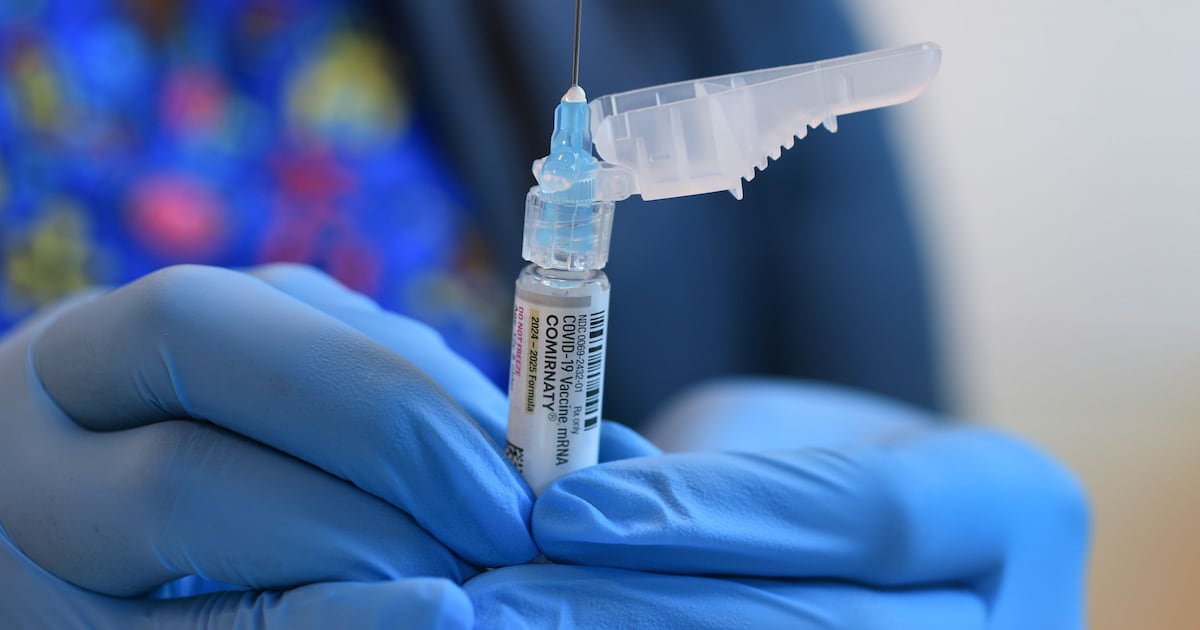
Republican U.S. senators Ron Johnson and Rand Paul have released a cache of text messages from Dr. Anthony Fauci’s former government phone, touching off a fresh wave of false claims that COVID-19 vaccines are unsafe during pregnancy. The messages, made public Monday as part of the senators’ investigation into Fauci’s leadership during the pandemic, include a January 2021 exchange in which Fauci speculated that a second vaccine dose “theoretically could be associated with miscarriage in the 1st trimester.” They also include Fauci’s criticism of an April 2021 study published in the New England Journal of Medicine. Within hours, social media users and some political figures seized on the messages to claim that researchers had found an 82 percent risk of miscarriage from COVID-19 vaccination. Sen. Ted Cruz shared the false statistic in a since-deleted post. Experts immediately rejected the claim. “This is a well-studied area. We knew this in 2021, that there wasn’t an increased risk, and now we have five more years of data. So it’s hard to believe we would miss a factor of eight increase in miscarriages,” said Dr. Kevin Ault, an obstetrician-gynecologist and president-elect of the U.S. National Foundation for Infectious Diseases, in an interview with CNN’s Erin Burnett. The episode is a textbook example of how preliminary scientific discussion can be distorted into misinformation that affects real people’s medical decisions. Fauci’s remark was cautious and conditional, made at a time when vaccination in pregnancy was still being studied. But the phrase “theoretically” was quickly dropped as the claim spread, and the release of the texts was treated as proof of hidden risks.
To understand why the 82 percent figure is false, one has to look at the original study and the correction that followed. The Johnson news release points to an April 2021 study in the New England Journal of Medicine that used data from a vaccine safety monitoring system to track outcomes for nearly 4,000 women who received COVID-19 vaccines during the early months of the rollout. Among those women, the researchers identified 827 who had a “completed pregnancy” at the time of analysis. Of those 827 pregnancies, 712 ended in live births, 104 ended in spontaneous abortion, or miscarriage, and 11 had other outcomes. Initially, the researchers reported a miscarriage rate of 12.6 percent, calculated by dividing 104 miscarriages by 827 completed pregnancies. That number was comparable to the average miscarriage rate of 10 percent to 20 percent, according to the Mayo Clinic. However, in September 2021, the journal issued a correction. The correction explained that the study did not have enough data to calculate the risk of miscarriage. Because follow-up time was limited, the outcomes of most of the nearly 4,000 participants were unknown, and the denominator of 827 completed pregnancies did not sufficiently represent the full sample. The researchers also noted that 700 of those 827 completed pregnancies had reached the third trimester by the time the mother was vaccinated. Since the risk of miscarriage depends on gestational week, any estimate “would need to account for gestational week-specific risk of spontaneous abortion.” As the authors wrote, “no denominator was available to calculate a risk estimate for spontaneous abortions.” The correction was not an admission of harm; it was a methodological clarification meant to prevent overinterpretation of a small, early subset of data.
The false 82 percent figure comes from a deliberate miscalculation that exploits that correction. Critics who wanted to claim the vaccines are dangerous took the 104 miscarriages from the study and divided them by 127, the number of completed pregnancies in which vaccination occurred during the first or second trimester. That arithmetic produces 104 divided by 127, or about 82 percent. The calculation is invalid for several reasons. First, the study’s authors had explicitly said that no denominator was available for a miscarriage risk estimate, because the risk varies by gestational week at vaccination and the timing of the loss. Second, the 104 miscarriages were not all among women vaccinated in the first or second trimester; they were all of the miscarriages observed across the entire cohort of 827 completed pregnancies. Third, by excluding the 700 third-trimester pregnancies, critics introduced a severe selection bias. Women who reached the third trimester without a miscarriage had already passed through the period of highest risk, so their outcomes should not be disregarded in a calculation of overall miscarriage risk. The original 12.6 percent rate, although not a definitive risk estimate, was within the expected background range. The 82 percent statistic, by contrast, is a methodological artifact with no scientific validity. It has nevertheless been repeated widely across social media, and it is exactly the kind of “bad source of information” that doctors say can have real consequences for maternal health. The correction was intended to make the science more accurate, not to provide ammunition for people who had already decided the vaccines were dangerous.
Experts in maternal-fetal medicine and public health say the evidence strongly supports COVID-19 vaccination during pregnancy. “It is without question that the benefits of the vaccine outweigh the risks, and the world’s literature on this topic includes hundreds of thousands of women,” said Dr. Brenna Hughes, chair of the Society for Maternal-Fetal Medicine’s Infectious Disease and Emerging Threats Committee. The U.S. Centers for Disease Control and Prevention has gathered dozens of studies on its website that all come to the same conclusion. “COVID-19 vaccination before and during pregnancy did not increase health risks for pregnant women or their babies,” the CDC states. “In addition, studies have also shown that COVID-19 vaccination during pregnancy provides protection to both the pregnant woman and the baby.” Hughes acknowledged that miscarriage concerns are common among pregnant women and that doctors spend a great deal of time discussing risks and benefits with their patients. “When we offer any intervention in pregnancy, the first question is: ‘Is it safe for me? Is it safe for the baby?’” she said. In her practice, she tells pregnant women that the most common side effects of the vaccine are a sore arm and possible fatigue. The benefits, she said, are “incredibly clear,” and the outcomes are “quite the opposite” of what misinformation suggests. This confidence is based on many years of data, including studies of hundreds of thousands of women, not on a single private text message from a health official. Obstetricians across the country have incorporated COVID-19 vaccination into standard prenatal care, and professional medical societies include it in their formal recommendations.
Another central point from experts is that the real danger to pregnant women is COVID-19 itself, not the vaccine. “We had hundreds of maternal deaths in 2021 due to Covid, and we still have severe illnesses, ICU stays, stillbirth, preterm deliveries related to those respiratory diseases,” Ault said. “Vaccination during pregnancy reduces the risk of all those things. So if somebody’s making decisions on these bad sources of information, that has a real downstream effect on maternal health.” During the height of the pandemic, obstetric units around the country cared for severely ill pregnant women with COVID-19, many of whom required intensive care or early delivery. Meanwhile, the safety profile of the vaccine has remained reassuring. The false 82 percent claim could not only dissuade pregnant women from getting vaccinated, but also cause some to delay necessary medical care or to seek unproven treatments out of fear. Doctors stress that the risk-benefit calculation is not close: COVID-19 infection poses significantly more risk to pregnant women and their babies, while the vaccine offers protection for both. The COVID-19 vaccines were made available to pregnant women only after careful review, and ongoing monitoring has not found a signal of harm. In fact, the evidence has only grown stronger since the vaccines were first authorized. Pregnant women who are vaccinated develop antibodies that can pass to the fetus, providing some protection to babies too young to be vaccinated.
Hughes said she worries that the latest round of misinformation will leave pregnant women with broader doubts about the entire medical system. “One of the concerns that we’re seeing now is that people aren’t sure who to trust and who the trusted messenger should be,” she said. She points to medical societies as the most reliable sources of information, because their recommendations are made by committees of experts, not by any single individual. “We are very careful about the science that we put into our guidelines,” she said. “We rigorously assess it for quality. We debate it to make sure that we think that the science is strong enough, and it is not one person making a decision or a recommendation. This is a committee of people with decades of expertise on these topics who really carefully look at the literature and ensure that we feel that it’s adequate before we make these recommendations.” The release of Fauci’s text messages has not changed the scientific reality. The messages were preliminary and theoretical, and they predate the enormous body of evidence that has accumulated since vaccines were introduced. That evidence consistently shows that COVID-19 vaccination is safe in pregnancy and does not increase miscarriage risk. Pregnant women and their families should look to their health care providers, the CDC, and professional medical societies for guidance rather than to social media posts built on a misreading of a corrected study. As Ault reminded viewers, the experts knew by 2021 that there was no increased risk, and five more years of data have only made that conclusion stronger.


