





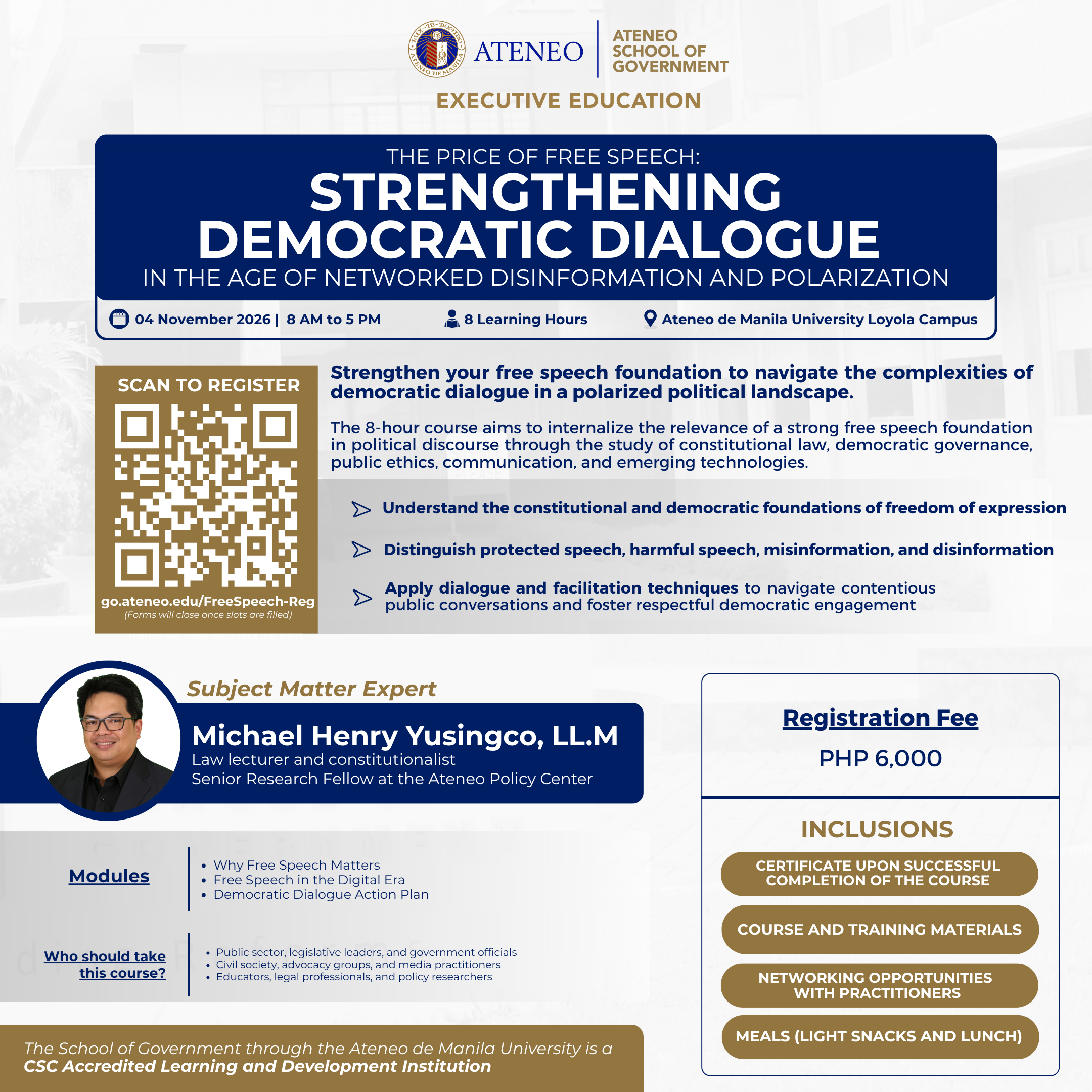
In an era where digital platforms have become the primary battleground for public opinion, the Ateneo School of Government (ASOG) is stepping forward with a bold educational response. Through its Executive Education Center, the school has announced a one-day training course titled “The Price of Free Speech: Strengthening Democratic Dialogue in the Age of Networked Disinformation and Polarization.” The course will be held on 04 November 2026 at the Ateneo de Manila University Loyola Heights Campus. This eight-hour executive program is designed to help participants understand the vital role of free speech in democratic governance while confronting the pathologies of networked disinformation and toxic polarization. The training aims to internalize, not just intellectually but also practically, the relevance of a strong free speech foundation in political discourse. It does so by drawing on insights from constitutional law, democratic governance, public ethics, communication, and emerging technologies. As digital platforms continue to shape how citizens receive information, engage with public officials, and participate in elections, the need for a more thoughtful approach to expression has never been more urgent. In the Philippines, where social media use is among the highest in the world, the interplay between expression, misinformation, and governance is particularly salient. With many citizens relying on digital platforms for news, political engagement, and even public services, the vulnerability of democratic conversation to organized manipulation has become a pressing concern. The course’s timing, set in late 2026, reflects an awareness that democratic institutions are under constant pressure from information manipulation and extreme partisanship. By bringing together a rigorous, multi-disciplinary curriculum, the Ateneo School of Government seeks to equip professionals with the knowledge and skills needed to protect and strengthen democratic dialogue. More than just another training session, the initiative is framed as a contribution to the wider public good, helping to rebuild a culture of respectful and informed conversation. Nested within the larger mission of Ateneo de Manila University, which has long been associated with excellence, service, and social justice, this course represents an effort to bring academic scholarship into direct conversation with the pressing problems of contemporary governance. The announcement has already drawn interest from public sector practitioners, educators, communicators, and civic leaders who recognize that the challenge of disinformation does not discriminate across sectors or institutions. With a clear focus on governance, ethics, and communication, the course promises a robust exploration of issues that affect every society navigating the complexities of the digital age.
At the heart of the curriculum is a set of five carefully articulated learning outcomes that define what participants should be able to do after completing the eight-hour training. First, they will be able to explain the constitutional and democratic foundations of freedom of expression. This includes understanding how free speech is protected, why it is considered a cornerstone of democracy, and how different legal systems balance expression with other societal interests. Second, participants will distinguish between protected speech, harmful speech, misinformation, and disinformation. This is not merely a matter of definitions; it requires cultivating the critical ability to identify what is legally permissible, what is ethically problematic, and what is deliberately engineered to deceive. Third, the course will enable participants to analyze contemporary governance dilemmas involving free speech in digital spaces. Social media platforms, messaging applications, and algorithmic recommendation systems have created complex regulatory puzzles for states and institutions, and this objective unpacks those challenges in practical terms. Fourth, the training provides techniques for dialogue and facilitation, helping participants guide conversations that have become tense, polarized, or dominated by bad-faith actors. The ability to moderate a public forum, manage a community conversation, or respond to misleading claims without escalating conflict is essential for leaders in every field. Finally, participants will develop practical strategies for fostering respectful democratic engagement within their own organizations and communities. This final outcome transforms the course from an academic exercise into an action-oriented experience, giving participants a concrete plan to apply their learning when they return to their respective posts. Taken together, these learning objectives reveal a curriculum that is both principled and pragmatic. It acknowledges that free expression is not absolute; it must be situated within a framework of responsibilities, especially in contexts where speech can be weaponized to erode trust and destabilize democratic institutions. The course’s grounding in multiple disciplines ensures that no single lens dominates. Constitutional law provides the rules of the game, governance and public ethics supply normative direction, communication studies offer insights into how messages are produced and received, and emerging technologies explain the infrastructure through which information now travels.
The target participants for this course are as diverse as the problem it seeks to address. This is by design. Disinformation and polarization are not confined to any one profession or sector. Public managers who must communicate government policy to skeptical citizens, communication officers who handle official social media accounts, civil society advocates who monitor election integrity, educators who teach media literacy, and legal professionals who advise on speech regulation all have a stake in this conversation. The course is designed to accommodate that variety, offering concepts and tools that can be adapted to different institutional contexts. The eight-hour structure is compact but intensive, allowing participants to move from foundational concepts to applied skills within a single day. The faculty and resource persons involved in the training are expected to bring expertise from law, public administration, communication research, and digital governance, providing a multi-dimensional learning experience. Participants will be encouraged to share their own experiences and dilemmas, turning the classroom into a living laboratory for democratic problem-solving. The training is structured to respect the different starting points of each participant, offering a common vocabulary while remaining sensitive to the specific challenges that each sector faces. For instance, a local government information officer might grapple with how to respond to viral falsehoods about government programs, while a civil society organizer might be more concerned with protecting activists from online abuse. The curriculum is broad enough to speak to both. The case studies that are likely to animate the discussions will revolve around online hate speech, viral disinformation, state propaganda, platform accountability, and the responsibilities of political leaders in maintaining civic norms. Because the course is hosted by the Ateneo School of Government, a recognized institution in public administration and governance education, it carries with it a serious commitment to ethical leadership and public service. It is not simply about managing the symptoms of polarization; it is about re-establishing the conditions for genuine dialogue and collective decision-making. In this sense, the course is an intervention into the very culture of public conversation, aiming to model how disagreement can take place without disrespect, questioning without delegitimization, and debate without dehumanization. The emphasis on facilitation techniques underscores the belief that good democratic outcomes do not emerge automatically from freedom of speech. They require intentional effort, listening, and structured deliberation. By the end of the day, participants should not only speak more carefully but also be better equipped to create spaces where others can do the same.
The cost of participation has been set at Php 6,000 per person, an amount designed to be accessible to public sector professionals while preserving the quality of the training experience. This fee covers all essential elements of the course, including a certificate, which is issued upon successful completion of the course requirements; comprehensive training materials; access to post-training resources; and opportunities for peer learning even after the program ends. Meals, consisting of morning and afternoon snacks and lunch, are also included. This inclusive pricing structure means that participants can fully immerse themselves in the day without worrying about logistic or additional costs. The registration process is straightforward and has been digitized for the convenience of applicants. Interested individuals may register through go.ateneo.edu/FreeSpeech-Reg, while payment instructions and options can be found in the ASOG registration guide at go.ateneo.edu/ASOGRegGuide. These links are intended to make the enrollment experience as seamless as possible, reflecting the professional standards of the Executive Education Center. For those who require further assistance, the center’s support team can be reached by sending an email to execed.asog@ateneo.edu. Given the subject matter of the course, the organizers are likely to attract participants who are not only professionally obligated but personally motivated to improve the quality of public discourse in the Philippines and beyond. The certificate is an important incentive, particularly for public sector employees who need to document their continuing education, but the real value lies in the skills gained and the networks formed. Access to post-training resources and peer learning opportunities is a distinctive feature of the program, creating a community of practice that extends beyond the classroom and enables participants to continue learning from each other’s experiences. Such a community is crucial to the long-term impact of the training, because the challenge of disinformation is not a one-time problem but a persistent feature of digital public life. Participants leave not only with notes and handouts, but with a shared vocabulary, a set of practical techniques, and relationships that can support them in future initiatives. In that sense, the Php 6,000 tuition represents not an expense but an investment in both individual capability and collective democratic health.
The Ateneo School of Government has also encouraged interested individuals to review its broader 2026 training offerings under the Executive Education Program. The full list of courses is accessible through the school’s official announcement, “Ateneo School of Government Executive Education Program opens 2026 Training Courses for the Public Sector.” This wider catalogue reflects ASOG’s continuing commitment to public sector capacity development, offering topics that address contemporary challenges in governance, leadership, policy analysis, and public ethics. By opening multiple courses for 2026, ASOG aims to serve professionals from local government units, national agencies, legislative offices, non-profit organizations, and development partners. The free speech course sits within this portfolio as a timely offering, responding to the growing concern about information disorder and its impact on democratic institutions. The School of Government, known for its research and training in public management and governance, sees executive education as a vital bridge between academic knowledge and practical application. The invitation to review other courses is therefore more than an administrative note; it is an invitation to view the free speech training as part of a continuum of learning. For example, public servants who take the course may also be interested in basic leadership and ethics programs, communication for development, policy formulation, or multi-sectoral governance workshops. The synergy between these topics can help build more holistic capacities among practitioners, allowing them to respond to complex public problems with a wider range of tools. The Executive Education Center has developed a reputation for designing programs that respond directly to the felt needs of the public sector, and the 2026 catalogue appears to continue that tradition. As government agencies and civil society organizations plan their annual training calendars, ASOG’s offerings provide reliable, academically grounded options. For those who wish to take part in the free speech course, the recommendation is to register early, complete the payment instructions, and prepare for a full day of engaged learning. The course could be taken alone or in combination with other programs, depending on individual career development plans. Either way, it represents a meaningful opportunity for professional growth and public service renewal.
The announcement of “The Price of Free Speech” comes at a moment when democratic institutions worldwide are being tested by rapid changes in communication technology, the rise of algorithmic propaganda, and the deepening of partisan divides. In such an environment, the ability to engage in honest, open, and respectful dialogue has become a rare and vital skill. This course offers a structured space to reflect on how we talk to each other about politics, how we handle lies and misinformation, and how we rebuild the trust that makes democratic governance possible. The Ateneo School of Government’s Executive Education Center has framed the program as both a professional development opportunity and a civic obligation. It recognizes that strengthening democratic dialogue is not a task for governments alone; it is a shared responsibility of every institution, every leader, and every citizen. By enrolling in this training, participants make a statement about their commitment to democratic values. They signal that they are ready to confront disinformation not by escalating polarization but by modeling a better kind of public conversation. The course is designed to produce practical outcomes: better informed public servants, more effective communicators, more thoughtful facilitators, and more resilient communities. The venue at the Loyola Heights Campus offers a serene and conducive environment for reflection and exchange, appropriate to the gravity of the topic. Registration information, payment procedures, and contact details are all easily accessible through the official ASOG links, making it easy for prospective participants to take the first step. The deadline is not explicitly stated in the original announcement, but interested applicants should not delay given the anticipated demand among public sector professionals. As the training date of 04 November 2026 approaches, the course stands as a reminder that discussions about free speech cannot be postponed until the health of democracy becomes a crisis. In the end, “The Price of Free Speech” asks each participant to consider not only the legal limits of expression, but the ethical demands it places on each of us. Ultimately, the success of the course will be measured not only by the number of certificate holders, but by the quality of conversations that happen afterward in barangay halls, government offices, newsrooms, classrooms, and public squares. This one-day training is a small but significant step toward restoring dignity, honesty, and nuance to our public life.


