


Paragraph 1
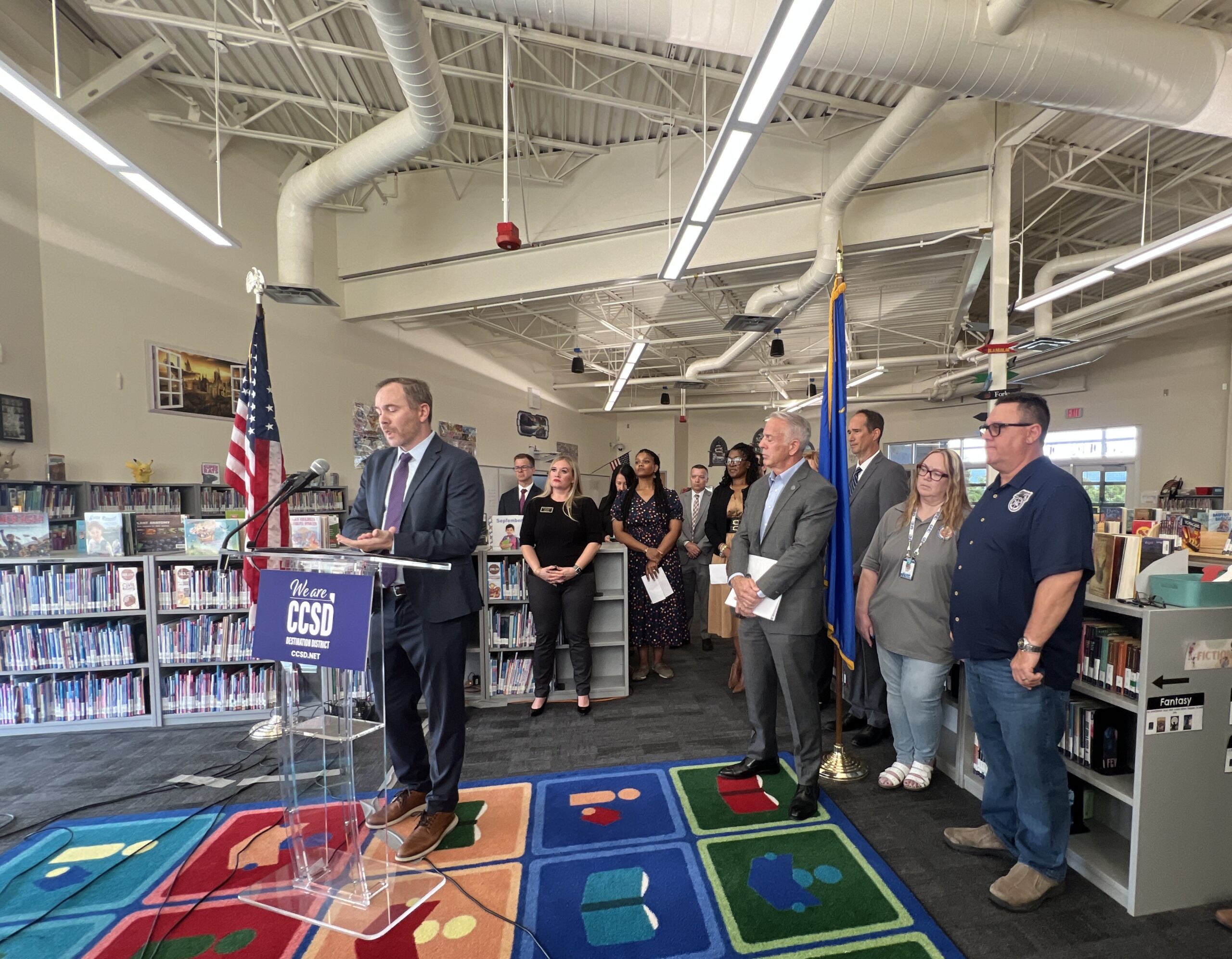
In a decisive move to stave off an impending financial crisis for Nevada’s public schools, Governor Joe Lombardo (R) stood alongside state lawmakers and Clark County School District (CCSD) officials on Monday to advocate for a permanent legislative fix to the state’s K-12 education funding dilemma, which has been exacerbated by deeper-than-anticipated enrollment declines. The urgency of the situation was underscored by the fact that earlier this month, CCSD—the nation’s fifth-largest school district—was facing a staggering $51.6 million mid-year budget cut, a financial position that sparked widespread fears of teacher layoffs and classroom disruption. Those existential threats were temporarily neutralized last Friday when the Governor’s office announced an emergency regulation permitting the state to utilize previously allocated per-pupil funding that had been approved by the Legislature during the 2025 legislative session. This funding mechanism is critical because the projected enrollment totals approved at that time are significantly higher than the actual student counts now materializing across many districts for the current 2026-27 school year. During a press conference held at Howard Wasden Elementary School in Las Vegas, Governor Lombardo framed this regulatory action as a necessary but temporary stopgap, explicitly warning that the state cannot ignore the shifting demographic realities. “We are not pretending that enrollment trends are going to disappear,” Lombardo stated, signaling that the 120-day reprieve is designed to give legislators the necessary time to craft a comprehensive and sustainable solution before the next legislative session convenes on February 1, 2027.
Paragraph 2
The emergency regulation enacted by the governor’s office represents a crucial financial bridge for districts reeling from the immediate shock of reduced cash flow. Lombardo confirmed that affected school districts will receive additional funding for the next 120 days, a period strategically calculated to carry them through to the start of the 2027 legislative session. The disbursement will occur through monthly payments, with the first tranche expected to total approximately $13.4 million distributed across all qualifying districts beginning next month. While the governor’s office did not immediately provide a granular breakdown of the allocation per district, State Superintendent of Public Instruction Victor Wakefield indicated that subsequent payments could actually increase as the state receives and processes updated enrollment figures, which are typically refined as the academic year progresses. The financial source for this infusion is the existing state budget account designated for school funding, effectively a reserve of unspent appropriations. “It’s actually dollars that were discussed, vetted, approved during the ’25 session, and right now they were just in a carry forward account because we spent less than what was legislatively approved this past year,” Wakefield explained during the press conference, clarifying that this is not new money but rather a reallocation of funds that were already earmarked for education. This fiscal maneuvering buys critical time for school districts to stabilize their operations without resorting to immediate, draconian cuts. “The purpose of this action is not to preserve every existing structure indefinitely,” Wakefield added, articulating a clear vision for the reprieve. “It is to give districts the runway to make thoughtful decisions rather than disruptive ones.”
Paragraph 3
The root cause of this financial instability lies in the structural mechanics of Nevada’s K-12 funding formula, the Pupil-Centered Funding Plan (PCFP), which was adopted in 2021 during a period of robust student population growth. Wakefield described the formula as a “really well-intended policy at a time when there was a lot of growth.” The PCFP operates on the principle that money should follow the student, meaning state funding is allocated based on actual student enrollment numbers. However, the formula’s implementation measures enrollment on a quarterly basis, creating a dynamic funding environment where districts’ allocations can fluctuate significantly throughout the academic year. If enrollment dips, state funding drops correspondingly, leaving districts scrambling to adjust their budgets mid-year. This is precisely the situation that has materialized this year. Wakefield explained that the state began witnessing a shift in enrollment trends last year, but it became undeniably clear this year that the decline is both sustained and deeper than initially projected. Data provided by the governor’s office paints a stark picture: every school district in the state, with the exception of Lincoln County and the State Public Charter School Authority, reported enrollment figures lower than what the Legislature had budgeted for in the 2025 fiscal year. This widespread decline has exposed the vulnerability of the PCFP, which was designed for an era of expansion, leaving it ill-equipped to handle the realities of demographic contraction now facing the state.
Paragraph 4
For Clark County School District, the largest in the state, this funding crisis has manifested as a series of difficult budget decisions that have unfolded over the past year. Heading into the 2026-27 school year, CCSD was compelled to make significant cuts to school and administrative budgets, including positions for teachers and staff, in direct response to the falling enrollment numbers. District officials were careful to note that those spring cuts did not result in teacher layoffs. However, the financial pressure became so acute last fall that the district laid off 37 support staff members due to similar budget constraints. The passage of the emergency regulation provides a lifeline, but Superintendent Jhone Ebert clarified that its effects will still necessitate some internal shuffling. With the emergency funding in place, Ebert explained that a small percentage of employees may have to move to a new position, potentially at another school, but crucially, no one will lose their job for the remainder of this school year. This reassurance is vital for maintaining staff morale and ensuring stability for students. Ebert framed the issue as a systemic challenge affecting the entire state, not just the urban districts. “CCSD’s goal is to mitigate the effects of statewide declines in student enrollment across all school districts because, as mentioned, this is not just a CCSD issue, this is a state issue,” Ebert said at the press conference, emphasizing the need for a coordinated statewide response rather than piecemeal solutions.
Paragraph 5
Looking beyond the immediate emergency funding, officials have begun to float potential long-term solutions, with the primary focus centering on amending the PCFP to make it more resilient to fluctuating enrollment. Clark County schools are actively working on a bill draft request that proposes a fundamental change to how funding is calculated. Their proposal would base funding on student counts from a single point in time during the previous year, or alternatively, on a three-year enrollment average, whichever yields a higher number. This “hold harmless” approach would shield districts from sudden, sharp drops in funding caused by a single year’s decline, providing more predictable revenue streams for budgeting purposes. Meanwhile, State Superintendent Victor Wakefield suggested a different approach, advocating for a quarterly average method to calculate enrollment for funding distribution. This method would smooth out the peaks and valleys of student mobility throughout the year. However, Wakefield also stressed the importance of ensuring that growing schools, particularly the state’s successful charter schools, still have the opportunity to receive additional funding to meet their expanding needs. The data shows that the State Public Charter School Authority has been the notable exception to the downward trend, with enrollment rising to 73,793 students, an increase of 1,491 from the previous projection. This dynamic creates a delicate balancing act for policymakers: they must create a formula that protects districts facing decline without inadvertently penalizing those that are growing.
Paragraph 6
As the 120-day emergency funding window begins, the broader political and fiscal implications are coming into focus. Governor Lombardo has been unequivocal that this is not a permanent solution, and his comments signal a willingness to engage with the Legislature, though the specifics of a final deal remain unclear. The emergency regulation is a stopgap measure that essentially resets the clock, forcing the two sides to find common ground before the next legislative session convenes in February 2027. When questioned about the potential for simply increasing per-pupil funding as part of the long-term strategy, Wakefield offered a cautiously optimistic response, stating, “I support strategic investment of as many dollars as we can marshal to our kids.” This comment suggests that while formula changes are likely necessary, additional financial resources will also be part of the conversation. The coming months will be critical as stakeholders, including teachers’ unions, school boards, and parent groups, weigh in on the best path forward. The challenge for Nevada is to craft a funding system that is both financially prudent and educationally effective, one that acknowledges the demographic realities of declining enrollment while ensuring that students who remain in the system receive a high-quality education. The $13.4 million first payment is a temporary salve, but the wound of chronic underfunding and systemic inequity will require a comprehensive, bipartisan cure that goes beyond a 120-day bridge.