




MADRID – Spanish Prime Minister Pedro Sanchez said on Aug 31 that there were signs Russia and Israel had spread disinformation over Spain’s migration policy that triggered the late-July rush of migrants into Ceuta, but he said there was no evidence of Moroccan involvement. Speaking on radio station SER, Sanchez said research by the European External Action Service, the EU’s diplomatic corps, had indicated that Russian and Israeli networks, working in conjunction with far-right networks, were behind misleading claims that encouraged thousands of migrants to attempt the crossing. More than 72,000 migrants irregularly crossed from Morocco into the tiny Spanish territory between July 30 and 31, an unprecedented surge at one of the European Union’s only two land borders with Africa. At least 100 people died in the attempt, according to Ceuta’s local authorities. The comments were Sanchez’s most direct attempt to explain the crisis as a coordinated influence operation aimed at Spain, and he firmly rejected opposition accusations that Morocco had deliberately opened its border. “When people talk and speculate about the participation of Moroccan authorities, I deny this outright,” Sanchez said.
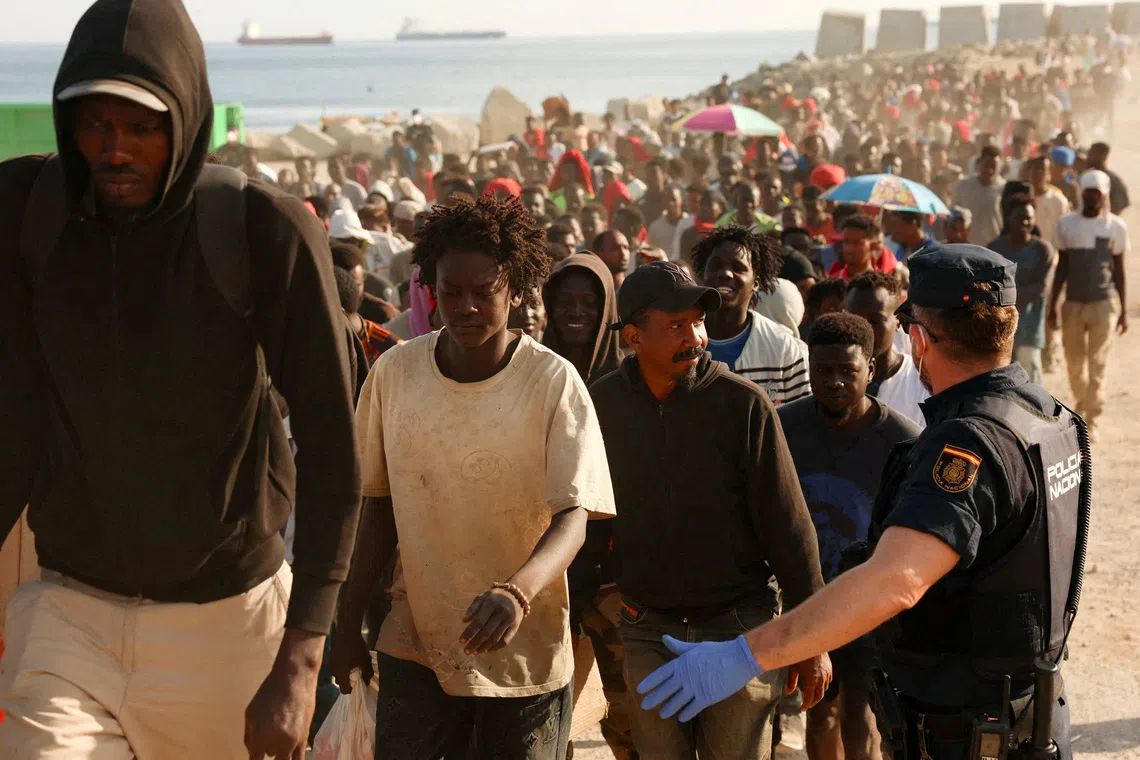
The crisis transformed Ceuta, a small autonomous city surrounded by Moroccan territory, into the focal point of Europe’s migration challenges. In the space of two days, thousands of migrants, many of them young Moroccan men and others from sub-Saharan Africa, streamed across the border or swam around the breakwaters that separate the enclave from Morocco. Spanish authorities deployed police and military reinforcements, but the sheer scale of the movement overwhelmed border management systems. Local security forces spent days trying to return migrants to Morocco under longstanding bilateral agreements, while aid organisations rushed to provide shelter and medical care. Spanish authorities said that videos on Instagram, TikTok and other social media platforms spread misleading claims that migrants reaching Ceuta by sea would be allowed to remain in Spain, directly encouraging more people to attempt the journey. Spanish opposition parties and some human rights groups accused Rabat of deliberately allowing the mass crossing to pressure Madrid, a charge Morocco has denied. Sanchez’s refusal to blame Morocco signals his government’s determination to keep bilateral relations from spiralling into a full diplomatic crisis.
Sanchez told SER that the EU’s diplomatic service had conducted research showing that Russian and Israeli networks were involved in spreading the disinformation alongside far-right networks. He said it was clear that both countries had used the crisis to criticise Madrid because of dissatisfaction with Spain’s positions on the wars in Ukraine and Gaza. Spain has been a vocal supporter of Ukraine since Russia’s full-scale invasion, sending military aid and sheltering European defence initiatives. At the same time, Sanchez has taken one of the strongest pro-Palestinian stances among European leaders, repeatedly condemning Israel’s military operations in Gaza and recognising Palestinian statehood. That policy has enraged Israel, which has accused Spain of undermining its right to self-defence. Sanchez did not provide detailed evidence of how the alleged disinformation networks operated, or what specific content they produced. He said only that the EEAS findings pointed to coordinated activity aimed at destabilising Spain. The prime minister’s remarks highlight a growing concern in European capitals that migration flows are increasingly being weaponised through social media and hybrid warfare tactics, especially at border points where false information can spread faster than official government communications.
Israel reacted with immediate fury to Sanchez’s accusation. Foreign Minister Gideon Sa’ar said in a post on social media platform X that Sanchez was “lying shamelessly” when accusing Israel of disseminating misleading information about Ceuta. Sa’ar suggested that the Spanish leader was attempting to distract from domestic policy failures, a charge that reflects the sharply deteriorating relationship between the two governments. Israel has repeatedly clashed with Sanchez’s leftist coalition over the Gaza war, and the accusation is likely to deepen the diplomatic rift. Russia’s embassy in Spain and the EEAS did not immediately respond to requests for comment, leaving Sanchez’s claims unverified. The lack of immediate response from the EU body he cited as the source of the research added ambiguity to the situation. It remains unclear whether the EEAS findings were formally shared with the Spanish government, whether they were still being assessed, or whether Sanchez was describing preliminary intelligence. What is clear is that the Spanish government is willing to make strong public allegations against foreign powers in an effort to frame the Ceuta crisis not as a failure of border policy but as a deliberate act of external interference.
On the ground, Ceuta remains tense and fragile. Roughly 5,000 migrants, some of them seeking asylum, have remained in the enclave since the border rush, triggering near-daily protests from local residents who say the Spanish government has failed to manage the situation. Tensions have been particularly high around the makeshift migrant camp at El Trampolin beach, where police reports describe sporadic attacks against security forces and infrastructure. On Aug 30, police arrested three Moroccan citizens for throwing bottles filled with corrosive liquids against an army patrol in Ceuta, according to news agency EFE, citing police sources. No one was injured in the attack, the report added. The incident illustrates the volatile security environment in a territory that is only about 18 square kilometres in size but carries enormous symbolic and strategic weight. Local authorities have repeatedly demanded more resources, stronger border control, and clearer rules for processing migrants. Madrid has promised reinforcements, but the combination of overcrowding, local anger and the presence of vulnerable migrants has created a complex humanitarian and political emergency. Human rights groups have called for transparent asylum procedures and an end to pushbacks, while some residents insist on the immediate expulsion of all irregular migrants. The dual pressure reflects the difficulty of balancing border security with legal obligations in one of Europe’s most heavily fortified frontiers.
Sanchez also announced on Aug 31 that the Cabinet would deploy an additional €168 million in emergency funds to reactivate Ceuta’s economy, a figure equivalent to 8 per cent of the enclave’s gross domestic product. That package comes on top of €180 million pledged the previous week for medium-term recovery efforts, bringing the total announced support to nearly €350 million. The funds are intended to support local businesses, improve public services, and create jobs in an economy that has long relied on cross-border trade with Morocco and has been severely disrupted by the crisis. Sanchez framed the investment as part of a broader effort to stabilise Ceuta and address the root causes of migration-related instability, rather than depending on security measures alone. The announcement also appeared calculated to reassure a jittery local population and ease the political pressure on his government after weeks of protests and criticism from opposition parties. Whether the money will be enough to restore calm remains uncertain. The combination of diplomatic conflict with Israel, unresolved questions about Russian interference, strained relations with Morocco, and the continuing presence of thousands of migrants ensures that Ceuta will remain a flashpoint in Europe’s migration debate for some time. Sanchez’s willingness to blame foreign disinformation networks may satisfy those who want to see the crisis as a hybrid attack, but it also raises the stakes for his government if the promised evidence does not materialise. For the people of Ceuta, the emergency aid and the accusations are less important than the urgent need for security, stability and a functioning migration policy.