







Sanchez Accuses Russia, Israel and Far-Right of Driving Ceuta Disinformation Storm
By Ilayda Cakirtekin
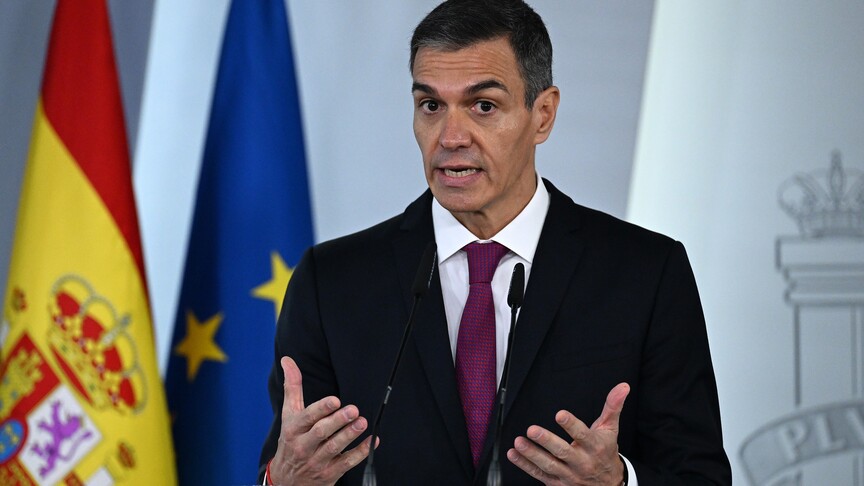
MADRID, 31 August 2026 (Updated) — Spanish Prime Minister Pedro Sanchez on Monday directly implicated Russia, Israel and an international far-right movement in the spread of disinformation surrounding the migration crisis that overwhelmed Spain’s North African enclave of Ceuta in late July. In an interview with broadcaster Cadena SER, Sanchez said that hoaxes circulating on social media during the emergency were “associated with both Russia and Israel, as well as an international far-right (movement) that always uses migration, not only to attack Spain but also Europe.” He added an important nuance, saying: “The reality we are facing does not necessarily mean that it has to come from a state actor.” The comments represent the most senior official acknowledgment yet that the crisis was compounded by coordinated information manipulation. Sanchez reaffirmed that judicial and intelligence investigations into the causes and amplification of the Ceuta crisis are continuing, and he indicated that several lines of inquiry remain open. The crisis in question occurred on July 30-31, when, according to the Spanish government’s official estimate, around 72,000 people irregularly crossed from Morocco into Ceuta, a small Spanish territory on the African coast. That unprecedented influx briefly brought a number of migrants almost equivalent to the enclave’s population, overwhelming local authorities and triggering alarm across Europe. The scale of the crossing, and the speed with which misleading narratives spread, have since transformed what might have been a regional border incident into a continental political flashpoint. Sanchez’s interview with Cadena SER was his most extensive public statement since the mass crossing began, and it was immediately seized upon by political opponents and other European governments. Some members of Spain’s opposition demanded to know what evidence had led the prime minister to name Russia and Israel, while others accused him of deflecting blame from his own migration policies. The government, however, maintained that the disinformation campaign was a central component of the emergency, not a side issue. The prime minister’s remarks also underscore a growing concern among European governments that real-world crises, especially those involving migration, can be weaponised by hostile actors seeking to destabilise the European Union.
One of the key falsehoods highlighted by Sanchez involved a Supreme Court ruling that he said had been deliberately misrepresented and then amplified across social media. According to the prime minister, the fabricated interpretation suggested that any individual who entered Ceuta by swimming around the border barriers could not be legally deported. “Which is untrue,” Sanchez said, “but this misinformation was used and disseminated on social media.” He said criminal organisations involved in human trafficking had picked up the claim and used it to encourage further crossings, turning a legal misunderstanding into a logistical nightmare. The prime minister’s explanation reflected a broader problem for European border authorities: legal rulings, especially those touching on asylum and deportation, can be complex, and malicious actors have become skilled at distilling them into simple, false narratives that are easily shared. In this case, the alleged Supreme Court decision concerned procedural requirements for returning undocumented migrants, but online posts twisted it into a blanket guarantee that swimmers could not be expelled. Spanish government lawyers later had to issue public clarifications, and several embassies added their own warnings, but by then the narrative had already travelled across messaging apps and social platforms. Sanchez stressed that the government’s investigation into the origins and spread of the hoaxes is continuing, and he did not rule out the possibility of legal action against those who knowingly promoted false information. He also drew attention to the role of human trafficking networks, saying they had a direct financial interest in convincing people that the route into Ceuta was effectively a no-consequence entry into the European Union. The combination of a distorted court ruling, organised crime and foreign-linked influence operations had created a perfect storm, he suggested. His interview left little doubt that Madrid now views disinformation as a security threat in its own right, not simply as a communications challenge. The government has since set up a dedicated monitoring unit within the National Security Council to track false narratives around migration, according to officials familiar with the matter, although Sanchez did not provide operational details in the interview.
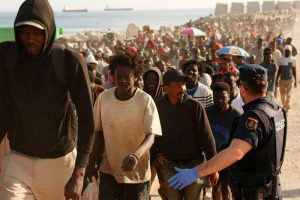
The mass crossing that triggered the political storm took place over two days at the end of July. Thousands of people, many of them Moroccan citizens but also others from sub-Saharan Africa and the Maghreb, approached the Ceuta coastline at dawn, using the beach and the rocky areas around the border as entry points. Some waded or swam around the breakwaters, while others scaled the fences. Spanish police and the Civil Guard attempted to push back the flow, but the numbers were so large that reinforcements had to be flown in from the mainland. By the end of the second day, the government said, approximately 72,000 irregular entries had been recorded. The figure is staggering in comparison to Ceuta’s population, which is officially estimated at around 85,000. Of those who entered, a significant number were quickly returned to Morocco, while others were accommodated in temporary facilities, sports halls and disused warehouses. Humanitarian workers described scenes of severe overcrowding, with families sleeping on floors and food distribution stretched to breaking point. The episode has been described as the largest single inflow of irregular migrants into Spanish territory in modern history, and it raised alarm among local residents, many of whom had lived through previous border surges but never on this scale. Ceuta is one of Spain’s two land borders with Africa, the other being Melilla, and both have long been flashpoints for migration. Morocco and Spain have often taken joint action to control the frontier, but relations between the two countries have been delicate in recent years, periodically leading to moments of reduced border pressure. At the time of the crisis, the Spanish government did not initially blame Morocco for the influx, but opposition leaders and some EU officials called for a strong diplomatic response. The crisis also exposed the difficulty of guarding a coastline that is only a few miles long but extremely complex, with currents, rocks and a busy port. In the weeks since, Spain has reinforced its border contingent with additional patrol vessels, drones and temporary barriers, while also seeking closer information-sharing with Moroccan authorities. Nevertheless, the scale of the event has prompted a deeper debate inside Spain about the sustainability of its migration management systems and the limits of deterrence.
The international reaction to the Ceuta crisis was swift and unforgiving. A group of 22 European Union countries signed an open letter to the European Commission arguing that Spain’s relatively open migration policies had acted as a “pull factor,” effectively encouraging migrants to attempt the crossing. The letter, which was circulated among member states and later leaked to several news organisations, did not name Spain in the initial draft, but its framing was widely read as a direct criticism of Madrid. Several governments, particularly in Central and Eastern Europe, have for years advocated for stricter border enforcement and automatic returns, and they saw the Ceuta episode as proof that a permissive asylum and migration regime could threaten the entire bloc. Sanchez responded by urging a balanced approach. In his Cadena SER interview, he said migration must be managed with order and humanity, but also with security. He rejected the idea that any single country’s policies could be blamed for a phenomenon as complex and global as migration. He reminded listeners that Spain had effectively protected its southern border through improved cooperation with Morocco and that the EU needed a common response based on solidarity and shared responsibility rather than punitive frameworks. The 22-country letter was nonetheless a significant diplomatic event, signalling a hardening political climate in Europe as migration figures on multiple routes continued to rise. For Spain, the ability to shape the subsequent debate may depend as much on managing disinformation as on securing the border. Sanchez explicitly linked the foreign and far-right influence operations to the broader European struggle over migration narratives. He said the aim of the disinformation was to use a real crisis to destabilise Europe, and he used the interview to appeal for unity. “We have to be capable of explaining that migration is a reality we have to face, not a threat that can be resolved with simplistic formulas,” he said in one of his most quoted lines. He also called on European institutions to develop rapid-response mechanisms for debunking false content during border emergencies, while stopping short of demanding specific platform regulations.
The decision by Sanchez to name Russia and Israel as sources of disinformation added an unfamiliar geopolitical dimension to the migration story. Russia has long been accused by European intelligence agencies of promoting anti-migrant narratives as part of a wider strategy to exacerbate social divisions and weaken the European Union. Numerous reports from security services across the continent have documented social media operations designed to amplify far-right content, distribute false stories about crimes committed by migrants and inflame disputes between member states. Israel has featured less frequently in such allegations, but its intelligence and private influence networks have been accused of public diplomacy campaigns, particularly during periods of conflict, and Sanchez’s remarks were met with surprise in some diplomatic circles. The prime minister was careful, however, not to assert direct state responsibility, again saying that “the reality we are facing does not necessarily mean that it has to come from a state actor.” This ambiguity may reflect the nature of modern information warfare, in which governments, semi-official organisations, sympathisers and commercial clickbait farms can all push in the same direction without formal coordination. Sanchez also pointed to the role of an “international far-right movement” that routinely uses migration as a lever to attack Spain and Europe. This formulation allowed him to blur the line between foreign interference and domestic political exploitation. The governments of some EU member states with far-right parties have made opposition to migration a central theme, and a number of those parties have echoed narratives very similar to the hoaxes that circulated around Ceuta. Whether the disinformation ultimately originated in Moscow, Tel Aviv, or European fringe groups may be difficult to prove, but Sanchez’s point was that the effect was the same: a real humanitarian and security challenge was weaponised to erode public trust in institutions, amplify political polarisation and shift the blame for a complex border emergency onto the victims and onto European solidarity. The Spanish government said it would present its findings to allies, and the topic was expected to be raised at the next European Council meeting. Spanish intelligence services have reportedly increased their monitoring of social media networks related to migration, and Madrid has called for a Europe-wide alert system dedicated to identifying false content during border crises.
At its heart, the Ceuta crisis and its aftermath demonstrate how migration has become a battlefield for information warfare. The Spanish government continues to investigate not only who entered the enclave and how, but who created and spread the false messages that helped turn a border incident into an international political and diplomatic event. Sanchez said the investigations are continuing and reaffirmed that Madrid would not compromise on the rule of law or border security. He also reiterated that the claim about swimming into Ceuta preventing deportation was false, and that any migrant caught entering irregularly would face legal consequences, subject to established asylum procedures. In the longer term, Spain is pressing for a reform of the EU’s migration and asylum rules to include stronger requirements for rapid returns, greater solidarity in hosting refugees and tougher sanctions against online platforms that allow disinformation to go viral. The 22-country letter, however, suggests that the political balance in Europe is tilting towards deterrence rather than discretion. The Ceuta episode has become a cautionary tale for other Mediterranean countries worried about being used as a gateway by migration ringleaders and foreign actors alike. Whether the Spanish government’s claims about Russian and Israeli involvement will be substantiated remains to be seen, but by raising the issue at such a senior level, Sanchez has made disinformation an unavoidable part of the migration debate. For Europe, the lesson may be that strict border security alone is not enough; the border is also fought in the information space, and falsehoods can travel faster than any patrol boat. As Sanchez put it, the challenge is not only to respond to the facts on the ground, but to fight for the truth in the digital world. The crisis of July 30-31 will not be the last, and the strategies developed in its aftermath will shape how Europe defends its frontiers, and its democratic resilience, for years to come.


