






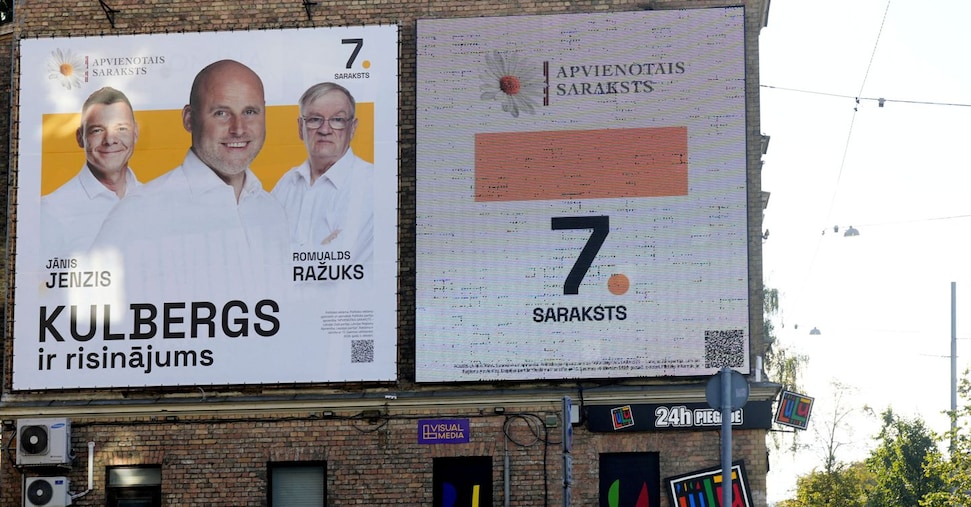
On Saturday, 3 October, Latvia will go to the polls in a parliamentary election that many in the Baltic state regard as a test of whether a democracy can function in the direct shadow of Moscow. About 1.5 million eligible voters will elect the 100 members of the Saeima, Latvia’s unicameral parliament, in what officials have described as the most delicate moment in the country’s recent history. The border with Russia and Belarus is under close surveillance, and the constant spectre of Moscow’s hybrid war looms over every campaign event. The economy is showing visible cracks—inflation stands at 3.5 per cent and purchasing power remains below the European average—but the cost of living is not what is driving the debate. Voters, according to the country’s own political leaders and polling evidence, have just one priority: national security. That priority has been shaped by years of war in Ukraine, by the collapse of Latvia’s once-important trade relationship with Moscow, and by a stream of hostile acts that have turned the Baltic republic into a front-line laboratory for Russian interference. Few elections in any European country this year will carry heavier political baggage.
Latvia’s position on the war in Ukraine has been uncompromising from the very beginning. Riga is one of Kyiv’s most staunch supporters, pushing within the European Union and NATO for stronger sanctions, more military aid and a clear path for Ukraine’s integration into the West. Latvia’s defence spending is now approaching NATO’s target of 5 per cent of GDP, an extraordinary figure for a country of fewer than two million people. The consequences have not been limited to the battlefield in Ukraine. Trade with Moscow, once a mainstay of the Latvian economy, has been brought to a standstill, and the country has become a prime target of Kremlin hybrid warfare. Disinformation, cyber attacks, GPS interference, border provocations and sabotage operations orchestrated from Russia have all become part of the landscape. In that context, the government has requested the intervention of the Organisation for Security and Co-operation in Europe to monitor the vote. The State Security Service, known as the VDD, has said it will step up security measures to ensure free and fair elections, with the specific aim of identifying and preventing any attempt to unlawfully influence the conduct and outcome of the poll. The VDD has warned that Russia may intensify its disinformation campaigns in the final hours before election day, using individuals inside Latvia to spread false news and exploit social media vulnerabilities.
One of the most sensitive fronts is the country’s Russian-speaking population. Although it is a minority, it is the largest Russian-speaking community in the Baltic states and accounts for almost 25 per cent of Latvia’s population. That makes it a substantial bloc of the electorate, and one that Moscow’s disinformation machinery has historically sought to cultivate. Not all Russian-speakers are aligned with the Kremlin, but the community is an obvious target for external manipulation, especially when trust in domestic politics is low. The instability of Latvia’s political class has added to the danger. Disillusionment has grown steadily, and a poll cited by Reuters found that a third of Latvians say they are undecided or do not wish to vote at all. Low turnout, combined with a fragmented party system, can create openings for forces interested in destabilising the country. International election observers are therefore expected to be present across Latvia, and the VDD has placed a strong emphasis on protecting the integrity of the ballot. The presence of monitors is intended to reassure the public, but it also serves as a deterrent to anyone who might be tempted to interfere, whether from the inside or the outside.
The political background to Saturday’s vote is turbulent. In 2022, New Unity—a centre-right alliance comprising Unity and four regional parties—won the election, but its period in government was marked by a series of scandals that gradually eroded its support. Krišjānis Kariņš, who was prime minister after that victory, resigned the following year because of internal conflicts within the coalition. He was replaced by Evika Siliņa, but she too resigned last May. Her departure was preceded by fierce controversy over her decision to dismiss the Defence Minister, Andris Spruds, over the slow implementation of the anti-drone defence system. At a time when airspace violations and drone incursions have become a standard feature of hybrid pressure, the failure to act swiftly on such a critical capability was seen by many voters as a significant error. The electoral toll has been severe. Polls published by the public broadcaster now put New Unity at just 4.3 per cent, below the five-per-cent threshold required to win seats in the Saeima. If that result is reflected in the real vote, the party that led Latvia through the most dangerous security confrontation since the Cold War would be completely wiped out of parliament.
A collapse of New Unity would not necessarily mean a reversal of Latvia’s foreign and defence policy. All major Latvian parties recognise that NATO membership and solidarity with Ukraine are existential questions, and any government formed after the election is likely to remain firmly pro-Western. But the fragmentation of the political landscape could make the formation of a stable coalition much harder. With no single bloc commanding a majority, the next Saeima may need four or five partners to gather enough seats for a workable government. Negotiations could be lengthy, and smaller parties may demand disproportionate concessions on defence spending, energy policy or domestic reform. That is a dangerous prospect at a time when predictability and strategic unity matter more than ever. The Kremlin will be watching for any sign of instability in Latvia, and Russian state media would almost certainly amplify a prolonged government crisis as evidence that the pro-Ukrainian consensus in the Baltic region is cracking. Western allies are likely to treat the election as a strategic event, not simply as a routine exercise in democratic rotation. The strength of Latvia’s democratic institutions, the clarity of its political direction and the resilience of its electorate are all now matters of shared interest for the broader European security order.
Ultimately, Saturday’s election is a test of whether Latvia can protect its political process from external interference while preserving the legitimacy of the result. The authorities have taken visible precautions: the OSCE has been invited to monitor, the VDD has been mobilised, border surveillance has been intensified, and defence spending has reached levels that were unthinkable a decade ago. Yet the integrity of an election is not only a question of institutional preparation; it also depends on the willingness of citizens to take part. With a large portion of the electorate undecided or planning to stay home, and with a significant Russian-speaking minority targeted by outside propaganda, the outcome remains genuinely uncertain. What is certain is that the 100 members chosen on 3 October will face the immediate task of forming a government in a country that lives with the permanent threat of hybrid warfare. For Latvia’s friends and partners, the deepest meaning of this election will not be found in the final seat count alone. It will be found in the simple fact that a small Baltic democracy, standing on the edge of an increasingly dangerous European security landscape, is still able to hold free and fair elections and to determine its own future. That is the real challenge behind the ballot box, and it is a challenge Latvia cannot afford to fail.


