





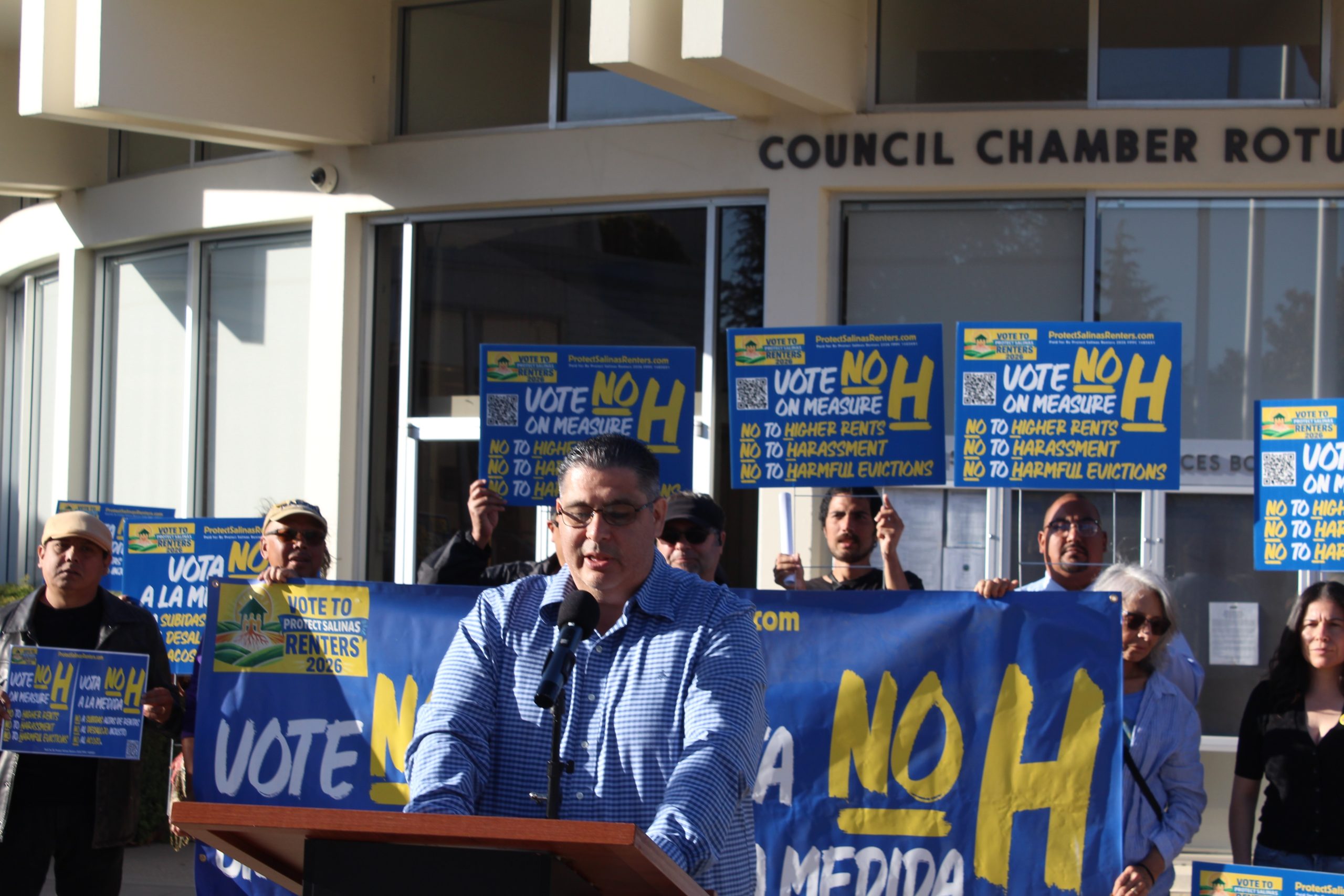
SALINAS — A deepening political battle over the future of tenant protections in this Central Coast agricultural city intensified this week as the tenant advocacy group Protect Salinas Renters accused supporters of Measure H of deliberately misleading voters with campaign materials claiming that a “yes” vote would deliver affordable housing and emergency rental assistance. The measure, which appears on the November ballot, asks voters to decide whether to keep or repeal four tenant protection ordinances adopted by the Salinas City Council in September 2024: the Residential Rental Registration Ordinance, the Rent Stabilization Ordinance, the Tenant Protection and Just Cause Eviction Ordinance, and the Tenant Anti-Harassment Ordinance. A “yes” vote repeals those ordinances; a “no” vote keeps them in force, including an annual rent increase cap of 2.75% for rental units built before 1995. The clash has pitted tenant advocates and community groups against a coalition of landlords, real estate interests, and three city councilmembers who say the existing rules are hurting the housing market and need to be replaced with more direct assistance. On Tuesday, members of Protect Salinas Renters gathered outside Salinas City Hall to demand that Councilmembers Margaret D’Arrigo, Gloria De La Rosa, and Aurelio Salazar correct what they called misinformation about Measure H, arguing that the public is being misled at a time when housing insecurity is already high across Monterey County.
The controversy centers on a campaign flyer and accompanying advertisements in which the three councilmembers appear in support of a “yes” vote, claiming that repealing the tenant protections will bring affordable housing and rental assistance to Salinas. “Salinas needs housing and rental assistance that works for the people who live here. I’m voting Yes on Measure H because it delivers both,” D’Arrigo said on the flyer. Salazar and De La Rosa made similar statements. The ads were paid for by a political action committee called Protect Salinas Residents, a group distinct from Protect Salinas Renters, and the financial disclosure records show that its top two funders are United Dominion Realty, a publicly traded real estate investment trust based in Colorado, and the California Association of Realtors Issues Mobilization PAC. United Dominion Realty alone manages more than 1,500 apartments in Salinas and more than 60,000 nationwide, according to the company’s website. Tenant advocates argue that this funding source reveals the real motivation behind the measure: large corporate landlords and real estate interests want to strip away rent stabilization and tenant protections so they can raise rents more freely and avoid registration requirements, all while wrapping their campaign in the language of housing affordability. The name similarity between Protect Salinas Renters and Protect Salinas Residents has also created confusion among voters, with some unsure which side is which on the ballot.
According to the County of Monterey, which publishes nonpartisan election information for municipal measures, a “yes” vote on Measure H repeals the Residential Rental Registration Ordinance, the Rent Stabilization Ordinance, the Tenant Protection and Just Cause Eviction Ordinance, and the Tenant Anti-Harassment Ordinance. These four ordinances have been in effect in Salinas since September 2024, and they were designed to address a housing market that has become increasingly unaffordable for low- and middle-income families. The rent stabilization ordinance caps annual rent increases at 2.75% for units built before 1995, which covers much of the city’s older housing stock. The tenant protection and just cause eviction ordinance limits the reasons a landlord can evict a tenant, providing greater security of tenure. The anti-harassment ordinance protects tenants from landlord intimidation and retaliation, while the rental registration ordinance requires landlords to register their properties and provide contact information for property managers. Tenant advocates say these protections are essential for keeping families in their homes and preventing displacement. However, the county’s official description also notes that efforts to build more affordable housing or add emergency rental assistance are not included in Measure H itself. Those provisions exist only in the campaign promises of the “yes” side, not in the text of the measure, and opponents say that is a crucial distinction that voters should understand before they cast their ballots.
Those in favor of Measure H argue that repealing the ordinances will allow the city council to replace them with emergency rental assistance programs, which would provide one-time funds to households that are behind on their rent. They also claim that rent control discourages new development and causes landlords to sell their properties, which over time reduces the supply of rental housing and worsens the very affordability crisis that tenant protections are meant to address. According to this argument, a “yes” vote is a vote for a more market-friendly approach to housing policy, one that relies on increasing supply and providing targeted assistance to renters in crisis rather than imposing price controls on landlords. Supporters of the measure have pointed to the need for new housing in Salinas and have said that the current regulatory environment is too burdensome for property owners. They argue that emergency rental assistance is a more efficient and compassionate way to help struggling renters because it can be directed to those most in need, whereas rent stabilization benefits all tenants in older units, regardless of income. The “yes” campaign has also sought to reassure voters that the measure is not about ending all tenant protections, but rather about replacing a flawed system with one that is more responsive to the current housing emergency.
Opponents of Measure H, however, have forcefully pushed back against these claims, calling them “a blatant attempt at deception.” Jesus Valenzuela, a former Salinas city councilman, said the argument that a “yes” vote will lead to affordable housing is particularly misleading because of California’s Costa-Hawkins Rental Housing Act, a state law that exempts single-family homes, condominiums, and post-1995 construction from rent control. That means new apartment buildings in Salinas would not be subject to the rent stabilization ordinance even if Measure H is defeated, so repealing the ordinance would do nothing to encourage new construction. “That ‘yes’ on H is for affordable housing is a blatant lie and plays on the hopes of some of our most affected community members that desperately need affordable housing,” Valenzuela said. He noted that several major growth areas are currently under construction in Salinas, none of which are affected by rent control because they were built after 1995. Jacob Sandoval of the League of United Latin American Citizens pointed to Oxnard, a city with a similar ordinance since 2022, where new developments have continued to be built despite rent stabilization. “They’ve said if we pass these, people are going to sell units. We’ve had this for a year and people didn’t sell units,” Sandoval said. Tenant advocates also dispute the claim that repealing rent stabilization is necessary to fund rental assistance, pointing out that the city already has an emergency rental assistance program in place alongside the rent stabilization ordinance. That program provides short-term financial assistance to tenants who are up to three months behind on their rent and facing eviction, and it has already assisted hundreds of households in Salinas.
Dr. John Silva, a longtime Salinas physician, argued that emergency rental assistance is no substitute for keeping rents affordable in the first place. “With rent stabilization, people hold onto their money. They have it in their pocket,” Silva said. “I can buy my medicines with it, I can afford my childcare with that money. So you have agency… rental assistance is after you’re in extremis, after you’re already behind on your rent, you’re about to be evicted.” His comments underscore a broader philosophical divide between the two campaigns: one side sees rent stabilization as a preventive measure that keeps tenants economically stable, while the other views it as a government intervention that distorts the housing market. As of publication time, Councilmembers D’Arrigo, De La Rosa, and Salazar had not responded to requests for comment, but D’Arrigo and De La Rosa took to Facebook following Protect Salinas Renters’ press conference to reaffirm their support for Measure H and their belief that the measure will lead to better housing outcomes. In addition to her earlier statements, D’Arrigo also claimed that the rental registry included in the ordinances “requires all housing providers to provide the city with their tenant’s personal information.” According to the text of the ordinance, however, what is actually required is the name, mailing address, phone number, and email address of the landlord’s property manager, not the personal information of tenants. That distinction, opponents say, is another example of the misinformation that has come to define the campaign, and it is precisely why they are calling on the councilmembers to retract their statements before Election Day. The future of tenant protections in Salinas now rests with the voters, who must decide whether to trust the promises of the “yes” campaign or the warnings of tenant advocates who say a “yes” vote will only make the city’s housing crisis worse.