


Disinformation Researcher: UAE Funded Massive Network to Link Sudan to Chemical Weapons
A disinformation researcher has uncovered what is described as a massive, coordinated network allegedly funded by the United Arab Emirates to spread false claims that Sudan used chemical weapons in its ongoing civil war. The network, according to the researcher’s findings, was not a casual collection of online activists but a structured operation involving fabricated news outlets, fake human-rights organisations, thousands of social-media accounts, and teams of content producers working in multiple languages. Its central aim was to create a self-reinforcing narrative that Sudan’s armed forces had crossed one of the world’s most dangerous red lines: employing poison gas or other prohibited chemical agents against civilians in Darfur and elsewhere. The allegations, if substantiated, would mark a major escalation in the information war around Sudan’s conflict and would implicate one of the Middle East’s most powerful states in attempts to manipulate international opinion on a catastrophe that has already killed tens of thousands and displaced millions. The researcher’s work, based on months of open-source investigation, has been shared with diplomatic and journalistic audiences, and it is already prompting calls for independent verification and possible accountability. The report describes an operation that was deliberately structured to hide its origins, making it appear as though Western journalists, African officials, and ordinary Sudanese citizens were spontaneously raising alarms about chemical weapons. Instead, the researcher argues, the alarm was carefully manufactured, timed to peak around moments when the UAE was under diplomatic scrutiny over its alleged military support for the Rapid Support Forces. The finding reshapes how the Sudan conflict is understood: not only as a brutal military confrontation between two rival armies, but as a battlefield where foreign powers have used deception as a weapon to influence peace negotiations, sanctions decisions, and public memory.
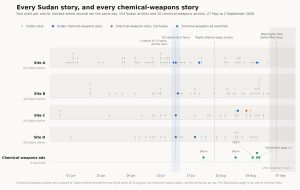
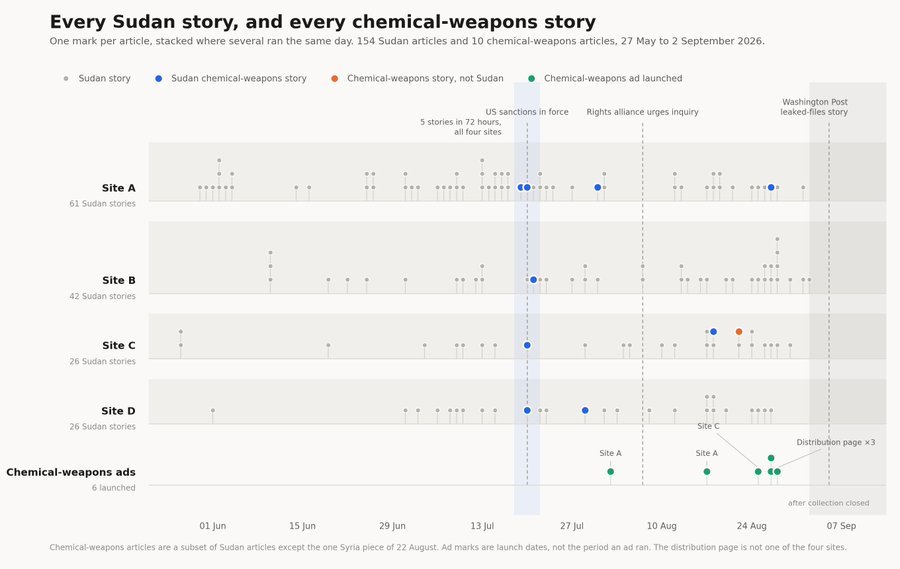
The network’s structure, as described in the analysis, was elaborate and difficult to detect. At its core were dozens of websites designed to look like independent news portals, some of which copied the logos, layouts, and even the article formats of established media outlets. These sites published stories claiming that Sudanese soldiers had been seen distributing gas masks to civilians, that doctors in Darfur had discovered traces of chemical agents in victims’ wounds, and that the Sudanese army had attacked refugees with chlorine bombs. The articles were carefully written to sound objective, often citing invented “internal government documents” or anonymous “security officials” who had supposedly leaked evidence. Around this core, the network operated social-media accounts that posed as Sudanese exiles, human-rights defenders, and concerned citizens. They coordinated hashtags that were pushed into trending lists on X, Facebook, and TikTok, then promoted the articles across Telegram channels, YouTube videos, and even podcasts. The social-media operation was partially automated, using software to post comments, like and share content, and tag journalists and politicians. But the operation also used paid influencers, some of whom had thousands of real followers and were instructed not to reveal that their posts were part of a campaign. This mix of bots and humans made the network difficult to detect because its posts could easily look like organic public opinion. The researcher said that the digital fingerprints—server registrations, payment details, account metadata—pointed toward companies and individuals with connections to the UAE and to communication firms previously retained by Emirati institutions. The campaign also used AI-generated imagery and manipulated video stills, recycling footage from older conflicts in Syria and Iraq and presenting it as evidence from Sudan. In some cases, the network manufactured entire witness testimonies, with fabricated names, locations, and medical records. These false elements were then inserted into stories that were picked up by smaller regional outlets, creating the illusion of independent journalism. The end result was a closed loop: the fake websites were the source, the bot accounts amplified them, and real journalists, seeing the chatter, sometimes quoted those articles as evidence of public concern.
The chemical-weapons accusation was deliberately chosen, the researcher argued, because of its unique capacity to provoke international outrage and immediate official action. Chemical weapons occupy an unusual place in the modern legal order: they are banned under the Chemical Weapons Convention, and the mere allegation that they have been used can trigger emergency inspections by the Organisation for the Prohibition of Chemical Weapons, emergency United Nations resolutions, sanctions, and even calls for military intervention. For audiences still haunted by the Syrian conflict, chemical weapons carry an almost automatic association with atrocity. The network knew that Sudan’s government, already struggling with a difficult war against the RSF, could be severely damaged if the accusation gained traction. So it manufactured an evidence base of videos, photographs, and testimony, then distributed that material to friendly accounts, then asked influencers to frame it as undeniable fact. In one example reported by the researcher, a video of a smoke plume from a conventional airstrike was captioned as a chemical cloud and shared across dozens of accounts. In another, a still from an old Syrian civil-war video was repurposed and described as Sudanese. The goal was not to convince sophisticated analysts but to force journalists and civil-society organisations to spend weeks checking claims, asking for clarifications, and chasing false leads. This tactic is known in disinformation-research circles as truth laundering, and it has been used by governments to shut down investigation of their own misdeeds. The researcher said the network had no interest in facts; it was interested in time and credibility. It did not need to prove anything. It only needed to create doubt and suspicion, and to make the phrase “Sudan chemical weapons” become a familiar, searchable, and seemingly legitimate topic for diplomats and reporters.
The broader context of the UAE’s role in Sudan makes the findings particularly explosive. Since the war between the Sudanese Armed Forces under General Abdel Fattah al-Burhan and the Rapid Support Forces under General Mohamed Hamdan Dagalo, known as Hemedti, erupted in April 2023, the UAE has been repeatedly accused by the SAF, United Nations experts, and international NGOs of arming and financing the RSF. Investigators have documented evidence of weapons crossing the border from Chad into Darfur, some arriving in flights traced to Emirati-linked companies and taking off from Abu Dhabi and Dubai. UAE officials have consistently denied these reports, insisting that their aircraft were delivering humanitarian supplies and that their policy supports a peaceful resolution of the conflict. But the influence operation described by the researcher would fit a pattern: if the UAE could force the world to focus on the alleged crimes of Sudan’s army, then its own support for the RSF would appear less threatening. The RSF, particularly in the early months of the war, was widely depicted in international media as a predatory militia responsible for mass killings, the burning of villages, and the ethnic violence that tore Darfur apart. The UAE, which has invested heavily in its image as a modern hub for sports, technology, and humanitarian logistics, was sensitive to accusations of financing such horrors. The chemical-weapons narrative offered a way to reshape the story, turning Sudan’s army into a monster and, by implication, presenting the RSF as a force fighting a dangerous regime. The researcher’s report noted that the network’s most intense activity occurred immediately after UN expert reports or international news investigations about UAE arms flows were published. In other words, every time the UAE came under serious public pressure, the network fired back with a new wave of chemical-weapons storytelling. This suggests a level of coordination that goes beyond ordinary online trolling and points to a professionally managed information-warfare operation.
Reactions to the findings have been quick and divided. Sudan’s government has long argued that hostile countries are manipulating information, and the new research provides a named mechanism. Sudanese officials, reacting to journalists’ questions about the report, called it proof that the UAE and its allies were waging a media war alongside the military war. They called on the African Union, the Arab League, and the United Nations Security Council to launch a formal investigation and to preserve digital evidence. Sudanese civil-society groups, many of which have suffered from the conflict’s deliberate starvation, siege, and displacement, also said that disinformation was an invisible bomb. They warned that false chemical-weapons claims could dangerously raise the stakes of the war, potentially bringing foreign militaries into the fray under the guise of humanitarian intervention. International human-rights organisations expressed less certainty, saying that the network and the chemical-weapons allegations must be assessed independently; the OPCW is the only institution with the authority to determine whether chemical agents have actually been used. The UAE’s official media response has not yet been fully detailed, but in the past, the UAE embassy in Washington and other diplomatic missions have categorically denied supporting the RSF, describing such claims as campaigns of defamation launched by Emirati rivals. A spokesman for the UAE foreign ministry was quoted in Gulf media as saying that the allegations were ridiculous and part of an ongoing effort to damage the UAE’s standing. That response, however, may not be enough, because the researcher has reportedly provided a list of specific websites, registration dates, account names, and payment trails that can be checked by journalists and courts. The campaign is not a mysterious set of coincidences; it is a documented infrastructure that, if genuine, can be traced and audited. Independent media and watchdog organisations have already begun reviewing the evidence, and several have confirmed the existence of the fake websites, although they say the full financial chain still needs to be tested.
Ultimately, this investigation matters because it strikes at the heart of how truth is manufactured in wartime. The Sudan conflict is not only a war of bullets and bombs; it is also a war of narratives, where social-media platforms have become battlefields and the prize is the attention of the world. False allegations of chemical-weapons use are not harmless conspiracy theories. They can cause international organisations to withdraw staff from life-saving operations, trigger embargoes, lead to the suspension of aid, and provide a legal pretext for foreign intervention. They also do terrible damage to the memory of real victims, whose suffering cannot be properly mourned when lies are used as a weapon. For the people of Sudan, the greatest tragedy is that this information war is happening while the actual war is still burning through their cities and refugee camps. The researcher’s conclusion is simple: the international community cannot afford to look away. Independent investigators should push to unseal records, social-media companies should preserve evidence and remove the network’s accounts, and the UN should examine whether states and individuals who fund influence operations that imperil civilians can be held legally accountable. There is also a broader lesson. If a wealthy state can build a fake human-rights movement out of nothing, then every future claim of atrocity—however real—will be greeted with suspicion. That is precisely what the network wanted: not to stop the truth, but to make it impossible to find. The truth about Sudan, including the role of the RSF and its foreign sponsors, must not be buried under an avalanche of manufactured poison. As his report makes clear, a network was built to reshape a war through lies. Whether those lies fail is now up to the public, the press, the platforms, and the diplomats who claim they want to save Sudan.