







Paragraph 1: The Regulatory Crackdown Amid a National Crisis
In a decisive move aimed at curbing the dangerous spread of falsehoods during one of Nepal’s most severe humanitarian crises, the Press Council of Nepal (PCN) has issued formal directives to 72 social media users and page administrators over the past four days, instructing them to immediately remove what it deems “inappropriate and misleading” content or face stringent legal repercussions. This sweeping regulatory action, unprecedented in its scale of targeting individual digital accounts, comes as the Himalayan nation grapples with the catastrophic aftermath of relentless monsoon rains that triggered flash floods and devastating landslides across multiple provinces, claiming hundreds of lives and leaving thousands missing. The PCN, acting as the country’s principal media regulatory body, explicitly identified that the offending material was predominantly circulated via personal Facebook accounts, TikTok profiles, and X (formerly Twitter) handles, representing a novel and challenging frontier for a regulator traditionally accustomed to overseeing established newspapers and broadcast outlets. As rescue teams sift through debris and devastated communities, the proliferation of bogus rescue videos, fabricated casualty figures, and misleading political narratives has severely complicated an already chaotic information environment. The council’s intervention underscores a growing recognition that in the digital age, a natural disaster is invariably accompanied by a parallel “digital disaster” of misinformation, where unverified claims can spread faster than official government advisories, potentially diverting critical search-and-rescue resources, inducing panic among vulnerable populations, and undermining public trust in the state’s emergency response capabilities. This coordinated crackdown represents not merely a punitive measure but a stark warning to the thousands of content creators who have, perhaps inadvertently, become vectors for viral disinformation during a period of intense national vulnerability.
Paragraph 2: The Viral Video Fabrication – A Case Study in Irresponsibility
The most illustrative case that triggered the council’s scrutiny involved a viral video circulated by a Facebook page operating under the name “Dudhauli FM.” At approximately 7:26 AM on a recent Saturday, amidst the peak of rescue operations, the page posted a short 20-second clip that instantly set social media ablaze with thousands of shares. The footage depicted a uniformed official seemingly crawling through a narrow, debris-choked tunnel, surrounded by rescuers wearing hard hats and equipped with ropes. The accompanying caption, written in emotive Nepali, proclaimed: “Home Minister’s unique style: He reaches inside the tunnel at the disaster site to join the rescue!” This purported to show Nepal’s Deputy Prime Minister and Home Minister, Sudan Gurung, personally braving the dangerous and unstable conditions of a landslide tunnel in the Sindhupalchok district to assist trapped victims. The claim was emotionally charged, designed to portray the minister as a hands-on, courageous leader, and it rapidly accumulated tens of thousands of reactions, comments, and shares across platforms like Facebook, TikTok, and X. However, the wave of jubilant approval was soon met with rigorous scrutiny from vigilant fact-checkers and journalists from reputable news outlets. Upon meticulous verification, it was established with absolute certainty that the footage had absolutely no connection to the Nepal floods whatsoever. The original video was unearthed to be a record of a rescue operation that took place in Uttarakhand, India, specifically related to a tunnel collapse in that region months earlier. The individuals visible in the video wore uniforms emblematic of Indian State Disaster Response Force (SDRF) and Fire Service personnel, and the backdrop featured geological and infrastructural characteristics consistent with the Himalayan Indian state. The original clip had been posted on the official Facebook page of the Uttarakhand Fire Service on August 14, long before the recent Nepali disaster unfolded. The “Dudhauli FM” page, after being confronted with overwhelming and irrefutable evidence, later amended its caption to correct the error, but not before the false narrative had been viewed by millions, maliciously or recklessly linking a foreign rescue scene to the political credit of a Nepali cabinet minister during a period of heightened national grief and tragedy.
Paragraph 3: The Devastating Context – Why Misinformation is Life-Threatening
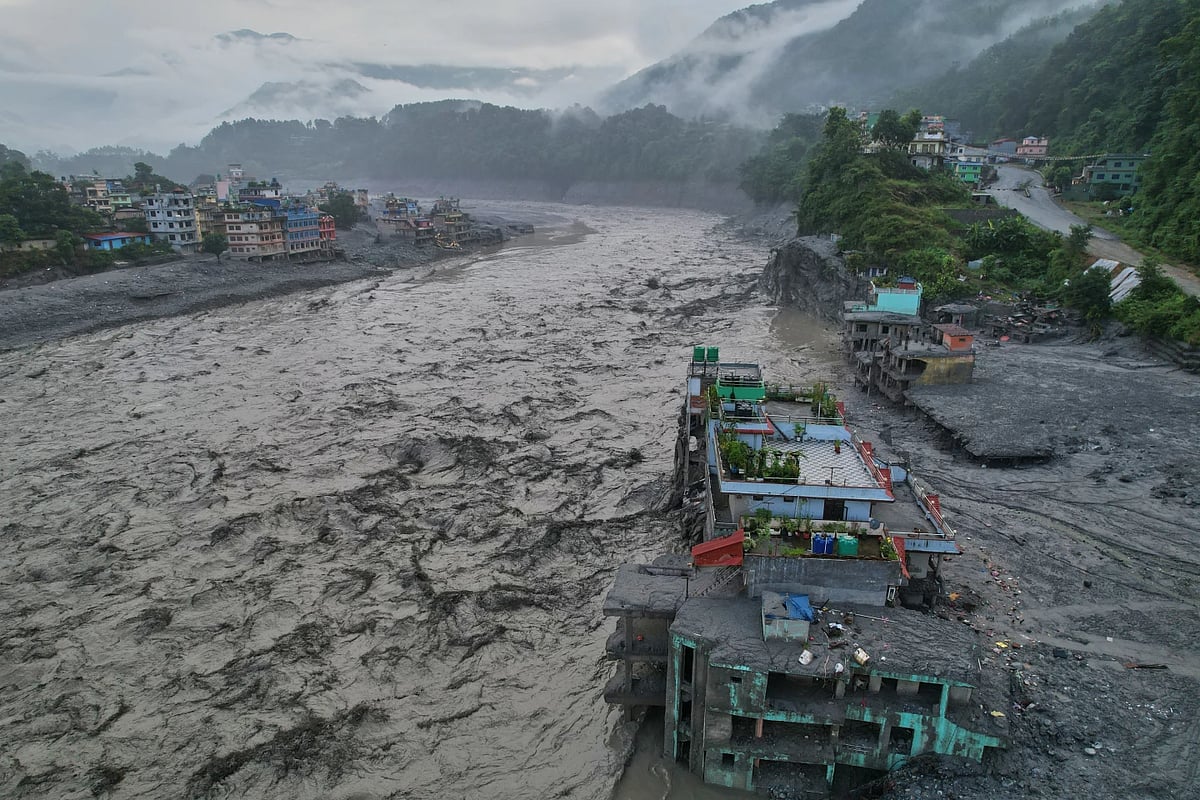
To fully comprehend the perilous nature of this misinformation, one must understand the sheer scale and intensity of the catastrophe currently engulfing Nepal. The annual monsoon, which generally brings life-giving rains to the farmlands, transformed into a deadly deluge this year, unleashing unprecedented volumes of water across the central and eastern regions, particularly affecting districts like Kathmandu Valley, Sindhupalchok, Kavre, Dolakha, Makwanpur, and Dhading. Rivers overflowed their banks with a terrifying ferocity, sweeping away entire villages, destroying critical infrastructure including the BP Highway and Prithvi Highway, and triggering massive landslides that buried entire households under tonnes of mud and rock. The National Disaster Risk Reduction and Management Authority (NDRRMA) has confirmed that the death toll has surpassed 200, with hundreds more still officially listed as missing, creating a heart-wrenching limbo for their families. The government has deployed the full might of the Nepal Army, Armed Police Force, and Nepal Police, alongside hundreds of civilian volunteers, to undertake hazardous search-and-rescue operations. However, the logistical challenges are immense and relentless: severed communication networks, completely blocked roads, washed-away bridges, and persistently bad weather have severely hampered efforts to reach isolated hamlets and mountainous settlements. It is precisely within this vacuum of accurate, verified information that misinformation thrives like a malignant tumor. For families desperately awaiting news of missing loved ones, a fabricated post claiming that a hospital in Kathmandu has seen a person matching their relative’s description can spark frantic, dangerous, and financially ruinous journeys into disaster zones, only to be met with crushing disappointment and despair. Conversely, false reports of an imminent dam failure, a dangerous animal escape, or drastically exaggerated death tolls can trigger mass panic, irrational evacuations, and chaotic stampedes that further clog emergency service lines, divert scarce rescue assets away from actual sites of need, and expose panicked civilians to secondary hazards. The government’s own painstaking efforts to compile accurate data are constantly undercut by these viral lies, forcing overworked officials to allocate precious time and manpower to debunking rumors and issuing corrective statements instead of coordinating relief logistics, distributing supplies, and managing the intricate task of disaster response.
Paragraph 4: The Press Council’s Legal Mandate and the Evolution of Digital Regulation
The legal mandate of the Press Council of Nepal provides the bedrock for this recent enforcement action, reflecting a necessary evolution in regulatory practices. Established under the Press Council Act of 1992 and subsequently refined through the National Media Policy and the 2016 guidelines, the council is vested with broad authority to ensure that media exercises its rights responsibly and does not publish content that jeopardizes national unity, public peace, social harmony, or the dignity of state institutions. While traditionally its disciplinary powers were directed at conventional media houses—newspapers, television stations, and radio networks—the exponential explosion of social media adoption in Nepal, which now boasts millions of active users, has forced a profound regulatory evolution. This latest directive explicitly names 72 individual users and page administrators, utilizing the council’s sweeping authority to summon, warn, and even penalize entities spreading “incorrect and misleading” news that could incite public unrest. The council has issued a public notice instructing these individuals to remove the offending posts within a strictly specified timeframe, warning that failure to comply will result in formal recommendations to the government’s cyber bureau to block their accounts entirely or to initiate legal proceedings under the comprehensive Electronic Transactions Act of 2008, which carries fines and potential imprisonment. This transition from regulating legacy newsrooms to policing citizen-generated content represents a monumental shift in Nepali media governance, one that raises legitimate and complex concerns regarding fundamental principles of freedom of expression and the potential for the abuse of such draconian powers to silence government critics. The council has taken pains to distinguish between critical opinion, satirical commentary, and verifiable fact, focusing its enforcement solely on demonstrably false statements. In this specific context, the council has presented documented, irrefutable evidence of clear factual fabrication—such as the mislabeled Indian rescue video presented as a Nepali government triumph. The action is therefore legally framed within the stringent parameters of publishing or distributing materials deemed “against the national interest or public morality.” Furthermore, the council has concurrently initiated a large-scale public awareness campaign, issuing press releases and partnering with radio stations to advise the general public to verify the source of any alarming information, to rely exclusively on official government sources like the Ministry of Home Affairs, Nepal Police, or the NDRRMA, and to critically evaluate any content before sharing it, thereby attempting to tackle the demand side of the misinformation ecosystem even as it enforces punitive measures against the supply side.
Paragraph 5: The Psychology and Economics Behind Viral Falsehoods
Why do such blatant falsehoods gain traction with alarming speed, and what motivates individuals to spread them? The answer lies at the complex intersection of human cognitive psychology, the ruthless algorithmic design of modern social media platforms, and the crude economics of content monetization. In an era where content creators on YouTube, Facebook, and TikTok are paid based on ad impressions, view counts, and engagement metrics, viral content—regardless of its veracity—is the primary currency of the digital realm. Disasters are inherently high-engagement events, drawing massive spikes in global and national traffic to platforms as people seek information and want to help. Consequently, unethical page administrators, opportunistic “citizen journalists,” and clickbait farms are strongly financially incentivized to produce highly sensational, emotionally charged, or politically polarizing content that features dramatic visuals to capture this organic traffic surge. The “Home Minister in tunnel” video is a perfect case study of this phenomenon, as it combined a visually compelling rescue scene with a noble political narrative, guaranteeing shares from both supporters of the minister who wished to highlight his leadership and critics who might share it to mock the theatricality of their political opponents. This cynical manipulation of “engagement bait” drives a staggering number of views, which translates directly into revenue from platform ad networks. Moreover, the emotional state of the audience during a crisis is one of heightened anxiety, stress, grief, and a desperate, almost primal need for information and reassurance. Cognitive psychology clearly demonstrates that the human brain processes negative, shocking, and threatening information faster and with more intensity than positive or neutral data, a survival mechanism known as the “negativity bias.” Furthermore, under acute stress and time pressure, individuals are far less likely to engage in slow, analytical, and critical thinking, instead relying on heuristic shortcuts, intuitive judgments, and gut feelings. This “cognitive miser” mode, combined with the “illusory truth effect”—where repeated exposure to a claim, even a false one, makes it feel more truthful—makes it exceptionally easy for fabricated stories to gain an insurmountable foothold within minutes. Additionally, the deeply entrenched political and ideological rivalries within Nepali society sometimes lead to the deliberate creation of sophisticated propaganda designed to either undermine or artificially bolster specific leaders, further weaponizing a national tragedy for sectarian advantage.
Paragraph 6: The Path Forward – A Collective Defense Against the Infodemic
As the floodwaters gradually recede, exposing the grim and muddy toll of the disaster, the battle against the parallel flood of misinformation is far from over; in many ways, it is only intensifying. The Press Council of Nepal’s decisive directive to these 72 users is a vital, albeit reactive, first step in the broader, ongoing fight to protect public safety, democratic integrity, and social cohesion. However, the council alone cannot stem this tide. The incident starkly highlights the urgent and undeniable need for a comprehensive, multi-stakeholder approach involving the government, social media platforms like Meta (parent of Facebook and Instagram), Google (YouTube), and TikTok, professional fact-checking organizations such as Nepal Fact Check and South Asia Check, and, most critically, individual citizens themselves. Social media corporations must substantially improve their automated and human-led mechanisms for identifying and flagging disaster-related misinformation and must prioritize the amplification of authoritative, official local sources over sensationalist viral posts. They must be held legally and ethically accountable to the jurisdictions they operate in, particularly in the Global South where the impact of their algorithms is often most severe. Simultaneously, robust grassroots media literacy campaigns are indispensable; schools, colleges, and community organizations must teach people how to pause, verify sources using reverse image search tools, cross-reference official statements, and seriously consider the potential destructive consequences before hitting the “share” button. The PCN must also maintain transparent communication regarding its decisions, ensuring that its enforcement actions are consistently framed as defending the public interest and protecting lives rather than being perceived as heavy-handed state censorship designed to suppress legitimate dissent or criticism of the government’s handling of the crisis. For the families still waiting with bated breath for news of their missing loved ones, and for the exhausted rescue workers navigating a both physically and informationally treacherous landscape, accurate, real-time information is as critical as food, shelter, and medical supplies. The 72 warnings serve as a stark, salutary reminder that in the 21st century, every click, share, and upload carries a profound societal weight and potential consequence. Only through collective vigilance, stronger platform accountability, enforceable legal frameworks, and an educated, resilient citizenry can Nepal hope to navigate future crises without being as devastatingly undermined by a fabricated tweet, an old mislabeled video, or a reckless piece of clickbait as it is by a torrential flood or a seismic earthquake. The council’s action is a necessary deterrent, but the durable cure lies in cultivating a deep national culture of verified truth and responsible digital citizenship, a monumental challenge that requires the active participation of every Nepali with a smartphone in their hand.


