






Cyberspace Is Not an Exempt Zone: Building a Healthy and Safe Online Environment
The digital age has fundamentally transformed how humanity communicates, learns, and conducts business. With the touch of a screen, anyone with an internet-connected smart device can access a world of information, express opinions, share emotions, and connect with communities regardless of geographic boundaries. Cyberspace has evolved far beyond a mere communication tool; it has become a vibrant ecosystem for education, commerce, creativity, and the dissemination of positive social values. Yet, with unprecedented connectivity comes unprecedented responsibility. The online world mirrors society itself, containing both its finest virtues and its most troubling vices. As more people around the globe integrate digital platforms into their daily routines, the need to establish norms of responsible behavior in virtual spaces has never been more critical. This dual nature of cyberspace—its capacity to uplift and empower while simultaneously harboring harmful conduct—represents one of the defining challenges of our digital era. Understanding this duality is the first step toward fostering an online environment that enriches rather than diminishes our collective social fabric.
The Escalating Problem of Misinformation and Online Misconduct
Alongside the tremendous benefits of digital connectivity, there has been a troubling escalation in inappropriate behaviors across social media platforms. The dissemination of false information, manipulation of images, distortion of content, defamation of honor and dignity, and exploitation of social media for personal gain have become increasingly prevalent in recent years. Throughout Vietnam and beyond, countless individuals, businesses, and organizations have fallen victim to coordinated misinformation campaigns, with victims suffering severe damage to their reputations, operational continuity, and livelihoods. What makes this particularly alarming is the speed at which false narratives can spread. A single sensational post can reach hundreds of thousands of users within hours, often before the affected parties have any opportunity to respond or correct the record. More concerning still, some individuals deliberately exploit the public’s natural curiosity and the viral nature of social media to spread rumors, incite public opinion, or manufacture controversies specifically engineered to attract views and followers. These calculated actions go beyond mere negligence—they represent a deliberate assault on the integrity of our information ecosystem. The economic consequences are substantial, as businesses lose customers and partners due to baseless allegations, but the social costs are even higher. Misinformation erodes the foundational trust that binds communities together, negatively impacting the information environment and threatening public order and safety in ways that are difficult to quantify but impossible to ignore.
Legal Consequences: No Immunity in the Digital Realm
The message that cyberspace is not an “immunity zone” has been reinforced through concrete legal action. Recently, authorities have initiated legal proceedings against several individuals for acts committed through livestreaming, information dissemination, and other digital activities that infringed upon the legitimate rights and interests of organizations and individuals. These enforcement actions send an unambiguous signal that the law applies equally in virtual and physical spaces. The legal system is adapting to the realities of the digital age, ensuring that those who weaponize social media to harm others face meaningful consequences for their actions. These recent incidents have sounded an alarm about the far-reaching consequences of inappropriate social media use, serving as a deterrent to those who might believe that anonymity or distance provides protection from accountability. The clear legal framework now established affirms that any statements, comments, shares, or actions in the digital environment that violate legal regulations will incur legal consequences. This represents a crucial development in protecting the legitimate rights of citizens while maintaining order and safety in cyberspace. The enforcement actions demonstrate a commitment to creating a digital environment where people can interact freely but responsibly, where rights are protected, and where the rule of law prevails. As the legal landscape continues to evolve, it provides a foundation for deterring harmful behavior while protecting the fundamental freedoms that make cyberspace such a valuable public resource.
Expert Perspectives: A Worrying Social Phenomenon
The growing concern over online misconduct has drawn attention from academics and public intellectuals who study the intersection of technology and society. Associate Professor Bui Hoai Son, a member of the National Assembly’s Committee on Culture and Society, has described this as a deeply worrying problem that demands urgent attention. According to his analysis, the online space has become inseparable from social life, but alongside the positive values it enables, we are witnessing a proliferation of fake news, misinformation, defamation, false advertising, and the exploitation of public curiosity for financial gain. What makes this particularly concerning, Professor Son notes, is that the consequences of these actions are no longer confined to the virtual environment. A single piece of false information can destroy a person’s reputation, devastate a family, cripple a business, disrupt social perception, and fundamentally undermine public trust in institutions. The asymmetry between the speed of harm and the speed of correction is stark: damaging information can reach millions of people within hours, while corrections or remediation efforts face substantial difficulties in gaining equal traction. Dr. Nguyen Tuan Anh from the Vietnam Youth Academy echoes these concerns, noting that harmful content is rampant across all digital formats, from news articles and images to videos and live streams on social media platforms. His analysis suggests this phenomenon reveals a very poor awareness of social media usage norms and, in many cases, a blatant disregard for legal standards among internet users. Both experts emphasize that addressing this issue requires understanding it not merely as a legal problem but as a fundamental challenge to social norms and collective behavior in the digital age.
Building Digital Culture Through Responsible Citizenship
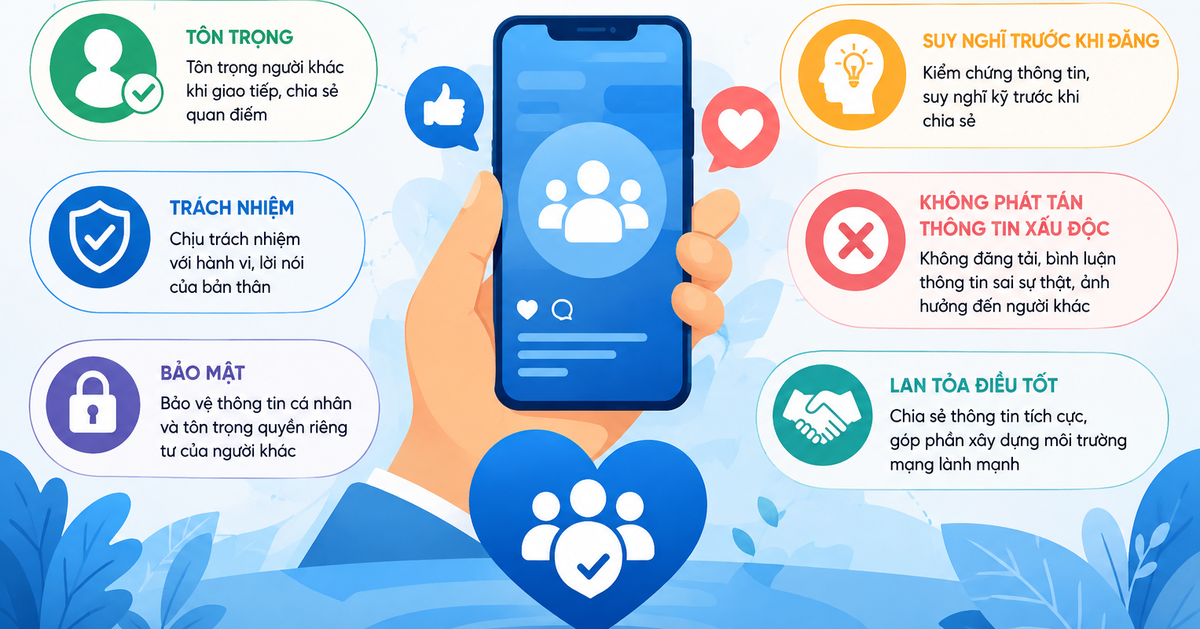
The path toward a healthier online environment begins with individual awareness and responsibility. Building a culture of responsible behavior in cyberspace is not exclusively the task of state management agencies but is equally the responsibility of every internet user. A civilized digital environment can only emerge when each individual is fully conscious of their accountability for every piece of content they post, share, or comment on. This requires developing consistent habits: verifying information before sharing, preferring official sources, adopting respectful language, tolerating legitimate differences in opinion, and refusing to contribute to the spread of fake news or harmful content. Every responsible share contributes to containing the spread of toxic information and constructing a healthier online ecosystem. Professor Son proposes a simple but powerful principle: take responsibility for every click, every comment, and every share. He advocates for a digital culture built on three fundamental values—mindfulness in consuming information, kindness in how we interact with others, and responsibility in everything we express. Each social media user is simultaneously a recipient of information and a creator of cultural norms. When individuals pause before sharing, verify before believing, and prioritize respect for others over self-expression, the online space transforms into a genuinely healthier environment. Significantly, experts urge users to resist the temptation, driven by curiosity or momentary emotion, to participate in online attacks, accusations, or public judgments against others. When someone commits wrongdoing, the legal system will address it; the online community should not transform itself into a virtual court that condemns, humiliates, or destroys reputations without due process. Dr. Nguyen Tuan Anh emphasizes that users must clearly distinguish what information should and should not be posted online, avoiding engagement with unverified or fabricated content, reporting violative accounts, and alerting authorities when serious legal violations affecting public order and security are detected.
Upholding the Rule of Law in Cyberspace
Lawyer Hoang Tung from Trung Hoa Law Office at the Hanoi Bar Association provides a legal perspective on building a healthy online environment. While the involvement of regulatory agencies is essential, he emphasizes that each citizen must raise awareness, behave responsibly, and comply with legal standards when using social media. The rights to freedom of speech and expression are fundamental constitutional rights protected for all citizens; however, they must be exercised within the framework of law, ensuring they do not infringe upon the legitimate rights and interests of other organizations and individuals. This balance between freedom and responsibility is the cornerstone of a functioning democratic society in the digital age. Mr. Tung recommends practical measures that every social media user can adopt, including developing the habit of verifying information before sharing and applying the principle of “waiting five seconds before pressing the share button.” This small pause creates space for reflection, allowing users to check sources and confirm authenticity before contributing to information dissemination. The collective effort of individual users, combined with clear legal frameworks and consistent enforcement, creates the conditions for a positive and constructive online environment. As Vietnam accelerates its national digital transformation, building a culture of appropriate behavior in cyberspace is not merely an immediate requirement but represents the foundation for sustainable development of the digital society. Every citizen must become a responsible digital citizen, respecting truth, behaving civilly, and upholding the rule of law. By working together—regulators, platforms, experts, and most importantly, individual users—we can build a cyberspace that reflects our highest values rather than our worst impulses, ensuring that this extraordinary digital frontier remains a space for learning, connection, creativity, and the dissemination of positive values for generations to come.


