


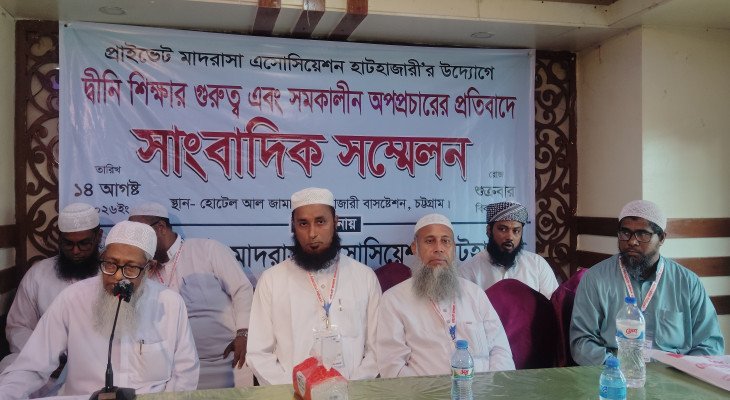
HATHAZARI, CHATTOGRAM — A press conference was held on Friday afternoon under the initiative of the Private Madrasa Association Hathazari at Hotel Al Zaman, located near the Hathazari municipality bus stand, to affirm the importance of religious education and to protest against what the organisers described as contemporary propaganda and disinformation targeting religious educational institutions. The event, which began at 5:30 pm, brought together a large number of religious scholars, madrasa teachers, students, and local community leaders. Allama Mufti Khalil Ahmad Kasemi, Director General of Hathazari Madrasa, attended the programme as the chief guest, while Maulana Hafez Abu Taib, President of the Private Madrasa Association, presided over the meeting. The special guests included Mufti and Muhaddis of Hathazari Madrasa Allama Mufti Jasim Uddin, Director General of Fatepur Madrasa Allama Mahmudul Hasan, and Director General of Charia Madrasa Allama Osman Saidi. Dr. Allama Nurul Absar Azhari was present as the main discussant of the event, and Maulana Hafez Rizwan Arman, Vice President of the organisation, read out the keynote address. The gathering was organised at a time when madrasa education has become a subject of intense debate in Bangladesh, with various quarters questioning its curriculum, methodology, and social contribution. The speakers, however, unanimously expressed their strong conviction that religious education is not only a means of spiritual uplift but also an integral part of the nation’s educational heritage.
In his remarks as the chief guest, Allama Mufti Khalil Ahmad Kasemi said that religious education and modern education are not contradictory, nor should they be regarded as rivals. He explained that the madrasa system has produced scholars, jurists, administrators, and social reformers for centuries. It has maintained a balance between divine knowledge and worldly sciences. The Director General of Hathazari Madrasa pointed out that the current wave of propaganda against religious educational institutions is baseless and misleading. He said that many people who criticise madrasas have never visited one and do not know the actual nature of the syllabus. He urged the media and civil society to conduct fair analysis before making any generalisation. He also stressed that the teachings of Islam encourage the pursuit of knowledge, morality, and justice. Maulana Hafez Abu Taib, as the president of the association, said that the madrasa community is a peaceful and patriotic community. He expressed deep concern over what he called a coordinated effort to spread false information and create a negative public perception. He declared that a conspiracy is being hatched to undermine the moral foundation of society. He called upon guardians, students, and all conscious citizens to remain aware and not to be influenced by fabricated narratives. Maulana Hafez Rizwan Arman, who read the keynote, highlighted specific examples of disinformation circulating in social media and other platforms, including allegations that madrasas encourage extremism or teach hatred. He strongly rejected such accusations and said that these malicious stories are far removed from the reality of thousands of madrasas across Bangladesh. The keynote also urged the government to take action against those engaged in spreading such harmful content.
The special guests delivered detailed speeches on the same theme. Allama Mufti Jasim Uddin, a noted mufti and muhaddis of Hathazari Madrasa, said that religious and secular knowledge should be seen as complementary rather than conflicting. He argued that a society that neglects moral and spiritual values cannot achieve genuine progress, no matter how advanced it becomes in technology or industry. “When moral values collapse, education becomes dangerous,” he said. He further explained that the current propaganda is an attempt to create an artificial division between religious and general education, while in reality both are necessary for the development of a complete human being. Allama Mahmudul Hasan, Director General of Fatepur Madrasa, reminded the audience that madrasa graduates have served the country in many fields, including education, medicine, engineering, law, and public administration. He said that it is deeply disappointing that some people deliberately ignore these contributions and present madrasas as a problem for society. He also mentioned that Islamic education has never been a barrier to modernity; rather, it has guided millions of people to live responsibly and ethically. Allama Osman Saidi, Director General of Charia Madrasa, said that the purpose of a madrasa is to build a peaceful and just society. He stated that Islam declares the pursuit of knowledge to be obligatory for every Muslim, and that the establishment of madrasas has historically been a means to fulfil that obligation. He also said that the recent negative discourse is based on ignorance and prejudice. Dr. Allama Nurul Absar Azhari, the main discussant, presented a more analytical perspective on the situation. He said that the so-called contemporary propaganda is not spontaneous but part of a well-planned movement to marginalise religious institutions and scholars. He challenged the critics of madrasas to provide concrete evidence for their allegations. He also argued that while a handful of incidents are celebrated as trends by certain vested interests, the enormous positive contribution of madrasas remains ignored. He asserted that respected scholars and institutions have worked silently for generations and have served society in areas ranging from social welfare to education and conflict resolution.
Other leaders of the Private Madrasa Association also spoke at the press conference. Maulana Abdullah, Maulana Imran Sikdar, Maulana Hafez Kamal, Maulana Forkan Arman, Maulana Hafez Mustafa, Mufti Anwar Hossain, Maulana Jahangir Alam, and Maulana Nizam Syed all expressed their strong views against misinformation. The discussion in this segment was conducted under the chairmanship of Maulana Hafez Saifullah, the joint editor of the organisation. The speakers unanimously stated that it is difficult for any conscious person to accept such disinformation about religious educational institutions. They said that madrasas are open and transparent institutions. Every year thousands of students are admitted through public examinations, and their academic progress is routinely evaluated. Many madrasas are recognised by the government and are subject to official inspection. Yet, despite all these facts, a particular lobby continues to spread falsehoods about the madrasa system. Some speakers recalled that during the Liberation War, many religious scholars and madrasa students participated in the struggle for independence. They pointed out that in today’s Bangladesh, madrasa graduates are serving in every sector of the country. They expressed particular concern about the use of social media platforms to publish defamatory content against religious scholars and institutions. They demanded that legal action be taken against pages, groups, and individuals that intentionally spread false information. The speakers also called on journalists to maintain ethical standards and neutrality while reporting on madrasa-related issues. They said that instead of focusing on isolated incidents, the media should also highlight the charity work, social services, and educational achievements of madrasas. One speaker asked, “If these institutions are truly places of hatred, why would millions of parents willingly send their children to them?” The question was met with widespread approval from the audience. Another speaker said that Islam teaches kindness, tolerance, generosity, and discipline, and that these values are instilled in students from their early childhood in madrasas.
The significance of this press conference lies in its broader context. Bangladesh has witnessed a growing debate over the role and nature of religious education in the country. Some sections of civil society and online activists have questioned the curricula of both aliya and qawmi madrasas, while isolated incidents have sometimes been used to paint the entire madrasa community with a broad brush. In recent years, security operations and arrests of individuals have occasionally led to negative coverage of madrasa education as a whole. In this climate, many private madrasa associations feel that they have been left with no choice but to respond. The Hathazari region has a long and distinguished tradition of Islamic learning, and the establishment of the Hathazari Madrasa has made the area an important centre for religious education in Bangladesh. Therefore, when the Private Madrasa Association Hathazari called this press conference, it was seen as an attempt by senior religious scholars and administrators to project unity and clarify their position. The speakers made it clear that they are not opposed to modern education. They argued that the madrasa curriculum has evolved over time and now includes subjects such as Arabic, Bangla, English, mathematics, science, social science, and Islamic studies. They said that the aim of their institutions is to produce students who are both morally sound and professionally capable. The leaders also discussed social problems facing the country, such as poverty, inequality, corruption, and the erosion of moral values. According to them, religious education is not merely a matter of ritual practice; it is a powerful force that can help solve these problems. They urged the government to treat madrasa institutions with fairness and respect, and not to adopt discriminatory policies. They also called on the authorities to monitor social media for hateful and defamatory content and to take necessary steps against those who use digital platforms to create social discord. The organisers thanked the journalists who attended the press conference and requested that they present the truth fairly to the public.
The press conference concluded with a series of resolutions presented by the leaders of the Private Madrasa Association Hathazari. First, the association reiterated that religious education is a fundamental right of the Muslim community and must be preserved, protected, and developed. Second, it strongly condemned all forms of misinformation and propaganda directed against religious educational institutions and religious scholars. Third, it called upon the government, educational authorities, and the media to act with responsibility and to avoid treating madrasas as security threats or sources of extremism. Fourth, it urged parents and guardians to remain confident about the education being provided in madrasas and not to be confused by false allegations. Fifth, it announced that the association would continue to organise awareness programmes, community dialogues, and further press briefings in order to present the true image of madrasas to the general public. Sixth, the leaders stated that if the campaign of disinformation continues, the association would consider stronger measures, including legal action and peaceful demonstrations. The meeting ended with a prayer for the peace, prosperity, and security of Bangladesh. In his concluding remarks, Allama Mufti Khalil Ahmad Kasemi once again emphasised the central theme of the press conference: “It is difficult for any conscious person to accept such disinformation about religious educational institutions.” He expressed his hope that the people of the country would understand the genuine contribution of madrasas and that truth would ultimately prevail over falsehood. The event, which lasted for several hours, ended peacefully at around 8 pm. The association expressed its gratitude to the management of Hotel Al Zaman and to the local administration for providing the necessary facilities and maintaining an orderly atmosphere. The press conference marked a strong public statement by the madrasa community of Hathazari and sent a clear signal that religious institutions will not remain silent when faced with what they consider an unfair and dangerous misrepresentation of their mission.