








Tinubu Urges Political Actors to Shun Ethnic, Religious Sentiments as 2027 Campaigns Begin
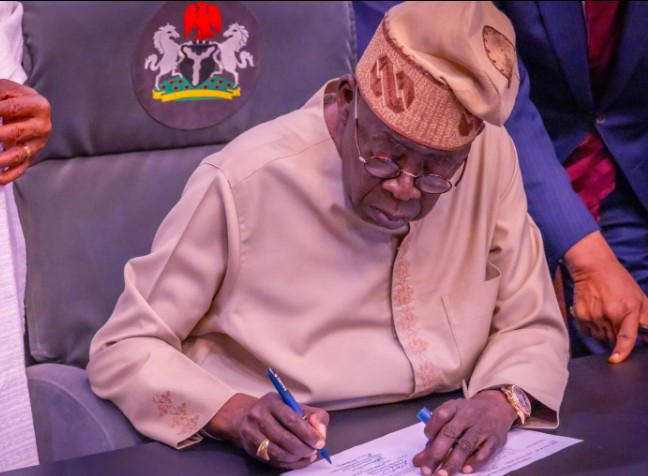
ABUJA – President Bola Tinubu has called on political parties and candidates across Nigeria to resist the temptation to exploit ethnic, religious, and other primordial sentiments in their quest for political power, warning that such divisive tactics threaten the unity and stability of the nation. Speaking on Tuesday in Abuja at the official signing of the Peace Accord, where he was represented by the Secretary to the Government of the Federation, Senator George Akume, the President underscored that political campaigns must be conducted in a manner that strengthens rather than tears apart the social fabric of the country. The event, which brought together political leaders, party representatives, and civil society stakeholders, marked a formal commitment to peaceful and issue-based campaigns ahead of the 2027 general elections. In a statement issued by the media adviser to the SGF, Yomi Odunuga, President Tinubu acknowledged that political disagreements and competing governing visions are legitimate and even necessary features of a thriving democracy. He cautioned, however, that electoral contests must never be allowed to degenerate into instruments of division that threaten national cohesion. The President’s remarks come at a time when Nigeria’s political landscape is already showing signs of intense maneuvering, with various alliances and realignments taking shape months before official campaign activities commence. His appeal was direct and unequivocal: the pursuit of power must not come at the expense of the nation’s unity.
The President emphasized that while it is natural for political opponents to disagree and to advocate different policies and visions for the country, such disagreements must be expressed with respect and a sense of shared national purpose. “In the spirit of the accord we have just signed, we must conduct ourselves in ways that strengthen, not tear, the fabric of our society,” he said. “It is natural during campaigns to disagree as opponents and advocate competing governing visions for our country. We may exchange occasional political jabs. But as members of the same household, the same national family, we must never resort to divisive or primordial sentiments of ethnicity or religion as tools for seeking power.” This admonition is particularly significant in a country as diverse as Nigeria, where over 250 ethnic groups and multiple religious traditions coexist. Historically, elections have sometimes been marked by ethno-religious tensions, often manipulated by politicians to secure regional or sectarian support. The President’s statement is a clear attempt to redirect political discourse toward issues that matter to ordinary citizens, such as economic opportunity, security, education, healthcare, and infrastructure. By urging candidates to focus on ideas and policies, Tinubu is seeking to elevate the quality of political debate and reduce the temperature of campaigns, which in previous cycles have been characterized by inflammatory rhetoric, hate speech, and violence. His words also resonate with the broader efforts of the National Peace Committee, which has consistently worked to ensure that elections in Nigeria are conducted in an atmosphere of peace and mutual tolerance.
President Tinubu further urged all political actors to make the forthcoming campaigns a contest of ideas, policies, and programmes capable of improving the lives of citizens and advancing national development. “Let us campaign on superior ideas. Let us debate issues and promote the best policies to expand opportunities for our people and accelerate Nigeria’s journey from a developing nation to a first-world country,” he said. This vision of a future Nigeria, emerging from underdevelopment to become a modern, prosperous nation, is central to the President’s message. He stressed that the forthcoming elections should not be reduced to a zero-sum game in which the only objective is winning at all costs. Instead, campaigns should serve as a platform for educating voters, presenting clear alternatives, and fostering a sense of collective ownership of the nation’s destiny. The President also made it clear that his own party, the All Progressives Congress (APC), is fully committed to the principles enshrined in the Peace Accord. “As the campaign season kicks off, I commit myself and my party, the All Progressives Congress, to the tenets of this accord,” he declared. He went further to outline specific commitments, including the rejection of violence, hate speech, the spread of misinformation—including through artificial intelligence—and all forms of incitement, especially via social media. This acknowledgment of the growing threat of AI-driven disinformation is noteworthy, as technology increasingly plays a dual role in modern elections, both empowering citizens and enabling sophisticated manipulation of public opinion.
The President’s warning about misinformation and social media is particularly timely given the rapid evolution of digital platforms and their capacity to shape narratives. In previous election cycles, social media has been used to amplify rumors, spread falsehoods, and incite ethnic or religious animosity. With the advent of generative AI and deepfake technologies, the potential for fabricated content to influence voters has increased dramatically. President Tinubu’s explicit mention of artificial intelligence signals an awareness that Nigeria’s electoral integrity in 2027 will depend not only on physical security but also on the trustworthiness of information ecosystems. “Our party rejects violence, hate speech, the spread of misinformation, including through artificial intelligence, and all forms of incitement, especially via social media. We are committed to peaceful, transparent elections that will strengthen political stability, social harmony, economic progress, and our nation’s prosperity. I encourage other political parties and political actors to do the same,” he said. The President’s call for all parties to adopt similar commitments is a recognition that no single actor can guarantee peaceful elections. It requires collective responsibility, mutual restraint, and a shared commitment to democratic norms. The Peace Accord, which has been signed before every major election in Nigeria since 2015, remains a critical mechanism for maintaining dialogue among political rivals and reducing the risk of violence. However, the true test lies in implementation, as candidates and their supporters must translate the promises made at the signing ceremony into disciplined behavior on the ground.
Reminding candidates and supporters that elections should never be seen as a do-or-die affair, President Tinubu pointed out that political rivals remain partners in the collective task of nation-building. “Let us remember that elections are not a do-or-die affair. We are partners in the nation-building project. Win or lose, our country, Nigeria, must be the ultimate winner,” he said. This statement reflects a mature understanding of democracy, where power is transient and the nation endures. It is a message aimed at discouraging the zero-sum mentality that has often led to electoral violence and post-election disputes. The President’s words are especially important for young people, who are often mobilized as foot soldiers during elections and may be tempted to engage in violence in defense of their preferred candidates. By reminding them that elections are temporary contests within a permanent nation, Tinubu is appealing to their sense of responsibility and patriotism. He also praised the National Peace Committee for its steadfastness in promoting non-violent, issue-based campaigns since 2014. The committee, led by former Head of State General Abdulsalami Abubakar, the Sultan of Sokoto, and Bishop Matthew Hassan Kukah, has played a crucial role in mediating between political actors and fostering an environment conducive to peaceful elections. Their efforts have been widely recognized, and the President’s acknowledgment serves to highlight the importance of independent institutions in safeguarding Nigeria’s democracy.
Reflecting on Nigeria’s democratic journey since 1999, President Tinubu highlighted significant technological advancements in election management by the Independent National Electoral Commission (INEC). He cited the Permanent Voter Card (PVC) and the Bimodal Voter Accreditation System (BVAS) as key innovations that have curtailed ballot manipulation and boosted public confidence. The introduction of these technologies has been a game-changer, reducing the incidence of multiple voting and other electoral malpractices that once plagued Nigeria’s elections. The President noted that the credibility of recent off-season governorship elections held in Anambra, Ekiti, and Osun states demonstrates that transparent processes reduce post-election litigation and deepen the consolidation of Nigeria’s democracy. These elections, while not without challenges, were generally accepted as improvements over previous exercises, with results that reflected the will of the voters. The deployment of BVAS to verify voters’ identities through biometric verification has significantly enhanced the integrity of the electoral process. However, technology alone cannot guarantee free and fair elections; it must be supported by a robust legal framework, well-trained electoral officials, and a citizenry committed to peaceful participation. President Tinubu’s recognition of these achievements is also a call to build on the gains made so far, ensuring that the 2027 elections are even more transparent and credible than recent ones. To that end, he called on civil society organizations, development partners, the media, and citizens to support efforts to promote civic engagement, good governance, and institutional trust ahead of the 2027 polls. The media, in particular, has a heavy responsibility to report accurately and professionally, avoiding sensationalism and hate-driven content that could inflame tensions. Civil society organizations, meanwhile, can play a vital role in voter education and monitoring, helping to hold political actors accountable to their commitments under the Peace Accord.
In conclusion, President Bola Tinubu’s address at the signing of the Peace Accord serves as a timely and essential reminder of the values that must underpin Nigeria’s democratic process. As the nation prepares for the 2027 general elections, the President’s messages—rejecting ethnic and religious sentiments, focusing on ideas and policies, shunning violence and misinformation, and seeing elections as a shared national project—provide a moral and practical framework for all participants. The commitment of the All Progressives Congress to the accord, alongside the President’s appeal to other parties to do the same, sets the stage for what could be a more peaceful and issue-driven electoral season. The emphasis on technological advancements in election management offers hope that the process itself will be credible, transparent, and widely accepted. Yet, the ultimate success of the 2027 elections will depend on how deeply these commitments are internalized by candidates, political parties, and citizens across the country. The Peace Accord is not a mere ceremonial document; it is a promise rooted in the shared destiny of over 200 million Nigerians. With the continued leadership of the National Peace Committee, the vigilance of civil society, the professionalism of the media, and the political will of contestants, Nigeria can demonstrate once again that its democracy is mature enough to manage differences without resorting to violence or division. As President Tinubu aptly stated, win or lose, Nigeria must be the ultimate winner. That conviction, if upheld by all, will not only secure peaceful elections in 2027 but also strengthen the foundations of a more prosperous and harmonious nation for generations to come.


