




‘Imperialist American Stooges’ Trying to Erase 35 Years of Achievements, Says Prachanda
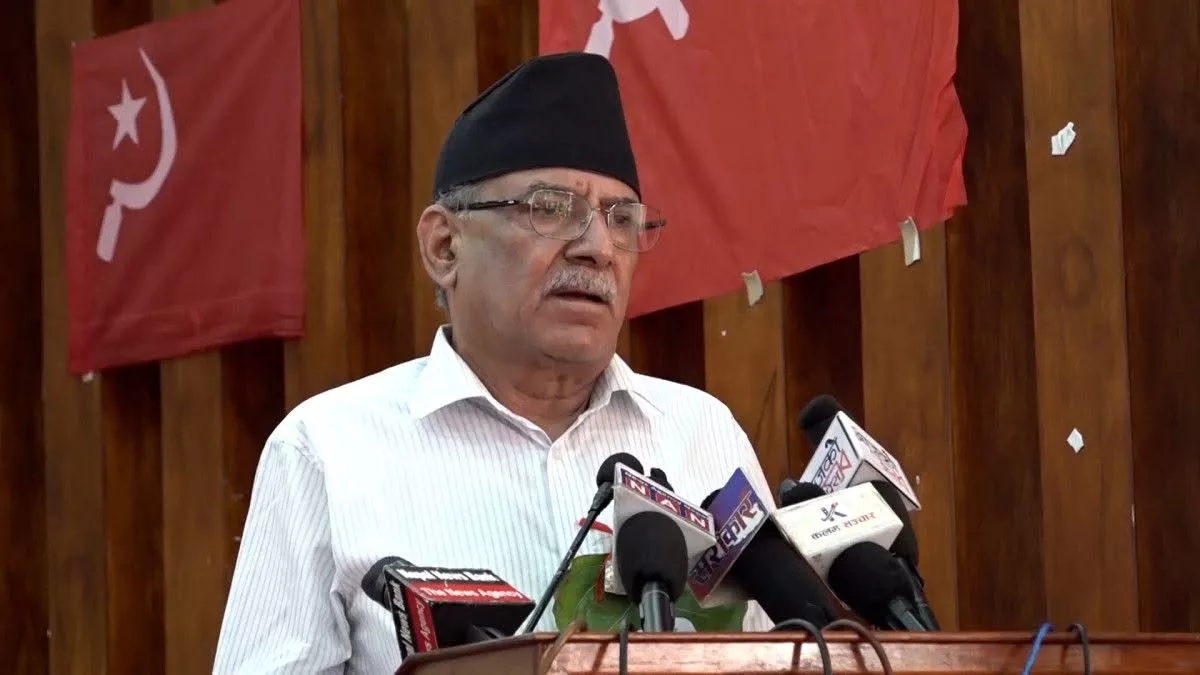
Kathmandu, — Communist Party of Nepal (CPN) Chairman Pushpa Kamal Dahal ‘Prachanda’ on Friday launched a blistering attack against what he called “imperialist American stooges,” accusing them of orchestrating a deliberate campaign to erase the historical contributions of Nepal’s old political parties and established leaders. Addressing a full meeting of the central committee of the All Nepal Peasants’ Federation held in Kathmandu, Prachanda expressed anger over a growing narrative, amplified on social media, that the major parties and their senior leaders had done nothing in 35 years and had only spoiled the country. The former prime minister described the narrative as a form of manipulation and conspiracy aimed at misleading the public and rewriting the modern political history of Nepal. Without naming specific individuals or organizations, Prachanda suggested that external forces with imperialist agendas were using digital platforms to control public perception and undermine faith in the leadership that steered Nepal through democratic movements, the peace process, and major national development projects. He objected strongly to the idea that wrong and distorted opinions about old parties and leaders were being created through social media algorithms, alleging that a well-coordinated conspiracy was in motion to make the current generation believe that the older generation of politicians had delivered nothing but failure.
Prachanda’s remarks highlight a growing frustration among senior political figures who feel that their legacies are being reduced by viral campaigns and populist anti-establishment sentiment, especially among younger voters who have grown up in an era of social media. “Currently, imperialist American stooges are saying that old parties and leaders have done nothing in 35 years, creating a narrative that they only spoiled everything,” he said at the Peasants’ Federation meeting. He added, with a clear sense of indignation, “Through algorithms, such manipulation and conspiracy have been done in the minds of the people that it seems we haven’t done a single good deed.” For Prachanda, this is not merely an attack on his own record but an attempt to erase the collective achievements of the political forces that led Nepal’s major transformations, from the restoration of democracy to the abolition of monarchy, the signing of the Comprehensive Peace Accord, and the drafting of a new constitution through a constituent assembly. In his view, the narrative that “old parties have done nothing” is ahistorical and dangerous, because it encourages public amnesia and makes it easier for undemocratic forces, including foreign-backed elements, to discredit the very institutions and leaders that won Nepal its political freedoms. He warned party workers and sympathetic organizations to be wary of such deceptive narratives and to counter them with facts and evidence drawn from the real contributions of past governments and mass movements.
In defending the record of the old political leadership, Prachanda turned specifically to major infrastructure projects that have become central to Nepal’s national pride and regional connectivity. “Who made the decision to construct the Mid-Hilly Highway? Who decided to build the North-South Corridor? Who initiated the construction of the Madan Bhandari Highway? Who advanced the work on the Hulasi Highway in the Terai?” he asked, suggesting that these transformative projects were all products of decisions made under governments led by established parties and leaders. The Mid-Hilly Highway, also known as the Pushpalal Highway, is a strategic east-west road through the hilly region that is intended to connect remote districts and improve access to markets, health facilities, and educational opportunities for millions of people living outside the plains and capital. The North-South Corridor, meanwhile, is a set of arterial roads designed to link Nepal’s southern border with China’s Tibet Autonomous Region in the north, potentially opening trans-Himalayan trade and transit routes and reducing Nepal’s historical dependence on Indian transit. Madan Bhandari Highway, named after a revered communist leader, is another major mountain roads initiative, connecting the eastern region to Kathmandu and beyond. Hulasi Highway in the Terai is crucial for the densely populated lowland region, where agricultural productivity and commercial movement depend heavily on reliable road connectivity. By invoking these projects, Prachanda sought to remind his audience that the highways and roads Nepalis now use were not gifts of external forces or products of spontaneous market development; they were planned and pushed forward through the political will of established leaders who often had to make difficult decisions in resource-scarce and politically volatile environments.
Dahal then turned to the energy sector, which he described as one of the clearest examples of old leadership delivering tangible national benefits. Speaking about achievements in energy, he said, “Earlier, a comrade said we did nothing in energy. Who said that energy is a great asset for us and that an energy revolution must be carried out within the country? Not only the concept of exporting 10,000 megawatts of electricity, but who ended load shedding in Nepal?” This assertion carries particular weight in a country that suffered for years under chronic power cuts of up to 16 hours a day, crippling industries, hospitals, schools, and ordinary household life. The end of load shedding in 2016 was widely celebrated as a major national milestone. Prachanda took credit for the broader vision of making Nepal an electricity exporter, a vision that has led to the construction of large-scale hydropower projects and cross-border transmission lines with India. He emphasized that the idea of an “energy revolution” inside Nepal was not a recent invention but was conceptualized during the tenure of old political leadership, and he called for accelerating the pace of hydropower development as a matter of national priority. In his view, Nepal’s energy potential — estimated at over 80,000 megawatts economically feasible — is a strategic asset that could transform the country from a net importer of electricity to a net exporter, generating revenue, creating jobs, and reducing foreign dependency. He dismissed those who accuse old parties of failing in energy by arguing that without the foundational decisions made by those leaders, Nepal would still be suffering from darkness and industrial stagnation. The demand for an energy revolution, he insisted, is not merely a development slogan but a patriotic necessity.
Beyond infrastructure and energy, Chairman Dahal instructed the leaders and cadres of the Peasants’ Federation to go to the grassroots and publicize the positive work that has been done over the past three and a half decades. He emphasized that the contributions of old and established political parties should not be ignored, and that Nepal’s path forward requires acknowledging the past as a foundation for future progress. His instruction to cadres is significant in the context of an increasingly digital and youth-dominated public sphere, where traditional party structures and old forms of political communication are losing ground. By directing the peasant organization to spread the message, Prachanda is attempting to rebuild a base of support for the legacy of the old leadership among one of the most organized sectors of Nepali society. The All Nepal Peasants’ Federation is a mass organization with deep roots in rural areas, where issues of land rights, agricultural subsidies, irrigation, and rural infrastructure remain urgent. Prachanda’s choice of this platform is deliberate: peasants are among the groups most directly affected by development projects such as highways and electricity, yet they are also vulnerable to anti-party narratives. He urged them to act as custodians of the truth about Nepal’s modern political achievements and to push back against the idea that everything has failed. In doing so, he acknowledged that public memory is a field of contestation, and that unless positive achievements are continuously documented and communicated, they can be easily forgotten or distorted. His remarks suggest a new political strategy: instead of accepting the narrative that old parties are irrelevant, he wants his cadre to go on the offensive, carrying the message that Nepal’s current democratic gains and development ambitions are built on the sacrifices and decisions of the past.
The political significance of Prachanda’s speech extends far beyond the meeting room. It comes at a time when Nepal is experiencing political turbulence and generational change, with new movements and social media influencers sometimes presenting all traditional parties as corrupt and ineffective. There has been a growth in anti-political sentiment, with many young people expressing distrust toward established parties and demanding systemic change. Critics, however, are divided on his claims. Some political observers note that Prachanda himself has been in power multiple times since 2008, including as prime minister, and therefore cannot simply blame external forces or social media algorithms for the public’s dissatisfaction. They point to unresolved problems such as corruption, unemployment, poverty, and political instability as factors that drive disillusionment. Others argue that his emphasis on “imperialist American stooges” is an attempt to deflect criticism of the domestic political class by creating an external enemy, a familiar tactic in Nepali politics. Nevertheless, his speech raises legitimate questions about historical memory and how a country assesses the contributions of its leaders. The infrastructure and energy projects he mentioned are real and visible, and many were indeed initiated or advanced under the leadership of older parties. Whether they were implemented efficiently or equitably is a separate debate. By speaking out, Prachanda is seeking to reclaim a narrative at a time when social media algorithms often reward sensational negativity over complex historical truth. Whether his message will gain traction with ordinary Nepalis remains to be seen, but his words serve as a reminder that the battle over Nepal’s past is also a battle over its future. For the old parties and leaders, the challenge is not only to defend their record but to translate past achievements into a compelling vision for the coming decades, especially in a world where digital communication has become the primary arena for shaping public opinion.