


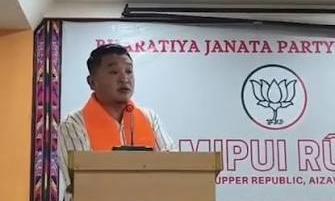
In a fervent rebuttal to mounting clerical opposition, the Bharatiya Janata Party (BJP) in Mizoram has launched a scathing attack on certain church leaders, accusing them of deliberately distorting facts and spreading “incorrect” information regarding the proposed amendments to the Foreign Contribution (Regulation) Act (FCRA). Addressing a state press conference, senior party leader and state general secretary Delson Notlia sought to counter the narrative that has been gaining traction across the Christian-majority state, urging the public to see through what he described as a campaign of misinformation and fear. The counter-offensive comes amid a crescendo of protests from various civil society and religious organizations, which have expressed alarm over specific provisions of the Bill, demanding that the central government retract or substantially revise the proposed legislation to protect the operational autonomy of religious institutions. The BJP’s response signals a major public relations battle over the exact wording and intent of the legislative changes.
The controversy centers on the Foreign Contribution (Regulation) Amendment Bill, which was introduced in the Lok Sabha on March 25 with the stated objective of tightening the legal framework governing foreign funding. Notlia explained that the bill was primarily introduced to ensure greater transparency, enhance parliamentary scrutiny over the inflow of overseas money, and, crucially, to prevent the diversion of foreign contributions for activities that could be deemed detrimental to the nation’s security and sovereignty. However, it is Section 16A of the proposed bill that has ignited a political and religious firestorm. This specific provision deals with the post-cancellation of registration and empowers designated authorities to seize and dispose of properties and assets acquired using FCRA funds, a clause that many Christian organizations fear could lead to government overreach and the arbitrary confiscation of church property, including schools, hospitals, and churches, should any registration irregularities emerge. The interpretation of this clause has become the primary point of dispute, with the state BJP leadership categorically rejecting the “apocalyptic” interpretation being given to it by its critics.
Attempting to allay the concerns, Notlia provided a detailed account of the series of high-level meetings between Christian leaders and Union government officials, highlighting what he claimed was a spirit of accommodation from the central government. He pointed to a pivotal representation submitted by the Mizoram BJP president, K Beichhua, to Union Home Minister Amit Shah on July 13. According to the state BJP leader, Home Minister Shah gave personal assurances during these discussions that the proposed changes were far from being a targeted attack on the Christian community or any other minority group. Instead, Shah framed the amendments as crucial administrative safeguards intended to fortify the legal provisions against the misuse of funds under the guise of charity or religious activity. The narrative being pushed by the saffron party indicates that the central government is entirely focused on tightening national security and ensuring that no foreign funding is used for anti-national elements, emphasizing that the rule of law and constitutional remedies will always prevail.
In a bid to counter the allegations of institutional targeting, the BJP also divulged dialogue regarding financial data. Notlia claimed that Shah provided figures showing that India received nearly ₹17,000 crore in foreign contributions in the recent fiscal year (2025-26), of which Christian organizations accounted for roughly ₹3,000 crore, representing less than 15 percent of the total intake. This data point was highlighted to illustrate that the government does not view Christian-led charities as a hostile entity or a threat, but rather as significant stakeholders in the country’s development. The state BJP unit insisted that this clearly proves the government views these organisations as partners in progress, not the enemy within. They maintained that the government is committed to a free and fair working relationship that prioritizes national interest, implying that the protests are based on a misreading of the government’s monetary oversight duties rather than any intention to nationalize church assets.
The narrative took a decidedly conciliatory turn when Notlia addressed the meeting between Mizoram Chief Minister Lalduhoma, various church leaders from the state, and Home Minister Shah on August 6. During this high-stakes meeting, the primary concern regarding the seizure of property was placed firmly on the table. In what appears to be a significant concession, Shah assured the delegation that the proposed amendments would not have retrospective effect. The Home Minister reportedly clarified that any cancellation of FCRA registrations that occurred before the bill becomes an act would not be subjected to punitive seizure actions retroactively. By making this pledge, the central government is attempting to signal its willingness to protect the long-standing land rights and assets of the church, which is a massive economic player in the region, while still maintaining its authority to deal with future violations. For the Mizoram BJP, this concession is proof positive that the church’s fears are unfounded, framing the government as responsive and willing to listen to reasoned debate.
Despite these alleged reassurances, the inherent tension remains palpable. The state BJP unit turned to fierce criticism of the organizers of an anti-FCRA rally held in Aizawl on August 11, accusing them of fear-mongering. The party took particular umbrage at claims made by Council of Churches in Mizoram (CCM) president Rev. Dr. R. Lalbiakliana among others, who suggested that the Central Government could seize churches, educational institutions, vehicles, and ambulances built with local funds merely because a now-cancelled FCRA registration was involved. Notlia rebuked the church leadership for conflating local and foreign funds and pushing a “baseless” narrative that the government would be empowered to “take over” property belonging to the church. “There is no such provision in the Bill,” he asserted, calling the claims “misleading and quite unfortunate.” The BJP’s position insists that the church is spreading hysteria to galvanize its support base against a piece of legislation that will simply streamline financial reporting and anti-terror financing mechanisms.
Finally, as the Foreign Contribution (Regulation) Amendment Bill heads to a Joint Parliamentary Committee (JPC) for further deliberation, the political posturing has intensified. The BJP accused the Congress party of exploiting the issue for short-term political gain by “taking the church leaders for a ride” and attempting to drag them into the quagmbre of partisan politics. By framing the protests as a manufactured controversy, the BJP is attempting to solidify its position with the electorate ahead of the upcoming assembly elections in the state. The state unit argued that the Congress party, which has been attempting a resurgence in the Christian-dominated state, has no real interest in the welfare of the Mizo people, viewing the crisis as nothing more than a chance to undermine the incumbent government. As the JPC deliberates, the debate now hinges on whether the center’s reassurances and clarifications can assuage the deep-seated distrust among civil society in the Northeast, or whether the Bill will continue to be viewed as a discriminatory piece of legislation.