








Paragraph 1: The Mistrial Verdict and the Case’s Devastating Core
The legal saga surrounding the tragic deaths of three young children in Duxbury, Massachusetts, reached a pivotal and unresolved juncture last week when a Plymouth Superior Court judge declared a mistrial in the murder case against Lindsay Clancy. The jury, after extensive deliberation, was unable to reach a unanimous verdict on whether the 35-year-old former nurse was criminally responsible for the strangulation deaths of her three children—5-year-old Cora, 3-year-old Dawson, and 8-month-old Callan—in January 2023. The mistrial leaves an agonizing vacuum for all parties involved: for the prosecution, which had sought first-degree murder convictions carrying a mandatory sentence of life in prison without parole; for the defense, which had mounted a vigorous mental health defense centered on severe postpartum psychosis; and most profoundly, for the surviving family members, particularly Patrick Clancy, the father of the slain children and Lindsay’s ex-husband. The core dispute that so bitterly divided the jury was the question of intent and capacity. Prosecutors argued that Clancy acted with deliberate premeditation, meticulously planning the killings and understanding the moral and legal wrongfulness of her actions, pointing to her background as a skilled labor and delivery nurse who had access to medical knowledge. Conversely, defense attorneys presented a compelling and heartbreaking narrative of a woman overwhelmed by a catastrophic psychiatric emergency, arguing that postpartum psychosis—a rare but brutally debilitating condition—had rendered her incapable of controlling her behavior or comprehending the reality of her actions. This fundamental disagreement over her mental state at the precise moment of the tragedy prevented a definitive resolution, forcing the court to declare a mistrial and leaving the door open for prosecutors to retry the case in the future.
Paragraph 2: Patrick Clancy’s Legal Warning Against Defamation
In the immediate aftermath of the mistrial, the focus shifted dramatically from the courtroom to the digital landscape, as Patrick Clancy, through his attorney Howard Cooper of the Boston-based Todd and Weld law firm, issued a stark and unambiguous warning of impending legal action. Cooper released a statement on his client’s behalf detailing an “escalating campaign of misinformation and defamation” that has besieged Patrick and his family, a campaign that has allegedly evolved from online gossip into a real-world threat to his personal safety, professional livelihood, and reputation. The statement is unequivocal in its condemnation of these actions, asserting that the spread of “blatant and baseless falsehoods must stop.” Cooper emphasized that every appropriate legal measure will be taken to hold those responsible accountable, even going so far as to reveal that law enforcement has been formally notified of the threats Patrick has received. The severity of the language—mentioning threats to his “life”—indicates that this is far beyond mere cyberbullying or negative commentary. It suggests a coordinated effort by certain individuals or groups to paint Patrick in a sinister light, potentially fueling a dangerous narrative where he is cast as a villain in the tragedy. This preemptive legal posture signals that Patrick is no longer willing to tolerate the relentless online abuse that has likely compounded his unimaginable grief, choosing instead to draw a hard line between public discourse and actionable defamation.
Paragraph 3: Targeting Social Media Influencers and Conspiracy Theorists
Attorney Cooper’s statement directly and pointedly implicates specific actors in this toxic ecosystem: “minor celebrities, social media influencers, and conspiracy theorists.” The phrasing is deliberate, targeting those who have seemingly co-opted this tragedy to amplify their own profiles, generate engagement, or achieve financial profit. In the age of true crime content, where platforms like TikTok, YouTube, and X (formerly Twitter) reward sensationalism, the Clancy case provides fertile ground for rampant speculation. Conspiracy theories have likely flourished, positing alternative narratives that absolve Lindsay of responsibility entirely, suggesting instead that Patrick was the architect of the crime or that external forces were involved—theories completely unsupported by the substantial evidence presented during the trial. These baseless assertions, amplified by influencers seeking viral hits, have morphed into a destructive campaign that labels Patrick as a murderer, an abuser, or a manipulative figure. Cooper’s frustration is palpable; he argues that these individuals are acting in “self-serving” manners, prioritizing clicks, sponsorships, and follower counts over the devastating reality of three dead children. By explicitly naming these groups, Patrick is drawing a legal boundary, putting them on notice that their speculative content crosses the line from protected free speech into actionable defamation, especially when it jeopardizes his physical safety by inciting harassment or vigilante behavior from their audiences.
Paragraph 4: The Trial’s Core Legal Battle and the National Spotlight on Mental Health
The mistrial was the culmination of a trial that captivated the nation, serving as a grim spotlight on the intersection of criminal law, motherhood, and psychiatric medicine. The prosecution’s case rested heavily on the timeline of events and Clancy’s demeanor following the killings. They presented evidence that she had researched methods of killing and had written journal entries suggesting a struggle with her mental state but also pointing to moments of lucidity and deliberate planning. They argued that she understood her actions were wrong, meeting the legal standard for criminal responsibility under Massachusetts law, which requires that a defendant be able to appreciate the wrongfulness of their conduct and conform their behavior to the requirements of the law. Conversely, the defense enlisted top psychiatric experts who testified that Clancy was in the throes of a severe psychotic episode, likely triggered by perinatal depression, sleep deprivation, and the pressures of caring for three young children. They described a woman who believed she was saving her children from a worse fate, experiencing delusions and hallucinations that distorted her perception of reality. The case catalyzed a profound national conversation about the serious gaps in maternal mental healthcare, highlighting how postpartum disorders are often underdiagnosed, underfunded, and overshadowed by the idealized image of new motherhood. The trial forced society to confront the terrifying reality that severe psychiatric distress can strike suddenly and violently, and that the legal system’s binary criteria for sanity often fail to capture the complex subtleties of such cases. This unresolved tension—legal accountability versus medical incapacity—was precisely what left the jury deadlocked at the close of the trial.
Paragraph 5: Patrick Clancy’s Perspective: Grief, Testimony, and a Mission of Advocacy
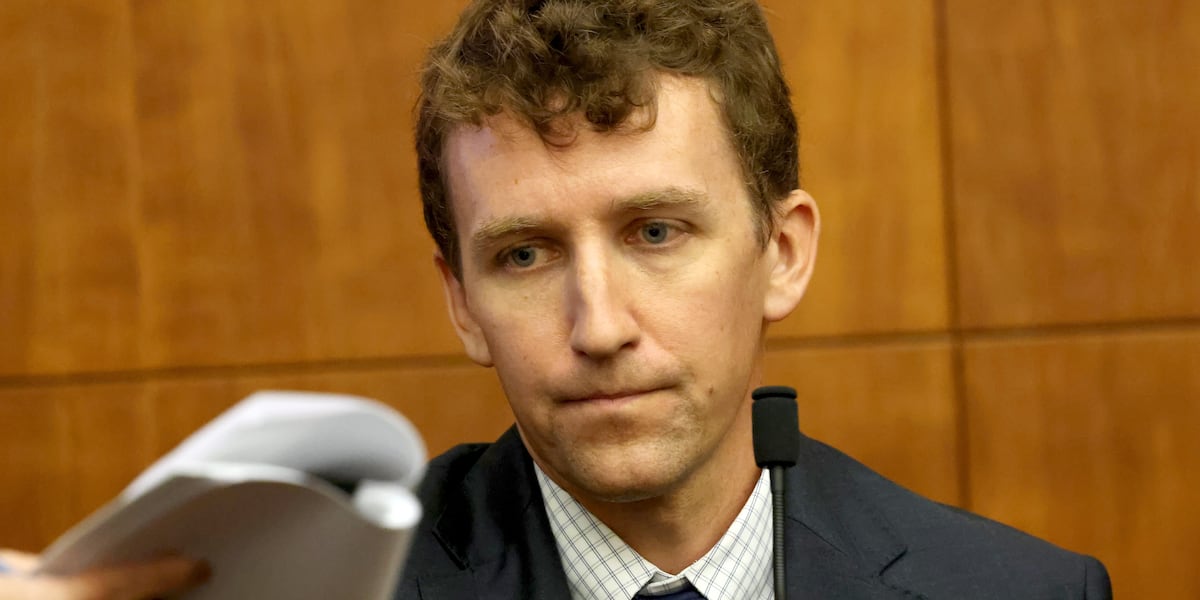
In the midst of the legal and online turmoil, Patrick Clancy’s voice remains a somber pillar of humanity. He took the witness stand during the trial, delivering a harrowing testimony that detailed his discovery of the children and his attempts to understand his wife’s actions. The image of him on the stand, as captured by pool photographers, underscores the profound personal cost of this public proceeding. His testimony was not just about the facts of the day, but about the love he had for his children and his enduring struggle with the duality of his wife—the loving mother he knew and the person who committed the unthinkable act. His attorney’s statement clarifies that his ultimate goal is not personal retribution or engagement in a public war of words, but rather “preserving the memory of Cora, Dawson and Callan Clancy.” This is the foundational motivation behind his legal warning. By attempting to silence the defamation, Patrick aims to reclaim the narrative from sensationalized fiction and return it to the sobering truth of their lives and deaths. Furthermore, he has consistently expressed a desire to support other women facing perinatal mental health challenges, turning his personal tragedy into a potential lifeline for other families. He wants to channel public energy toward improving screening, treatment, and support for maternal mental illness, ensuring that other children are not lost to this silent crisis. His legal actions are thus framed not merely as defensive measures against online trolls, but as a strategic move to clear the path for ongoing advocacy, free from the distraction of malicious lies.
Paragraph 6: Legal Prognosis, Societal Consequences, and an Unresolved Future
The mistrial now leaves the case in a precarious state, with the Commonwealth of Massachusetts holding the prerogative to retry Lindsay Clancy. Prosecutors have not indicated whether they will proceed, but given the severity of the charges, a retrial is a likely possibility, meaning the families and the public may face another grueling, emotionally devastating court proceeding. For Patrick Clancy, the threat of another trial is compounded by the immediate need to address the defamation campaign. Legal experts note that while defamation lawsuits against social media personalities are challenging to pursue due to the high burden of proof for actual malice and the protections of anti-SLAPP statutes, the notification of law enforcement indicates that the threats have crossed criminal territory, likely involving harassment, doxxing, or threats of physical violence. Those involved in spreading falsehoods may now face more than just a cease-and-desist letter; they could face criminal charges. Beyond the legal machinations, this case stands as a poignant symbol of the failures of the mental health system, the brutal limits of criminal justice in the face of psychiatric catastrophe, and the pervasive toxicity of online culture that thrives on real human suffering. The mistrial itself is a verdict of ambiguity—it acknowledges that neither side fully convinced the jury of the absolute truth of their narrative. As the world moves on to other stories, the Clancy family remains anchored in a devastating reality: three children are dead, a mother is institutionalized, and a father must now fight for his name and safety in a digital arena that shows no mercy. The ultimate legal outcome remains unwritten, but the underlying tragedy—and the imperative to address maternal mental health—will resonate far beyond the confines of the Plymouth courthouse.


