









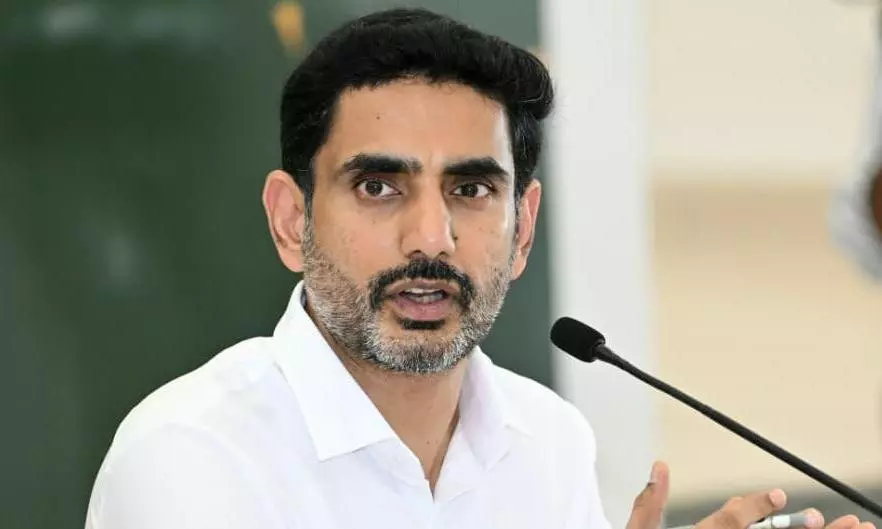
Amaravati: Andhra Pradesh IT Minister Nara Lokesh on Wednesday strongly defended the state government’s decision to establish data centres in Visakhapatnam, dismissing what he described as deliberate misinformation over their environmental and water requirements. Replying to a question in the Legislative Assembly, Lokesh said the government was fully aware of the concerns surrounding large-scale digital infrastructure but insisted that the benefits of the data-centre ecosystem far outweigh the challenges. He pointed to Google’s decision to invest in Visakhapatnam as a turning point that had triggered wider interest from other IT companies, and said the city was now poised to become a key destination in India’s rapidly expanding digital infrastructure landscape. The Minister’s remarks came amid growing public debate over the establishment of data centres in the port city, with critics questioning their water consumption, energy use and environmental footprint. Lokesh, however, argued that much of the criticism was based on incomplete information and failed to take into account technological advances in cooling systems, the state government’s careful planning, and the broader strategic importance of data centres in an increasingly digital and data-driven world. He also sought to reassure residents that the water needs of data centres would not come at the expense of Visakhapatnam’s domestic water supply, a central concern in the coastal city. The government, he said, had adopted a transparent and measured approach, with clear caps on capacity and a firm commitment to prioritise environmentally responsible companies.
Lokesh said data centres are not merely commercial infrastructure but critical to the AI-driven digital economy and India’s data sovereignty, particularly amid emerging geo-political challenges. He explained that as more countries assert control over their citizens’ data and as global technology supply chains become increasingly contested, India must build its own robust digital infrastructure to ensure that data generated within the country is stored, processed and secured domestically. Data centres, he said, form the backbone of cloud computing, artificial intelligence, financial technology, e-governance, telemedicine, digital education and countless other services that have become essential to modern life. The Minister noted that the demand for data storage and processing capacity in India has grown exponentially, driven by the rapid adoption of smartphones, digital payments, online commerce, 5G networks and the expansion of the Internet of Things. In this context, he said, Visakhapatnam’s emergence as a data-centre hub would not only attract investment and create jobs but also strengthen the country’s digital self-reliance. He described the state government’s decision as forward-looking and strategically important, and said the target of 6.5 GW of data-centre capacity had been set by Chief Minister N Chandrababu Naidu as a clear ceiling. According to Lokesh, that target has now been fully achieved, with allocations made to companies that will build and operate the facilities. The government, he said, would prioritise companies that demonstrate strong environmental responsibility, ensuring that growth in the sector does not come at the cost of the region’s ecological balance.
On the contentious issue of water consumption, Lokesh provided detailed figures to counter what he described as misleading narratives. He said that once the proposed data-centre ecosystem reaches its targeted capacity of 6.5 GW, it is estimated to require around 3 TMC of water annually, based on current technology. TMC, or thousand million cubic feet, is a standard unit used to measure large-scale water volumes in India, particularly in the context of irrigation and drinking-water projects. The Minister acknowledged that this is a significant amount, but stressed that newer cooling technologies are expected to reduce water consumption further as the industry evolves. He pointed out that data centres use water primarily for cooling, and that innovations such as liquid cooling, closed-loop systems, AI-driven energy management and advanced water recycling are already making modern facilities far more efficient than older designs. Lokesh also sought to put the figure in perspective by comparing it with other industrial uses. A 1 GW thermal power plant, he said, consumes nearly ten times more water annually than a data centre of comparable capacity. He questioned why protests over water usage were focused only on data centres when far more water-intensive industries have operated in the state for decades without similar scrutiny. The Minister argued that this selective criticism was unfair and ignored the government’s efforts to ensure that data centres use water sustainably and responsibly. He also noted that the data-centre industry itself has a strong financial incentive to reduce water and energy use, as operational costs are directly affected by resource consumption, and that global investors increasingly demand high environmental standards.
Lokesh went on to clarify the source of water for the proposed data centres, seeking to allay fears that they would compete with the city’s residents for scarce drinking water. He said the water required for data centres would come from the industrial allocation of the Polavaram Project, a major multi-purpose irrigation and drinking-water scheme being developed on the Godavari River. This allocation, he explained, is specifically earmarked for industrial use and would not divert water meant for Visakhapatnam’s domestic needs. The Minister also announced that the state government is committed to supplying Visakhapatnam’s urban water requirements through the Polavaram Project, with gravity-based supply expected to become operational within 18 months. Dedicated pipelines would be provided for data centres, ensuring that their water supply is separate from the city’s drinking-water network. This arrangement, he said, would provide a reliable and dedicated source of water for the data-centre ecosystem without putting additional pressure on the city’s existing water infrastructure. The Polavaram Project, once completed, is expected to transform water availability across Andhra Pradesh, and the government has consistently maintained that its benefits will be distributed equitably between domestic, agricultural and industrial users. By tying data-centre water supply to the industrial allocation, the state government hopes to avoid the kind of water conflicts that have plagued industrial development in other parts of India. The Minister also stressed that the government is not giving blanket approvals and will carefully evaluate each proposed facility, with particular attention to environmental impact, water efficiency and sustainability practices.
The Minister’s defence of the data-centre policy also touched on the broader question of environmental responsibility and the future of Visakhapatnam as a technology hub. He said the government was not giving blanket approvals and would carefully evaluate each proposed facility, with particular attention to environmental impact, water efficiency and sustainability practices. Companies that demonstrate strong environmental responsibility, he said, would be given priority in the allocation process. This includes commitments to use renewable energy, adopt water-saving cooling technologies, treat and recycle wastewater, and implement measures to minimise the carbon footprint of their operations. Lokesh said the government’s approach was consistent with global best practices, where data-centre operators are increasingly expected to meet stringent environmental standards. He also noted that the data-centre industry itself has a strong incentive to reduce water and energy use, as operational costs are directly affected by resource consumption. The Minister expressed confidence that Visakhapatnam’s data-centre ecosystem would become a model for sustainable digital infrastructure in India. He said the government would continue to engage with local communities, environmental groups and industry stakeholders to address concerns and ensure that the benefits of the digital economy are shared widely. He reiterated that the 6.5 GW ceiling set by the Chief Minister was not just a cap on capacity but also a commitment to planned, orderly and sustainable growth. The Minister also highlighted the ripple effects of Google’s investment, which has already generated significant interest from other global technology companies, and said the state cannot afford to miss out on the data-centre revolution.
In conclusion, Lokesh said the establishment of data centres in Visakhapatnam is a crucial step in Andhra Pradesh’s journey towards becoming a leading digital economy hub. He argued that the state cannot afford to miss out on the data-centre revolution, especially as India seeks to position itself as a trusted destination for data storage and processing in a world marked by geopolitical uncertainty and growing demands for data localisation. He acknowledged that legitimate questions about environmental impact and water usage deserve serious answers, but insisted that the government’s policy is based on facts, careful planning and a clear vision for the future. He called on all stakeholders to avoid spreading misinformation and to work together to ensure that Visakhapatnam’s development is both economically vibrant and environmentally sustainable. The government, he said, remains committed to transparency and will continue to provide accurate information about the data-centre projects. With the 6.5 GW target fully allocated, the focus now shifts to implementation, monitoring and the development of supporting infrastructure such as power, connectivity, water pipelines and skilled manpower. If executed as planned, the data-centre ecosystem could transform Visakhapatnam into a major node in India’s digital map, creating thousands of direct and indirect jobs, attracting ancillary industries, boosting the local economy and strengthening the country’s data sovereignty. At the same time, the government’s emphasis on environmental responsibility and its commitment to protecting the city’s water supply will be critical to maintaining public trust and ensuring that the benefits of this new industry are enjoyed by all sections of society.


