


Paragraph 1: The Viral Statistic That Wasn’t True
In her acclaimed 2025 New York Times bestseller “Empire of AI,” award-winning journalist Karen Hao brought to light a startling statistic that quickly became a rallying cry for environmentalists worldwide. The claim was that a proposed data center in a small Chilean town would consume over 1,000 times the amount of water required to sustain the town’s entire population. The figure was shocking, visceral, and seemingly damning evidence of the unchecked environmental rapacity of the artificial intelligence industry. Activists and concerned citizens latched onto the number, using it to fuel protests and demand immediate regulatory action against tech giants. However, the narrative took a dramatic and humbling turn when a meticulous review uncovered a fundamental unit error in the calculation. The confusion between liters per second and cubic meters per hour had inflated the projected water usage by a factor of 1,000. The corrected statistic, while still significant, painted a far less apocalyptic picture. This incident serves as a powerful and cautionary tale about the fragility of data in the digital age, particularly when it comes to the highly charged and often misunderstood topic of AI’s environmental footprint. It underscores a critical problem: in the rush to hold powerful technology accountable, the public, the media, and even well-intentioned researchers can fall prey to misinformation that, while emotionally resonant, is factually flawed. This single error, which went viral before being debunked, perfectly encapsulates the broader issue plaguing the discourse surrounding AI’s water consumption—a discourse that is increasingly characterized by exaggeration, oversimplification, and a dangerous diversion from the industry’s genuine and pressing risks.
Paragraph 2: The Exaggeration Epidemic and Misleading Metrics
As artificial intelligence becomes seamlessly embedded into the fabric of modern life—powering search engines, navigating our cars, and driving the apps on our smartphones—its presence has ignited a firestorm of public concern. Many of these anxieties are entirely justified, ranging from the specter of mass job displacement to the staggering electricity demands of massive data centers, and even the existential dread of a superintelligent AI leading to human extinction. Yet, amidst these legitimate fears, one of the most frequently cited complaints—the supposedly exorbitant water usage of AI—has been grossly exaggerated and dangerously oversimplified. This distortion is not accidental; it is actively fueled by a cacophony of political spam emails, sensationalist celebrity posts, and viral headlines on social media platforms. These overblown claims do more than just misinform; they actively distract from the reasonable and nuanced debates that society desperately needs to have about AI’s future. The data on AI water usage is, admittedly, murky and highly variable. A 2026 Forbes article cited a study estimating that a single query to ChatGPT-4 consumes anywhere from two milliliters to 150 milliliters of water—a range that spans from a few drops to about 30% of a standard water bottle, depending on factors like prompt length and server location. Conversely, a 2024 Washington Post article made the alarming claim that a single 100-word prompt uses 519 milliliters, or slightly more than a standard water bottle. While these estimates differ by over an order of magnitude, they both attempt to illustrate the scale of the issue using the accessible metric of “water bottles per prompt.” However, this comparison is fundamentally misleading. Direct human water consumption—drinking and cooking—constitutes a negligible fraction of an individual’s total water footprint, which is overwhelmingly dominated by the food we eat, the clothes we wear, and the energy we consume. To put this into stark perspective, producing a single hamburger requires approximately 660 gallons of water, equivalent to 5,000 standard water bottles. Similarly, manufacturing one cotton t-shirt demands the same 660 gallons. Therefore, even using the Washington Post’s higher estimate, asking ChatGPT a question every single day for the next twelve years would result in a smaller water footprint than eating just one hamburger.
Paragraph 3: Industrial Scale Comparison and Methodological Flaws
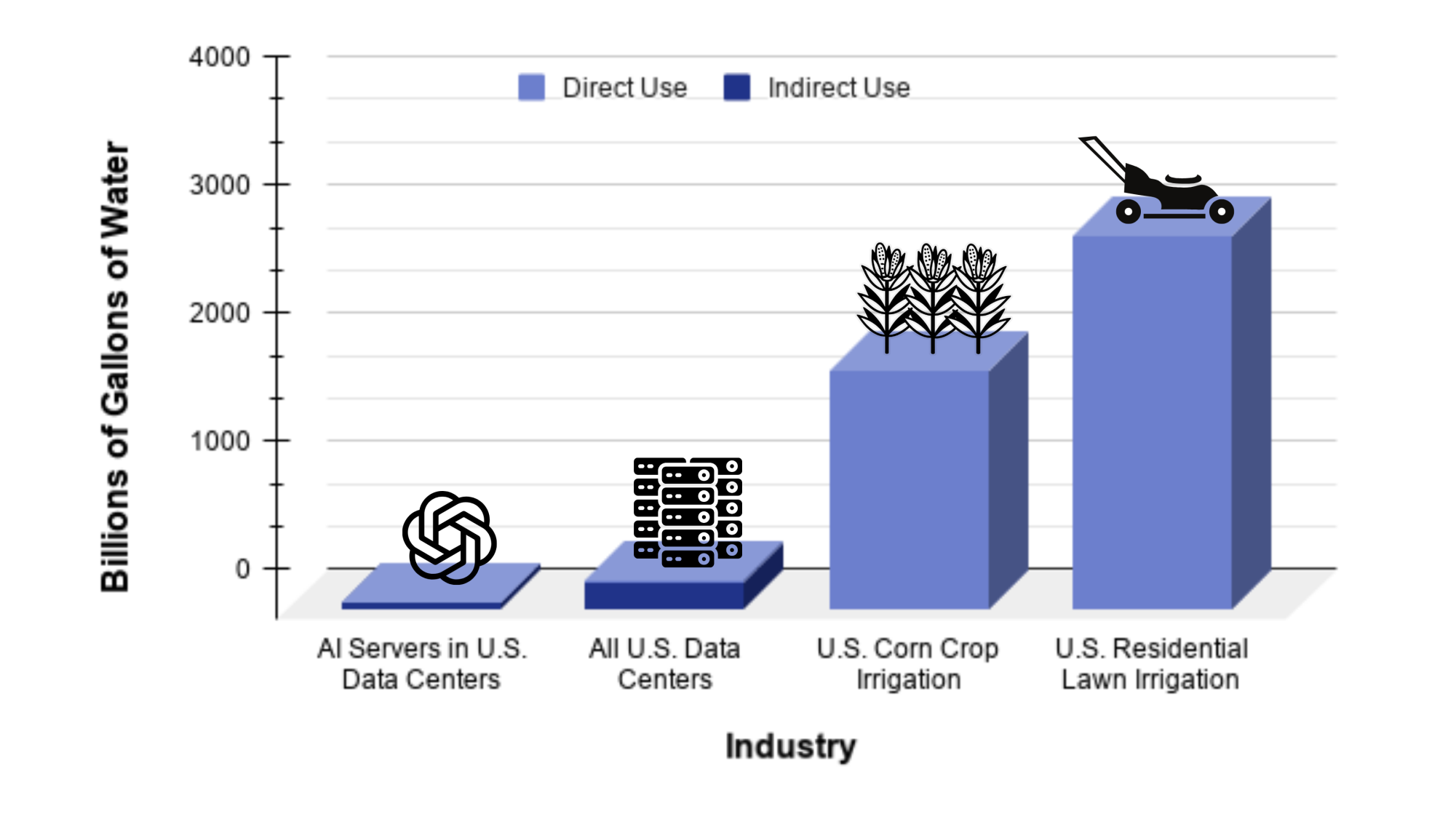
Even when scaling the analysis to the industrial level, AI’s water consumption does not hold a candle to a host of other major industries that are largely taken for granted. According to a 2026 CBS article, residential lawn irrigation in the United States alone consumes a staggering 2,900 billion gallons of water annually, while golf course irrigation uses an additional 531 billion gallons (accounting only for direct on-site use). In stark contrast, all U.S. data centers—where AI accounts for roughly 20% of total usage—consumed a total of just 228 billion gallons in 2023. This figure is considerably smaller than the water used to keep American lawns green or golf courses pristine. Delving deeper into that 228 billion gallons reveals an even more nuanced picture. Only 17 billion gallons were consumed directly for on-site cooling purposes. This is primarily due to evaporative cooling, the most common cooling method in data centers, where water absorbs heat from the hot servers and evaporates into the air. Like many processes in agriculture and manufacturing, evaporative cooling is consumptive: after it is used on-site, the water is removed from the local hydrological system. Crucially, data centers opt for water-based cooling over traditional air conditioning not out of negligence, but to minimize their total environmental impact, as air conditioning consumes considerably more electricity, which in turn has its own massive water and carbon footprint. The remaining 211 billion gallons used by all American data centers in 2023 were used indirectly and largely non-consumptively for off-site electricity generation. This is a critical distinction. Water usage for electricity generation is not unique to data centers; the majority of industries indirectly employ vast amounts of water to generate the power they need. However, indirect water usage for electricity generation is frequently excluded from water statistics for many other industries. This methodological inconsistency creates a profoundly misleading comparison when indirect water use is meticulously included for AI but conveniently excluded for agriculture, manufacturing, or other sectors, making AI appear uniquely wasteful when it is, in fact, following standard industrial practices.
Paragraph 4: The Nature of Consumption and Localized Impacts
The distinction between consumptive and non-consumptive water use is vital to understanding the true impact of AI. The 211 billion gallons used indirectly for electricity generation are largely non-consumptive, meaning the water is returned to the environment after passing through power plants, albeit often at a different temperature or location. This is fundamentally different from the 17 billion gallons used in evaporative cooling, which are lost to the atmosphere. However, even this direct consumption pales in comparison to the water lost in agriculture, where irrigation systems evaporate and transpire billions of gallons daily. The localized nature of water stress also complicates the narrative. The Chilean data center example, despite its unit error, highlights that a single facility can have a significant impact on a water-stressed region. But the global narrative of AI “drinking the world’s water” is a gross distortion. The reality is that AI’s water footprint is a fraction of a percent of the total water used in the United States, and it is dwarfed by the water required for corn, beef, nuts, laundry, lawns, cereal, fodder, and golfing. The overemphasis on AI’s water usage is not just a matter of inaccurate statistics; it is a strategic misdirection. By focusing public outrage on a relatively minor environmental impact, activists and sensationalist media are inadvertently shielding the public from the far more consequential and urgent threats posed by AI. The energy consumption of AI, while also often exaggerated, is a more pressing concern, but even that is manageable. The real issues—the potential for widespread labor market disruption, the concentration of power in a few tech monopolies, and the existential risk of creating an uncontrollable superintelligence—are the topics that demand our collective attention and regulatory scrutiny.
Paragraph 5: The Genuine Threats of AI Dwarf Water Concerns
When compared to the water footprint, the other issues surrounding AI are of a completely different magnitude of severity. The labor market impact is immediate and tangible. Predictions indicate that AI is poised to poach 6.1% of American jobs by 2030, a figure that represents millions of displaced workers facing economic ruin and social upheaval. This is a concrete, measurable consequence that requires urgent policy responses, such as robust social safety nets, retraining programs, and a fundamental rethinking of the social contract. In terms of electricity, data centers accounted for 4.4% of total American electricity consumption in 2024. While significant, only about 20% of that is attributable to AI specifically, leaving AI responsible for approximately 0.9% of U.S. electricity consumption—a manageable figure that can be addressed through grid modernization and renewable energy investment. However, the most chilling concern is the possibility of human extinction. A 2023 survey of nearly 3,000 top AI researchers found that the median participant believes there is a 5% chance of AI causing human extinction within the next 100 years. A 5% risk of annihilating the human race is a gamble of astronomical proportions, one that dwarfs any concern about water usage by an incalculable margin. If the anti-AI movement were to center its efforts on these major issues—job displacement, energy grid strain, and existential safety—instead of fixating on exaggerated water usage, legislators and AI companies could focus their resources on addressing these critical concerns. Instead, they are forced to battle public panic over a problem that is, in the grand scheme of things, a rounding error. This misallocation of attention and regulatory bandwidth leaves the United States dangerously ill-equipped to deal with the profound societal transformations that AI will inevitably bring.
Paragraph 6: Conclusion and a Call for Nuanced Debate
At the end of the day, artificial intelligence uses water, just like any other industry. It is a physical reality of running massive computational infrastructure. But the crucial context is that AI uses orders of magnitude less water than many of the other industries we take for granted. The water used to produce a single hamburger or a single cotton t-shirt is equivalent to years of personal AI usage. The water used to irrigate American lawns and golf courses is over ten times the total water used by all data centers in the country. The misinformation surrounding AI’s water usage is not merely a harmless statistical error; it is a dangerous distraction that diverts attention away from the more significant dangers of AI. By allowing viral falsehoods to dominate the public discourse, we are failing to have the honest, nuanced, and difficult conversations that are necessary to govern this transformative technology responsibly. We are arguing about a few billion gallons of water while ignoring the potential loss of millions of jobs and the theoretical, yet terrifying, possibility of human extinction. The path forward requires a commitment to data literacy, a demand for rigorous journalism that checks its sources, and a willingness to prioritize the most critical issues over the most sensational ones. Only by cutting through the noise and focusing on the real challenges—AI safety, labor policy, and energy sustainability—can the United States and the world hope to harness the immense power of artificial intelligence for the benefit of humanity, rather than being paralyzed by exaggerated fears that ultimately serve no one. The water debate is a symptom of a larger failure to engage with technology critically, and it is time to correct course before it is too late.