








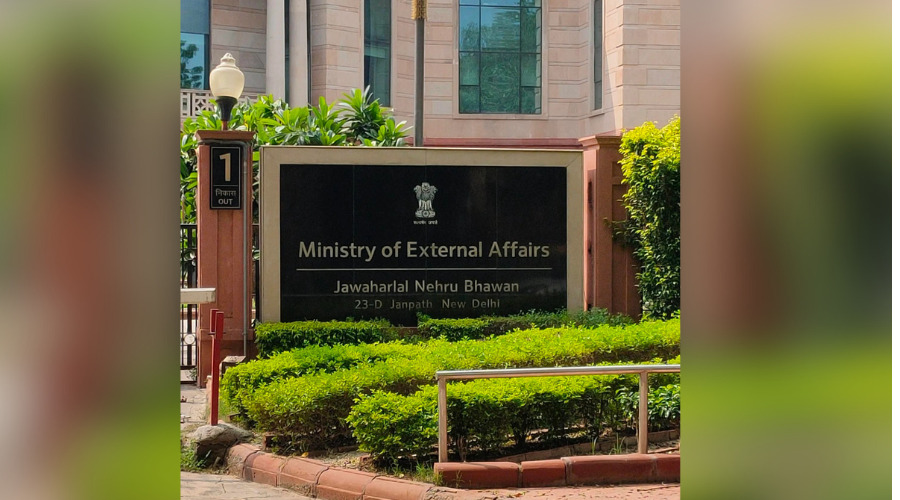
New Delhi, Aug 20: The Ministry of External Affairs (MEA) has established a dedicated institutional mechanism to monitor, analyse and counter anti-India propaganda and narratives in foreign media, including Bangladeshi news media, as well as across social media platforms. The move signals New Delhi’s growing recognition that hostile information campaigns can no longer be ignored in an era where misinformation travels faster than diplomacy. Disclosing this, officials in the MEA said that the External Publicity and Public Diplomacy (XPD) Division has put in place a structured framework to achieve this objective. The disclosure came in response to queries raised by a Parliamentary Committee on External Affairs, which has been examining India’s public diplomacy outreach and the challenges posed by false narratives in the neighbourhood. According to MEA representatives, the division not only tracks negative content but also actively counters it through fact-checking and proactive projection of India’s developmental, democratic and diplomatic successes. The mechanism is particularly significant given the rapid proliferation of digital platforms and the ease with which unverified content crosses national borders. For Assam and the broader Northeast, officials believe, this initiative could be a crucial step in addressing information disorder along the India-Bangladesh frontier. The region has historically been sensitive to cross-border rumours, ethnic polarisation and migration-related fears, and social media has amplified these vulnerabilities. With the Bangladesh border running through densely populated and culturally connected areas, narratives relating to border incidents, migration, minorities, ethnic tensions, trade and regional security quickly spill across boundaries and influence public sentiment on both sides. By creating a system to analyse such narratives in real time, the MEA aims to equip itself with a more coordinated response mechanism, rather than reacting only after a situation spirals out of control.
The MEA’s detailed response to the parliamentary panel makes it clear that the government considers countering disinformation to be an essential component of modern diplomacy. “The Ministry of External Affairs constantly monitors, analyses and counters anti-India propaganda and narratives in foreign media, including Bangladeshi news media, and social media outlets. The XPD Division has a mechanism in place towards achieving this objective,” MEA representatives informed the Parliamentary Committee. They further explained that the division counters fake news and false narratives through its dedicated fact-check unit and pushes out positive stories about India constantly, including through the social media handles of the Ministry, Indian Missions and Posts abroad, and other stakeholders. This dual approach—reactive counter-narratives and proactive positive storytelling—reflects a broader shift in Indian foreign policy. In recent years, the MEA has significantly expanded its digital presence, with ambassadors and high commissioners actively engaging on Twitter, Facebook, Instagram and other platforms. The XPD Division has emerged as the nodal point for this outreach, coordinating with Indian embassies and consulates to ensure that New Delhi’s perspective is represented in global debates. The emphasis on Bangladeshi news media is notable because India and Bangladesh share a complex and deeply intertwined relationship, marked by strong people-to-people ties, economic partnership and shared cultural heritage, but also by periodic friction over issues such as border killings, smuggling, cattle trafficking and alleged anti-India activities. In this environment, a single misleading video or inflammatory headline can cause disproportionate damage to public perception, and the MEA’s new mechanism is designed to limit that damage through rapid response and verified information dissemination.
For Assam and the Northeast, the initiative carries special importance. The region has often been at the receiving end of cross-border misinformation, particularly on topics related to illegal immigration, demographic change, indigenous rights and communal harmony. Social media platforms, including Facebook, WhatsApp, TikTok and YouTube, have become primary sources of news for millions of people in both India and Bangladesh, and their algorithmic amplification of outrage makes them fertile ground for false narratives. The MEA’s mechanism, according to officials, will pay particular attention to such cross-border information flows. The ministry’s fact-check unit is expected to coordinate with state governments, particularly in border states, to identify content that has the potential to disturb public order. The reference to “border incidents, migration, minorities, ethnic tensions, trade and regional security” in the official communication suggests that the government is acutely aware of the multiple flashpoints that can trigger a social media storm. For example, a minor incident along the international border, if exaggerated on social media, can quickly lead to protests, calls for retaliation or anti-minority rhetoric. Similarly, misleading reports about attacks on religious communities in either country can fuel polarisation and diplomatic tension. By monitoring Bangladeshi news media—both Bengali and English—along with social media content targeting Indian audiences, the MEA hopes to identify emerging narratives before they go viral. The ministry has also sought to strengthen ties with Bangladeshi journalists and media houses, encouraging accurate reporting and offering fact-based alternatives to sensationalism. Officials say this is not about censorship but about ensuring that India’s viewpoint is not drowned out by deliberate disinformation campaigns.
The mechanism is not working in isolation. The MEA has emphasised that it is participating actively in inter-agency efforts of the Central Government to counter fake narratives. “The Division regularly participates in the meetings of the Inter-Departmental Committees (IDCs), constituted pursuant to section 69(A) of the Information Technology Act, led by the Ministry of Information and Broadcasting (MIB) and the Ministry of Electronics and Information Technology (MeitY) for countering disinformation and fake news in news media and social media platforms,” the Ministry said. It also disclosed that the MIB-led IDC has representatives from the Ministries of Home Affairs, Defence, MeitY and the Federation of Indian Chambers of Commerce and Industry (FICCI). This multi-ministerial composition highlights the government’s whole-of-nation approach to information security. Section 69(A) of the Information Technology Act empowers the government to block public access to any information in the interest of sovereignty and integrity of India, defence of India, security of the State, friendly relations with foreign states, public order, or for preventing incitement to the commission of any cognisable offence relating to these matters. The IDC mechanism provides a legal and procedural framework for ordering social media intermediaries and news platforms to remove or block unlawful content. In practice, this means that when the MEA identifies a particular Bangladeshi news outlet or social media account as spreading anti-India misinformation, it can flag the matter to the IDC, which then examines the issue and decides on appropriate action. The Ministry, through the IDC, has already taken actions to counter anti-India misinformation campaigns running on Bangladeshi news media and social media accounts, officials said. While the government does not always disclose specific blocking orders or notices due to security and diplomatic considerations, the existence of the mechanism demonstrates that India is prepared to use both diplomatic and regulatory tools to protect its interests.
The timing and context of the MEA’s disclosure are significant. India and Bangladesh have in recent years built a robust partnership, with bilateral trade crossing USD 15 billion and cooperation expanding in energy, connectivity, defence and water resources. However, the relationship is not immune to turbulence. Domestic politics in both countries often intersect with cross-border narratives, and actors hostile to closer India-Bangladesh ties have been known to use disinformation as a weapon. The MEA’s focus on Bangladesh may also reflect concerns about the growing visibility of anti-India content in Bangladeshi media, particularly on issues like the Citizenship Amendment Act, the National Register of Citizens, border fencing, and treatment of minorities. Conversely, Indian media and social media platforms sometimes carry content that is hostile to Bangladesh, and the MEA’s monitoring is not limited to one direction; it is tasked with countering anti-India propaganda specifically, but its fact-check unit is equally concerned with correcting false information about India in the international arena. The ministry’s proactive outreach through its social media handles and Indian embassies is aimed at shaping the narrative in a way that highlights India’s democratic values, secular fabric and developmental achievements. It also serves to reassure India’s partners in the region that New Delhi’s approach is based on facts and mutual respect. Diplomats point out that every country has the right to protect itself against foreign interference, and India’s actions are consistent with practices adopted by many democracies that have established strategic communications units to fight disinformation. The XPD Division’s fact-check unit is also expected to interface with independent fact-checkers, media literacy groups and civil society organisations, although the government has not disclosed the operational details of these partnerships.
Looking ahead, the MEA’s new mechanism is likely to evolve in response to emerging challenges such as deepfakes, artificial intelligence-generated content, and coordinated disinformation networks that operate across multiple jurisdictions. The parliamentary committee’s interest in the subject suggests that lawmakers want to ensure that the Executive has a clear strategy and sufficient resources to deal with these threats. In an era when a single altered video can trigger violence along a border or ignite a diplomatic crisis, the ability to monitor, analyse and counter anti-India narratives is no longer a luxury—it is a requirement. The MEA’s assurance that the XPD Division has a mechanism in place is a positive signal, but it also raises expectations of transparency, effectiveness and accountability. Observers will be watching whether the ministry can translate its monitoring into timely and proportional responses that respect press freedom and freedom of expression, which are essential in any democracy. Balancing strategic communication with diplomatic sensitivity is a delicate task. The government must avoid being seen as suppressing legitimate criticism while simultaneously cracking down on misinformation that can harm national security. For Assam and the Northeast, where cross-border misinformation has the potential to inflame ethnic tensions and destabilise public order, the MEA’s mechanism could provide an early warning system. If it succeeds, it will not only protect India’s interests but also contribute to a healthier information ecosystem in South Asia, where facts prevail over falsehoods and where the open exchange of ideas does not become a casualty of information warfare. The ministry’s commitment to “constantly” monitoring and countering propaganda underscores that this is not a one-time exercise but an enduring priority. With the growing complexity of global media and the rise of new digital platforms, India’s diplomatic establishment is preparing for a long-term information struggle—one that will be fought not with soldiers and tanks, but with facts, narratives and the ability to convince the world of the truth.


