








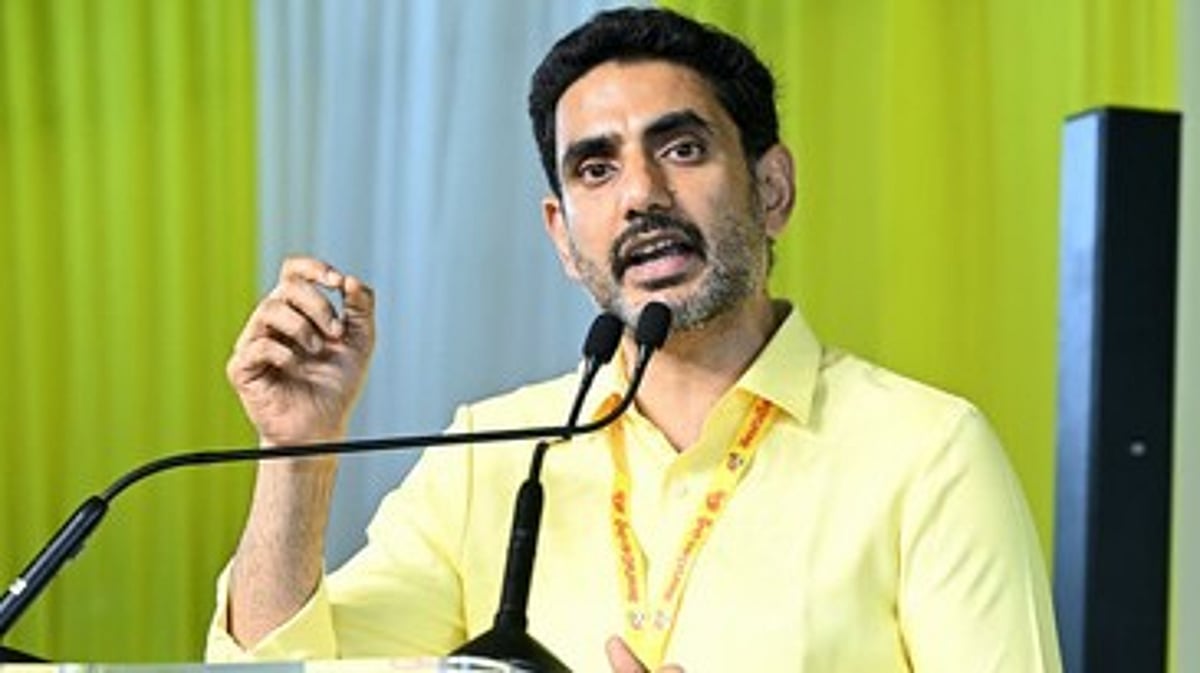
VIJAYAWADA: TDP national working president and Minister for Human Resource Development and IT Nara Lokesh on Tuesday called upon party leaders to treat social media as a serious political weapon rather than an optional tool. Addressing the second day of the Leadership Conclave at the TDP central office on “Political Communication and Public Orientation,” Lokesh said the party’s development and welfare initiatives would be truly valuable only if they were communicated clearly, continuously and directly to the people. He argued that social media is now one of the most important channels in public life and that leaders who underestimate it are making a costly strategic mistake. The conclave, which brought together party office-bearers, elected representatives and grassroots workers, was told that communication cannot remain limited to press releases, public meetings or election-time campaigns. In an era where attention is fragmented and false narratives spread fast, the TDP must have a persistent presence on every digital platform with a consistent message. Lokesh’s address assumes significance at a time when the government is trying to project its delivery model while countering opposition narratives. He said leaders must see themselves as communicators first and should not wait for the central office to package information for them. Instead, they should actively use social media to showcase schemes in education, IT, human resource development, welfare and infrastructure. Direct communication, he said, builds trust far more effectively than mediated communication and allows citizens to see the government’s work as their own. His speech was intended to change the organisational culture of the party by making communication a fundamental responsibility of every leader.
Lokesh said leaders must adopt direct and accessible formats of communication, citing Prime Minister Narendra Modi’s use of selfie videos as a successful example. He pointed out that Modi, despite being a national leader, uses a simple and personal format to connect with citizens, making governance appear human and approachable. The selfie video, Lokesh said, removes the distance between the leader and the public. It is quick, honest and easy to understand. He also referred to his own use of selfie videos during the Suzlon wind projects and the DSC misinformation campaign. In the case of Suzlon, the video helped explain the government’s renewable energy thrust and the practical impact of the projects in an accessible style. In the DSC misinformation campaign, the video was used to counter false stories and reassure candidates and their families that recruitment procedures would be transparent and merit-based. Lokesh told the gathering that a leader may deliver long speeches, but a one-minute video can often achieve what thousands of words cannot. He advised elected representatives to use their mobile phones to record short, honest videos explaining their work, their visits and the progress of government schemes. He also suggested that every achievement should be supported by data, photographs and on-the-ground testimonials so that the public receives verified information that cannot be easily distorted. The goal is not just to celebrate the government, but to create a continuous flow of truth in a political environment where falsehoods are aggressively circulated. Leaders who master this skill, he added, will become far more effective at every level.
A major part of Lokesh’s address focused on countering opposition propaganda. He alleged that opposition parties routinely engage in mudslinging, lies and deliberate distortions, and that the TDP cannot afford to respond with silence or indifference. He directed the party’s social media teams to promptly counter misinformation with facts and evidence. “Whether the issue is small or big, the facts must be conveyed to the people,” he said. That statement is likely to become a standard operating instruction for the TDP’s digital communication teams. He warned that the party should not ignore small issues because small falsehoods can gradually turn into big electoral narratives. Even if a lie appears ridiculous, it still needs to be addressed because every voter may not know the full truth. Lokesh referred to the DSC misinformation campaign as an example of how quickly falsehood can spread and how important it is to meet it with a well-documented and truthful response. He said the TDP’s response in that case was based on records and legal procedures, and that eventually exposed the falsehood. The same approach should be followed in every controversy. He also stressed the need for continuous dialogue with the public so that the party’s version of events becomes the dominant narrative. A proactive communication culture would protect the party from negative propaganda and build a reservoir of public trust. He instructed social media teams to respond quickly to party directives and programmes, and to ensure that party activities and government initiatives reached the people without delay. He said the response should happen in minutes, not days. In his view, the opposition will not wait for the government to complete its work; it will attack while the work is still underway. Therefore, the TDP must maintain a permanent digital newsroom culture that is always active, always accurate and always reaching out.
Lokesh also turned his attention to strengthening the grassroots structure. He called upon every elected representative to take ownership of public issues and strengthen their connection with the people. He used a blunt phrase: “Be an asset, not a liability to the party.” This means that every representative must be judged by performance, accessibility and communication. A leader who merely forwards complaints to higher authorities, Lokesh said, is not doing his or her duty. The people have elected representatives to solve problems, and the party has given them a platform to serve. Therefore, MLAs, MPs and local body members should become active problem-solvers and follow up on official work until issues are resolved. Faster resolution of public problems, he said, is essential for political credibility. He also stressed the importance of booth-level engagement. The booth is where elections are won, and if the party does not have strong booth-level organisation, its message cannot reach every voter’s doorstep. He asked leaders to continuously activate the cadre, train them in communication and deploy them in the field throughout the year. Direct public interaction is a force multiplier because people want to see their representatives in their neighbourhoods, not merely on social media. Leaders who are invisible in normal times cannot expect to appear only during elections. That would be seen as opportunism. Lokesh said the party structure should be trained in digital communication as well. Every district and constituency should have a communication team that collects local success stories, records testimonials of beneficiaries and projects them on social media. This would make the party’s message more credible because people like to see their neighbours, not only leaders, speaking about government schemes. His call for ownership was a clear message: representatives who cannot communicate and deliver will become a burden to the party.
Lokesh also set clear organisational discipline. He said the party must come first. Internal discussions and debates are welcome, and there can be difference of opinion within the party. However, once a decision is taken, there should be no confusion or dilution. The final agenda is one—for Chandrababu Naidu and the TDP. This remark is significant in a party where several leaders have individual followings and aspirations. Lokesh made it clear that personal ambition should always align with organisational interest. Public disagreements would only weaken the party and give ammunition to the opposition. The strength of the TDP lies in unity and in the leadership of Chandrababu Naidu. He also said leaders should identify their weaknesses and work on them. Communication is a skill that can be learned and improved. He asked leaders to attend training sessions, observe successful communicators and refine their public speaking, writing and digital presence. Stronger booth-level activity, continuous cadre activation, direct public interaction and faster grievance redressal together form what Lokesh described as a new political culture. This culture, he said, would build the organisation from below and prepare it for future electoral challenges. He said that a leader who strengthens the party will be valued, but a leader who becomes a liability will be exposed. The test is public trust, and trust is built by honest work, visible delivery and consistent communication. Lokesh’s message was both motivational and firm: the party will reward performance, and negligence will not be tolerated.
Concluding his address, Lokesh said the party’s biggest challenge is not the government’s ability to deliver but its failure to communicate the truth as strongly and as consistently as the opposition communicates misinformation. The government, he said, is working, but performance alone does not automatically create political capital. Political capital is created when performance is seen, understood and acknowledged by the people. If the opposition is loud and the government is quiet, the public will hear only the opposition. Therefore, TDP leaders must become tireless communicators of facts. They must make the truth interesting, shareable and repetitive until it becomes part of public consciousness. He reiterated that whether the issue is small or big, the facts must be conveyed to the people. Leaders should not assume that good work will speak for itself; it must be narrated, documented and amplified. He also asked leaders to take direct responsibility for resolving public issues rather than merely forwarding them to higher leadership. A leader who cannot communicate is like a soldier without a weapon. Lokesh’s address is expected to lead to a more aggressive and systematic digital communication strategy for the TDP. The message to every leader is simple: learn to communicate, remain truthful, be accessible, put the party first and ensure that the people see what the government is doing. Only then can the party successfully counter opposition propaganda and strengthen public trust. His speech may prove to be a turning point in the TDP’s organisational approach, marking the beginning of a digital-first, truth-based communication model for the party.


