


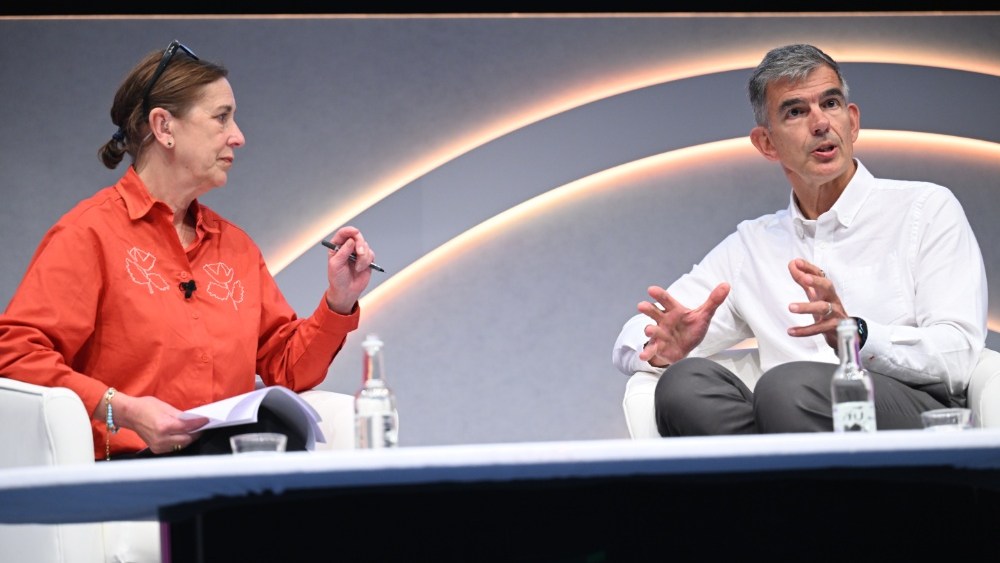
Matt Brittin, the newly appointed director-general of the BBC, made a striking debut at the Edinburgh TV Festival, engaging in a lively and at times combative Q&A session that covered the corporation’s most pressing issues. Taking the stage for his first major public appearance since assuming the role in May, Brittin, a former Google executive, fielded questions from a diverse audience that included journalists, producers, students, and even a political candidate from the recent Clacton by-election. His performance was characterized by a measured, direct, and often informal demeanor, a stark contrast to the high-stakes corporate environment he left behind. Described by many as inheriting a “poisoned chalice,” Brittin appeared determined to signal a new era of transparency and audience-centric focus for the BBC. He chose to forsake the festival’s digital Q&A app, instead opting for old-fashioned roaming microphones to connect directly with his interrogators, a small but symbolically potent decision that he later tied to his broader philosophy of getting closer to the audience. This approach set the tone for a session that was as much about taking accountability for past missteps as it was about charting a course for the future.
The discussion delved into the BBC’s evolving content distribution strategy, particularly its expansion into platforms like YouTube. Brittin argued that the BBC must adapt to the changing media consumption habits by being present wherever audiences are, emphasizing the critical role this plays in combating misinformation. He boldly stated that BBC News should be “everywhere” as a “disinfectant for misinformation,” a clear directive aimed at diversifying the corporation’s digital footprint. This vision, however, is complicated by the corporation’s current legal entanglement with former President Donald Trump. The lawsuit, which Trump filed in Florida, stems from a “Panorama” documentary that was alleged to have misleadingly edited footage of his speech during the January 6th riots. Brittin confirmed his full support for the decision, made under his predecessor Tim Davie, to vigorously defend the BBC against the $10 billion suit. He defended the BBC’s integrity and argued for dismissal on jurisdictional grounds, noting that the program with the problematic edit was not broadcast in the United States, a fact he maintained highlights the bad edit but also the lack of direct impact on U.S. viewers.
Drawing from his first six weeks touring the BBC’s extensive operations across the UK, Brittin offered a frank and critical assessment of the corporation’s production practices. He was notably candid about instances of over-production, particularly within its video podcast studios, where he questioned the necessity of expensive camera equipment and monitors placed in front of presenters. He suggested that for certain formats, quality could be achieved at a lower cost, using more accessible home equipment, a proposal that drew a sarcastic retort from his interviewer, Kirsty Wark. This willingness to challenge internal orthodoxies signals a potential shift in how the BBC allocates its resources. While Brittin’s analysis was framed as a move towards efficiency, it also hinted at a broader strategic reconsideration of what high production value truly means for the modern BBC. He appeared to be championing a leaner, more adaptable operational model that prioritizes content creation and audience reach over the scale and grandeur of traditional studio infrastructure.
Inevitably, the conversation turned to the most critical existential question facing the BBC: its funding model. With the license fee’s revenue declining as audiences shift to on-demand streaming services and inflation erodes its value, the corporation faces a significant and widening budget gap. Brittin acknowledged the severity of the situation, responding to comments from former BBC media editor Amol Rajan about his departure due to the funding deficit. He outlined a dual-pronged approach: the BBC must first focus on maximizing its impact with the audience, and then, it needs a sustainable funding settlement from the government. He made the case for a potential alternative to the current £180 annual license fee—a universal household levy. This tax, he suggested, could not only be a more stable and equitable source of income but could also potentially be cheaper for the public, dropping the cost from roughly £15 to £12 per month. He was careful to defer the decision to the government, framing his comments as making a case for sufficient funding to fulfill the BBC’s remit effectively, underlining the urgency of a solution.
Regarding the Trump lawsuit, Brittin sought to reinforce the BBC’s identity as a beacon of journalistic integrity, despite the embarrassing administrative error of the bad edit. His comments underscored a dual narrative: defending the corporation’s journalistic principles against external legal threats while simultaneously taking responsibility for internal operational failures. The lawsuit serves as a significant test of the BBC’s independence and its commitment to long-form investigative journalism, a field where it must remain competitive but also be exceptionally careful. Brittin’s assertion that supporting the case is vital for defending the institution’s integrity demonstrates a clear-eyed understanding of the stakes involved for the broadcaster’s global reputation. By separating the “bad edit” from a malicious intent, he attempts to reframe the narrative, positioning the BBC as a leader that owns its mistakes but does not compromise on its core values, even under the intense pressure of a $10 billion legal challenge from a powerful political figure.
In his closing remarks, Brittin’s vision for the future was both ambitious and nostalgic. His final exchange was with a young aspiring broadcaster who asked how he would make the BBC relevant for a new generation of talent. Brittin replied that the BBC must not be what it was, but what it should be for the future, and that it needs to be reinvented “for tomorrow.” He revealed that the inspiration to take the job came from reading about the BBC’s inception a century ago, where the pioneers invented broadcast radio without a clear blueprint, scaling up from a mix of mad, inaccessible operas and recipes to cover momentous events like the D-Day landings. He urged the BBC to harness that same pioneering spirit and innovative energy. This historical analogy served to frame his leadership not as a preservation of a legacy, but as a reinvention rooted in a core principle of innovation and public service, leaving the audience with a sense of a man prepared to take bold risks to ensure the BBC’s survival and relevance in an increasingly fragmented media landscape.