









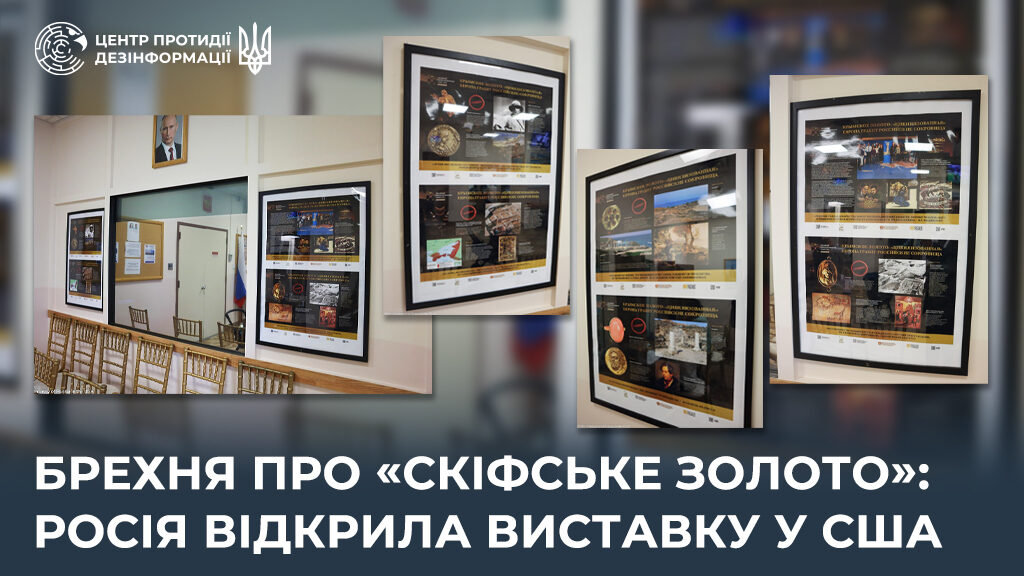
Russia has opened an exhibition at its embassy in Washington, DC, once again using the ancient treasures known as “Scythian gold” to promote the narrative that Ukrainian artifacts are part of Russian cultural heritage, according to Ukraine’s Center for Countering Disinformation (CPD). The exhibition is titled “Crimean Gold: ‘Civilized’ Europe Steals Russian Treasures,” and it appears to be a deliberate attempt to refashion a settled legal dispute into a story about European theft and Russian victimhood. The CPD, an official body under Ukraine’s National Security and Defense Council, reported that the Russian side claims the collection belongs to museums in Crimea, which is currently under Russian military occupation, and that Ukraine is illegally keeping these cultural values under its control. The Center warned that these statements are not innocent cultural commentary but outright manipulations of legal fact. The collection was in Amsterdam for a museum exhibition before Russia’s occupation of Crimea in 2014, and it remained the subject of a legal dispute for years. In 2023, the Supreme Court of the Netherlands delivered a final and binding ruling that the artifacts must be transferred to Ukraine and recognized the collection as part of the State Museum Fund of Ukraine. Russia, having no legal grounds to challenge that ruling, has instead resorted to propaganda campaigns and information manipulations, with the embassy exhibition serving as the latest example.
The very name of the Washington display, “Crimean Gold: ‘Civilized’ Europe Steals Russian Treasures,” is an attempt to flip the legal reality on its head. In the Russian version of events, the “civilized” countries of Europe are not protectors of international law but thieves who are using Ukraine as a proxy to strip Russia of its supposed cultural possessions. The Russian side tries to depict Crimea’s museums as the rightful owners of the ancient artifacts and Ukraine as an unlawful holder. The CPD, however, emphasizes that these claims are a distortion. The tradition of burying gold with the Scythian elite is not a Russian tradition in any meaningful modern sense. The artifacts, which include gold ornaments, jewelry, weapons, mirrors, ceremonial cups, and other objects from burial sites across the Black Sea steppe, were created more than two thousand years ago by Scythian, Sarmatian, Greek, and other ancient peoples who inhabited the territory of what is now Ukraine. The Scythians had no concept of Russian statehood, and no historical dynasty in Moscow or Kyiv can claim them exclusively. What can be claimed is legal title, and under the laws of Ukraine, the artifacts were registered as part of the state collection. The Russian exhibition, by framing the story in terms of cultural identity and imperial inheritance, tries to bypass the legal reality and replace it with an emotional story about historical Russia.
The legal history of the Scythian gold is long and unambiguous. The collection was sent to Amsterdam’s Allard Pierson Museum for a temporary exhibition called “Crimea: Gold and Secrets of the Black Sea” in February 2014, just days before Russia began its occupation of Crimea. After Moscow annexed the peninsula, the question arose as to where the artifacts should be returned. Ukraine insisted that they had come from state museums and belonged to the Ukrainian state, not to individual Crimean institutions. The Crimean museums, now under Russia’s control, demanded that the objects be sent back to the peninsula. The Dutch museum held the collection in the Netherlands while the ownership dispute was sorted out. In 2016, an Amsterdam district court ruled in favor of Ukraine, finding that the objects were part of the State Museum Fund of Ukraine and therefore could not be considered property of the Crimean museums. The Crimean institutions appealed, but in 2021 the Amsterdam Court of Appeal upheld the earlier ruling. Finally, in October 2023, the Supreme Court of the Netherlands rejected the final appeal and definitively ordered the collection to be transferred to Ukraine. Throughout the case, the Dutch courts examined Ukrainian law and came to the conclusion that the national museum fund was the legal owner. The decision was not a statement about which culture is more ancient or more beautiful; it was a statement about legal title, contractual records, and the principle that occupied territory cannot change ownership of state property.
The Center for Countering Disinformation notes that Russia, lacking any realistic legal mechanism to revisit the Dutch ruling, continues to use exhibitions and disinformation campaigns to keep the issue alive in the public mind. The Washington exhibition is a perfect example of this strategy. It is not intended as an academic presentation of archaeological research. It is a diplomatic event staged at Russia’s embassy in the United States, with a title carefully chosen to generate outrage and to cast Russia as the wronged party. The narrative is designed to appeal to multiple audiences at once. For Western audiences, it is meant to create a false sense that the legal battle is not over and that Europe has unfairly picked a side. For Russian-speaking audiences, it reinforces the image of an arrogant Europe that despises Russia and steals its treasures. For the global media, the exhibition tries to turn a matter of law into a matter of cultural grievance. The CPD’s role in exposing the exhibition is therefore essential: by naming the event as an information manipulation, the Center hopes to prevent it from being covered as a harmless cultural display. The exhibition is a political weapon dressed up in gold and historical references, and it is part of a much larger Russian effort to weaponize culture in the war against Ukraine’s national identity.
The battle over the Scythian gold is not just about ancient jewelry. It is part of a broader pattern in which Russia has tried to claim not only Ukrainian territory but also Ukrainian history. The Kremlin constantly refers to Crimea as a “Russian land” and to the ancient peoples of the steppe as “Russian ancestors,” even though the Scythian and Sarmatian cultures predate the Russian nation by many centuries. This historical revisionism is central to Moscow’s propaganda because it suggests that Ukraine is not a real country and that its cultural heritage is actually Russian. The dispute over the artifacts also has important consequences for international cultural property law. The Dutch courts’ decision reaffirmed a crucial principle: state-owned museum collections are part of national property, and an occupying power cannot legally claim them simply because it controls the land where a museum is located. If Russia’s argument were accepted, any occupying army could loot museums and claim that it was merely protecting its own heritage. The Scythian gold ruling is therefore a meaningful defense of the rules-based international order. It recognizes that cultural heritage must be protected, but that protection cannot be used to erase legal ownership. The exhibits belong physically and legally to Ukraine, regardless of Russian propaganda, and their fate has been decided not by street protests or diplomatic pressure but by the independent justice system of the Netherlands.
The Russian embassy exhibition is a sign of weakness more than strength. It cannot change the ruling of the Supreme Court of the Netherlands. It cannot change the fact that the Scythian gold is legally part of the State Museum Fund of Ukraine. It cannot change the reality that the museums of occupied Crimea are not in a position to claim international property rights, since their status is based on an illegal occupation that has never been recognized by the vast majority of countries. What the exhibition can do is create confusion, distract from the facts, and provide material for those who want to portray Russia as a victim of European cultural theft. But the Center for Countering Disinformation’s response makes it clear that this manipulation should be rejected. International audiences, journalists, museum professionals, and cultural institutions should be skeptical of any event staged in an embassy with a title that treats a judicial defeat as a theft. The story of the Scythian gold is ultimately a story about law, truth, and heritage. Russia can open exhibitions from Washington to wherever its propaganda machine reaches, but the golden treasures of the Black Sea steppe will remain in the custody of Ukraine, where the courts have placed them, and no carefully staged display in an embassy showroom can change that fact.


