







Kinsella at Queen’s Warns Hamas Is Winning the Information War, as Security Concerns Loom Over Campus Lecture
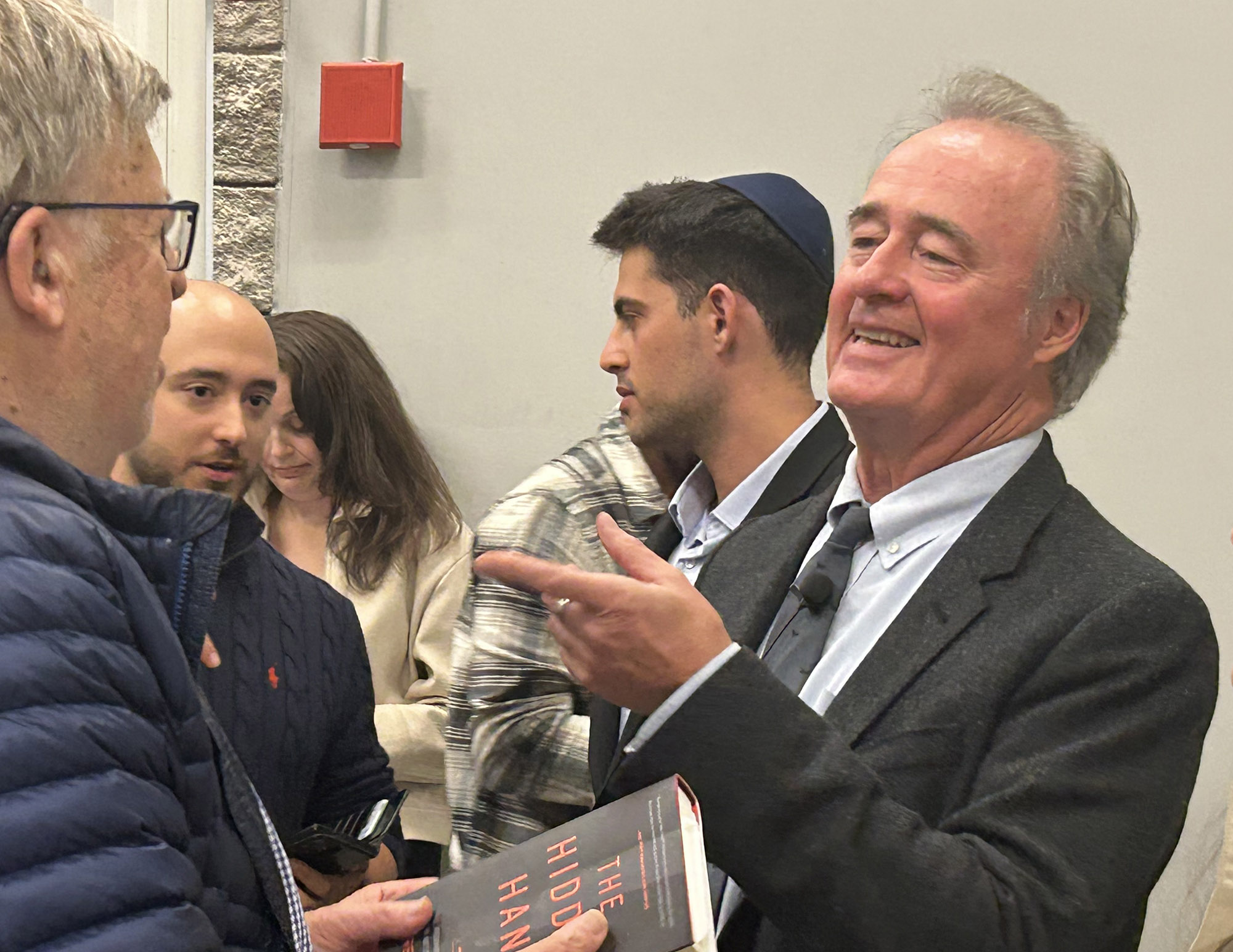
Warren Kinsella’s lecture at Queen’s University on Monday was not a typical campus event. The location was kept secret until 90 minutes before the doors opened, and the more than 150 people who filled the lecture hall were largely not current students. The heightened security was a direct response to the attack at a Belleville, Ont., synagogue during Yom Kippur services last week, when a gunman was killed and a police officer providing security outside the building was left with life-threatening wounds. That attack sent shockwaves through Jewish communities across the country and cast a long shadow over the evening’s proceedings. The event was organized by the university’s Jewish Law Students Association, with support from B’nai Brith and other organizations, and the decision to go ahead despite the threat was seen as an act of resolve. Some families attended, along with members of the association, but many in the room were decades removed from their undergraduate days. Others joined through a livestream, a detail that likely lowered the average age of the broader audience and extended the reach of Kinsella’s remarks beyond the lecture hall.
The lecture was promoted as Truth on Trial: Information Warfare, Democracy and the Rule of Law, and Kinsella, a firebrand political consultant, lawyer, journalist and former key adviser to prime minister Jean Chrétien, was well positioned to address the topic. He has worked on political campaigns “from California to Israel,” and his latest book, The Hidden Hand: The Information War and the Rise of Antisemitic Propaganda, was published this spring by Penguin Random House Canada. He also produced and narrated a documentary, The Campaign: Disinformation in a Time of War, which explores the same themes. Rather than reading an excerpt or screening clips, Kinsella spoke extemporaneously, offering a wide-ranging analysis of the rise of anti-Israeli sentiment and the deliberate stoking of antisemitic fires. He spoke with an almost professional envy as well as disgust as he laid out the machinery of Hamas’s sophisticated messaging apparatus, describing a propaganda machine that was neither accidental nor spontaneous but carefully designed to shape public opinion in the West.
Kinsella focused on the immediate aftermath of the Oct. 7, 2023, attacks, which killed at least 1,195 people in Israel during the Jewish holiday of Simchat Torah. He said that within minutes, while Hamas militants were still on Israeli soil, thousands of bots were activated on social media platforms, flooding the internet with disinformation and propaganda that reached hundreds of millions of users worldwide. This was not a matter of selective facts or even distorted narratives, he argued; it was a campaign of fabrication, producing whole-cloth fictional stories that were designed to inflame and mislead. “The messages were highly disciplined and strategic,” Kinsella said. “Hamas knew they could never beat Israel militarily — Israel would always beat them on the battlefield. What did they do instead? They started a campaign, a propaganda war to change public opinion in the west, an information war, because that they knew they could win. A campaign to isolate, delegitimize, and ultimately erase the Jewish state from the map and destabilize Western democracy.” The main target, he said, was young people, particularly those on university campuses. “It was designed to capture the hearts and minds of young people,” he said. “Main target was young people in places like Queen’s. They are winning using this.”
To illustrate the irony of Israel’s vulnerability, Kinsella held up an iPhone, noting that Israel is a global leader in technology development, and yet the very tools that have made the country a startup powerhouse have been weaponized against it. The misinformation campaign, he said, worked with incredible speed and efficiency. He cited a Harris poll taken in the immediate wake of the Oct. 7 attacks that found 70 per cent of people in the Gen Z demographic supported Hamas, and he claimed that pollsters had privately told him the numbers were “much worse.” Lauren Schwartz, co-president of the Jewish Law Students Association at Queen’s, said Kinsella’s assessment matched her own experience. “Unfortunately, most people in my generation rely on TikTok and Instagram reels for information regarding the Israel-Hamas war and misinformation is rampant,” she said. For Kinsella, winning hearts and minds was not an end in itself but a means to political influence. He pointed directly at Prime Minister Mark Carney, recalling that a year earlier Carney had gone to the United Nations and said Canada would recognize a Palestinian state only if the Palestinian Authority ended its pay-to-slay program, reformed governance, held elections for the first time in 20 years, and demilitarized. “Not one of those conditions has been met, but he recognized Hamas-run Palestine anyway,” Kinsella said. “Why? Why, before even one of the conditions were met?” His answer was one word: polls. “Politicians are as addicted to polls like it’s heroin,” he said.
Kinsella devoted considerable attention to the global infrastructure of the information war, including the role of Qatar in financing Hamas’s social-media campaign and the expertise connected to Al-Jazeera, the Doha-based broadcaster that has given the group a powerful platform. He argued that this was not a random or organic phenomenon but a coordinated effort backed by state actors with vast resources and a strategic interest in destabilizing Western democracies. Yet he insisted that the problem was not only overseas. He described his own long-running battle against a Toronto community newspaper that was covertly an operation backed by neo-Nazis. The first step, he said, was to threaten to expose the advertisers and others associated with the publication, cutting off its financial support. When that was not enough, he turned to litigation. He expressed frustration that he received no support from authorities to charge or prosecute hate-speech crimes, despite the newspaper’s clear ideological bent. The legal system, he suggested, has been slow to adapt to the realities of hate propaganda, leaving private citizens and civil-society organizations to carry the burden of defending democratic values.
Schwartz said she was proud that the Jewish Law Students Association had gone ahead with the lecture in the wake of the Belleville attack. “It’s telling that it falls on the shoulders of Jewish students to organize this rather than have our law school openly stand up for the rights of Jewish students,” she said. The comment reflected a broader frustration among Jewish students who feel that universities have been reluctant to confront antisemitism on campus. Kinsella’s closing message was simple: awareness is the first step. The machinery of disinformation can only be dismantled if people understand how it works and why it has been so effective. As the audience filed out of the lecture hall into the night, the heavy security presence was a reminder that the battle he described is not only digital. It is being fought on university campuses, in courtrooms, in community newspapers and in the corridors of power. The event at Queen’s was a small but significant demonstration that the fight for truth and the rule of law is far from over.


