


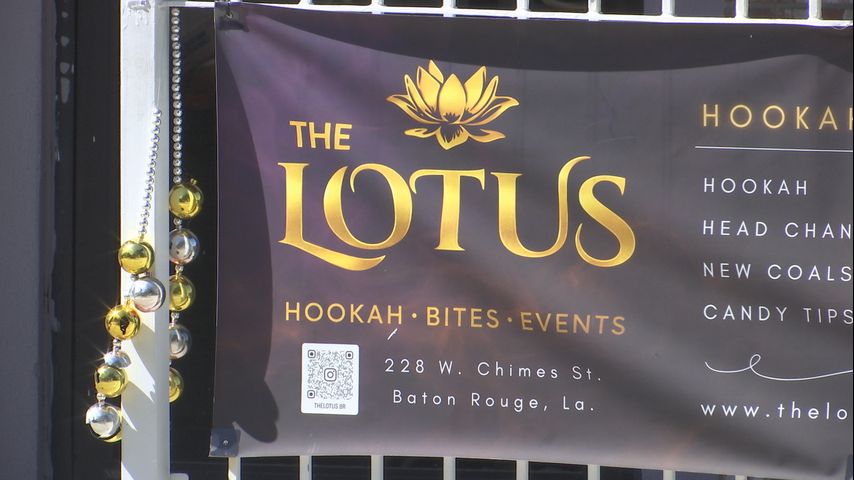
In the bustling college town of Baton Rouge, a tempest of controversy has erupted around a small hookah lounge, The Lotus, located on West Chimes Street—an artery that pulsates with student life near Louisiana State University (LSU). The establishment, which has been operating for nearly a year, finds itself at the epicenter of a public relations nightmare following a massive, frenzied street gathering that occurred late Monday night and stretched into the early hours of Tuesday. Footage captured by a viewer’s Ring camera depicted a terrifying scene: West Chimes Street transformed into a churning river of hundreds of people, some running in a panic, flooding the sidewalks and streets, creating a chaotic tableau that quickly went viral across social media platforms. Almost immediately, the digital mob pointed an accusatory finger directly at The Lotus, branding the lounge as the orchestrator of this unsafe and unlawful crowd. However, the business’s legal representation, attorney Hillary Hall Robinson, has stepped forward to adamantly reject this narrative, characterizing the blame as a severe case of misinformation driven by hearsay and a misunderstanding of the night’s events. Robinson asserts that the true genesis of this massive crowd lies not with the hookah lounge, but rather with an official, university-sponsored LSU Welcome Week event hosted by the Louisiana State University Housing Authority. According to Robinson, the overflow from that sanctioned back-to-school function, which drew a massive student attendance, inevitably spilled out onto the adjacent Chimes Street and surrounding neighborhoods, creating the impression that The Lotus was the catalyst when, in reality, it was merely caught in the aftermath of a university-organized celebration that had outgrown its venue.
The chaos of that Monday night was palpable and terrifying for those on the ground, particularly for Kwane Douglas, the Business Manager of The Lotus. Douglas recounted the harrowing sequence of events, describing how he had just stepped outside to instruct his security guards to disperse the crowd from the immediate vicinity of the lounge’s neighboring properties, a proactive measure to maintain order and ensure the safety of the surrounding businesses. It was at that precise moment, as he turned to re-enter the establishment, that the world erupted in sound and motion. He described a sudden, deafening commotion behind him, and as he spun around, he witnessed a literal “sea of people” scattering in every conceivable direction—a desperate sprint that suggested immediate danger, panic, or a perceived threat that remains the subject of an ongoing investigation by local law enforcement. This stampede-like behavior, while deeply concerning, is a distinct characteristic of large, uncontrolled gatherings where rumors, loud noises, or a minor altercation can trigger a chain reaction of fear. The police are currently working to unravel the specific catalyst that caused this explosive scatter, but for Douglas and The Lotus, the immediate consequence was far more severe. Awakening the next morning, he was confronted with a digital onslaught—a torrent of accusations, blame, and outright hostility on social media, all attributing the entire night’s chaos to his business. He noted that the blame was being propagated using a flyer that did not belong to The Lotus—a critical detail that reinforced his belief that this was a targeted miscarriage of justice. Feeling the weight of the defamation and the threat to his livelihood, Douglas made the decisive move to retain legal counsel, not merely to defend his business but to forcefully correct the public record with the true, documented sequence of events.
The counter-narrative, however, is not without its own vocal proponents. Brian Anderson, a realtor who owns several residential units adjacent to The Lotus, has presented a compelling argument suggesting that the hookah lounge actively courted this crowd. Anderson pointed to multiple social media posts on The Lotus’s official Instagram account that appeared to promote an “after-party” specifically titled as the “Welcome Week Block Party After-Party,” scheduled for the very night in question, August 17th. This promotion, he argued, explicitly targeted LSU students leaving the university’s sanctioned events, serving as a magnet that directed the overflowing student population directly to the doors of The Lotus and onto the streets around it. This is the crux of the dispute: a direct accusation of deliberate solicitation versus a defense of innocent proximity. Attorney Robinson and The Lotus have fiercely disputed this interpretation of the social media activity. Robinson argues that the posts in question were not official solicitations for an LSU Housing after-party; rather, she classifies any such connection as pure hearsay, rumors propagated by third-party attendees or social media influencers without any official endorsement or statement from the business itself. The defense hinges on the distinction between a business acknowledging a crowd and a business creating one. The Lotus maintains that while it was open for business that night, it did not solicit, advertise, or explicitly direct students to come to its premises as the official continuation of the university’s event. Robinson insists that if any staff member mentioned an after-party, it was an offhand, unofficial comment, not a coordinated marketing strategy. This distinction is legally and ethically critical, as it determines whether the business bears responsibility for the ensuing street disorder or was merely a passive venue overtaken by an external force.
Beyond the discourse of marketing and solicitation, attorney Robinson’s defense strategy pivots to the diligent, responsible conduct of The Lotus as a licensed business facing an unprecedented external surge. She maintains that upon realizing the scale of the overflow crowd—a crowd that originated from the LSU Housing Authority’s event—the management of The Lotus acted precisely as any safety-conscious business should. They enforced their legal occupancy limits rigidly, refusing entry to a “plethora of children” and potential patrons once capacity was reached. Robinson emphasized that they told everyone “no”—a stark rebuttal to the idea that they were packing people into the venue to profit from the chaos. The viral videos of people on the street, she argues, depict individuals who were not patrons of The Lotus but rather overflow participants from the university event who lingered in the public right-of-way. A business cannot be held responsible for controlling the actions of individuals who are legally outside its premises on public municipal streets. The physical separation between the controlled, indoor space of the hookah lounge and the uncontrolled, public realm of the street is a key legal buffer. If the business had tried to forcefully disperse a crowd of hundreds from the public street, they would have likely instigated an even greater riot or faced liability for assault. Thus, the defense paints a picture of a business sheltering in place, securing its perimeter, and limiting its internal occupancy while external forces—students from a university event—created the disorder.
In the wake of the incident, the consequences for The Lotus have been swift and severe, representing a tactical surrender to public pressure and regulatory scrutiny. Douglas has announced that the lounge is currently operating at a drastically reduced maximum capacity of just ten patrons—a near-total shutdown of a business that relies on social gathering and volume. Furthermore, a planned “Back-to-School Patio Party” advertised for Friday, August 21st, which was intended to welcome both LSU and Southern University students, has been completely cancelled. This decision is not an admission of guilt but rather a pragmatic measure to de-escalate tensions and demonstrate goodwill to the authorities. The business is explicitly cooperating with the standards and guidelines issued by the Louisiana State Fire Marshal’s Office, which has regulatory oversight over venue capacities and safety protocols. Robinson assured the public that The Lotus is taking the prescribed regulatory steps to ensure compliance. However, this cooperation is coupled with a firm stance of victimhood—framing the business as an innocent party suffering collateral damage due to a false narrative. The drastic scale-back in operations serves a dual purpose: it physically limits the potential for any future large gatherings on their property, thereby mitigating further risk of public outrage, and it serves as a visual testament to their claim that they are being unfairly punished. The cancellation of the Friday event sent a clear message that The Lotus is prioritizing community safety and legal compliance over revenue generation, even as they fight to clear their name from what they argue are baseless accusations.
As the dust begins to settle on this turbulent episode, attorney Robinson has signaled that this is not the final chapter. She has promised that The Lotus possesses a trove of untapped evidence—surveillance footage, internal documentation, and video recordings from that fateful night that were conspicuously absent from the public narrative presented by the accusers. Robinson stated, “We have the surveillance, we have the documentation, the videos ourselves of that night that was not shown, that would also show the evidence of what I’m saying.” This revelation suggests a strategic legal offensive is on the horizon, potentially involving defamation suits against specific individuals or media outlets who propagated the misinformation. The police investigation into the root cause of the stampede remains open, and the findings could significantly alter the public perception, potentially exonerating The Lotus if it proves a spontaneous panic unrelated to the lounge’s operations. This incident serves as a microcosm of the volatile intersection between university culture, local businesses, and social media vigilantism. In an era where a single viral clip can destroy a reputation within hours, the rush to judgment often outpaces the slow, methodical pace of legal verification. Whether The Lotus was a victim of circumstance or a reckless instigator remains a matter of legal interpretation and evidentiary discovery. For now, the streets of West Chimes have quieted, the lounge operates at a shadow of its former capacity, and a community waits—both for the police report and for the meticulously curated surveillance footage that Robinson claims will vindicate her clients and expose the true origin of a terrifying night in Baton Rouge.