








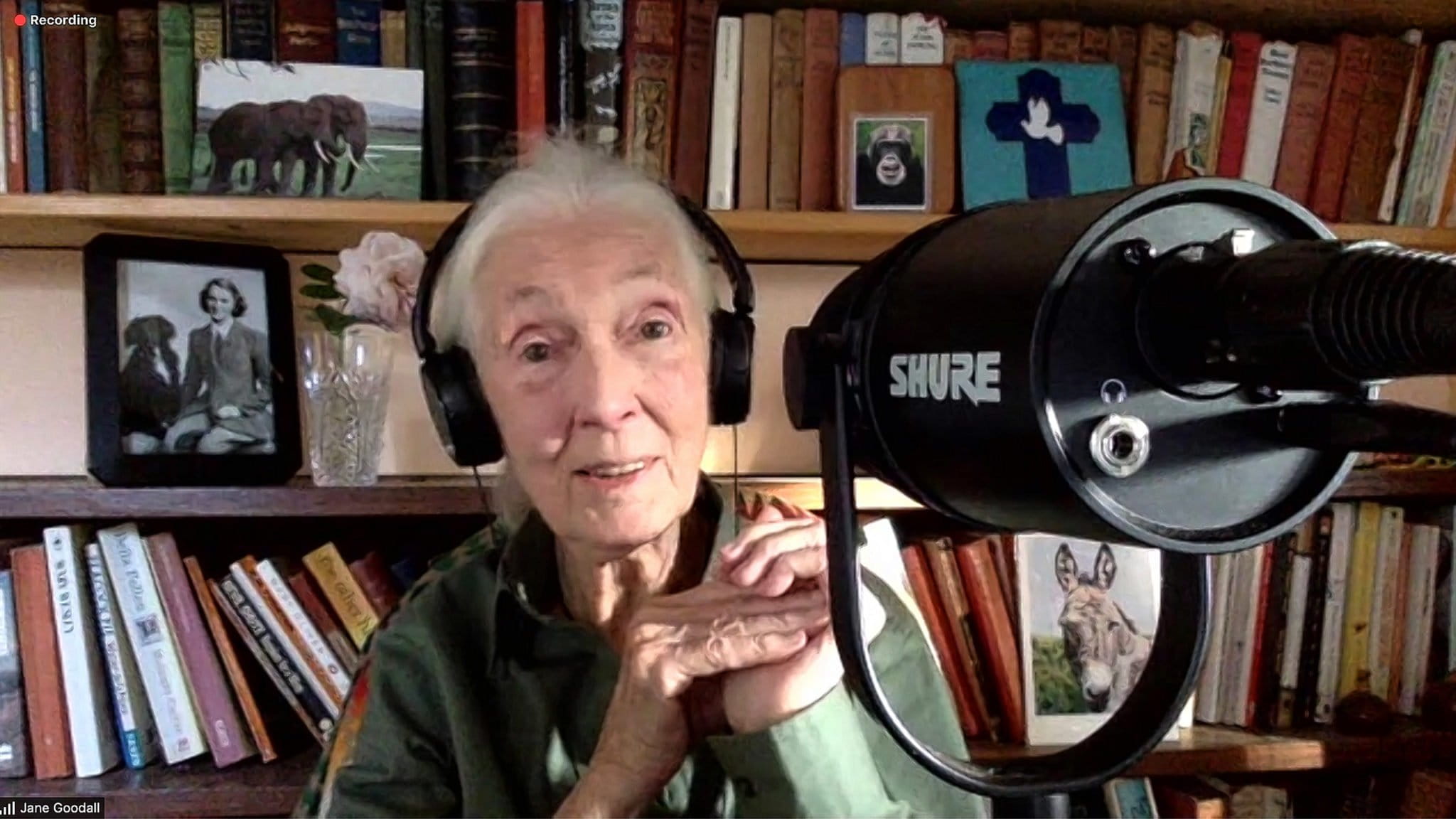
Christiana Figueres Named First Recipient of the Inaugural Jane Goodall Earth Medal
Christiana Figueres, the former executive secretary of the United Nations Framework Convention on Climate Change (UNFCCC) and the chief architect of the historic 2015 Paris climate agreement, has been named the inaugural recipient of the Jane Goodall Earth Medal, a new international honor designed to celebrate those who “unite science, courage and responsibility.” The award, created by the board of the Starmus Festival, an annual gathering that brings together scientists, artists and musicians, stands as a memorial tribute to the legendary primatologist and conservationist Jane Goodall, who died in October 2025 at the age of 91. Goodall, who reshaped the world’s understanding of chimpanzees and became one of the most recognizable voices for environmental hope and grassroots action, also served on the advisory council of Mongabay, the environmental news organization where the announcement was celebrated. The medal will be formally presented to Figueres during the upcoming edition of the Starmus Festival, which is scheduled to take place from October 17 to 22 in Spain. Speaking about the distinction, Figueres described Goodall as “an absolute giant” to her very last day, and said the fact that a medal had been created in Goodall’s honor, and that she had been chosen to debut it, was “an unbelievable honor.” The award establishes a symbolic bridge between two of the most consequential environmental leaders of the modern era: Goodall, who spent six decades documenting the inner lives of primates and building global conservation movements, and Figueres, who spent years navigating the treacherous politics of international diplomacy to secure a global emissions treaty.
Figueres’s path to this extraordinary honor has been defined by her ability to transform political division into collective action. Appointed in 2010 to lead the climate change convention’s secretariat, she assumed control of a negotiating process that had been repeatedly weakened by failures, deep distrust between wealthy polluters and developing nations, and the collapse of the 2009 Copenhagen summit. In December 2015, after years of patient diplomacy and creative engagement, she guided 195 nations to consensus in Paris, producing the first universal legal framework committed to holding global warming to well below 2 degrees Celsius, with an aspirational target of 1.5 degrees. The architecture of that agreement, built on nationally determined contributions and five-year review cycles, transformed the entire landscape of global climate policy and remains the cornerstone of all subsequent UN climate negotiations. After leaving the UN in 2016, Figueres has continued her advocacy through initiatives such as the Global Optimism group and the philosophy of “stubborn optimism” she developed to counter climate fatalism. Her reaction to receiving a medal named for Goodall carried unmistakable personal weight, and in a conversation on the Mongabay Newscast, hosted by Mike DiGirolamo, she reflected on the ways in which Goodall’s legacy had influenced her own worldview. Goodall, who began her pathbreaking fieldwork in Gombe, Tanzania, in the 1960s, did far more than upend scientific assumptions about tool use and culture among chimpanzees; she created a model of community-centered conservation and youth empowerment through initiatives such as Roots & Shoots, which now operates in dozens of countries. Figueres pointed out that both she and Goodall had consistently chosen to hold onto hope even when evidence of ecological collapse could easily justify despair, and that this shared spirit of determined grace lies at the very core of the Earth Medal’s purpose.
The Jane Goodall Earth Medal, as explained by astrophysicist and Starmus co-founder Garik Israelian, was conceived by two members of the festival’s advisory board: Brian May, the astrophysicist and Queen guitarist, and Peter Gabriel, the celebrated musician and human rights advocate. Israelian noted that May, who founded the animal protection organization Save Me, has spent years campaigning for the rights and welfare of wildlife, while Gabriel has built a reputation as a tireless champion of human rights and social justice. The union of these two commitments, safeguarding nonhuman life and defending human dignity, speaks to the expansive definition of responsibility that Goodall embodied throughout her career. The Starmus Festival itself, which was founded in the early 2010s with the involvement of prominent scientific voices including the late Stephen Hawking, has become a unique cultural experiment that places Nobel laureates, astronauts, academics and performers on the same stages in large public shows. This year’s edition, centered on the theme “The Search for Truth,” is set to address the growing crisis of information integrity in what political ecologist Bram Buscher previously characterized, during an appearance on the Mongabay Newscast, as the “post-truth era.” For Israelian, the choice of Figueres as the first medalist is entirely deliberate: she has spent her professional life converting complex scientific realities into shared political commitments, and she has demonstrated exactly the blend of evidence-based leadership and personal accountability that Goodall modeled for more than sixty years. The recognition, then, is not only an individual tribute but a public statement about the kind of human beings the scientific community wishes to elevate.
Embedded within the announcement of the medal and the festival’s theme is a sharp critique of contemporary media systems, a subject that both Figueres and Israelian discussed at length during the podcast episode. Figueres warned that audiences today are “swimming in both disinformation and misinformation all the time without even knowing it,” and she was explicit about what she sees as the engine behind this crisis: social media platforms built on engagement-driven algorithms that prioritize profit over factual accuracy. “The fact that we choose to consume more misinformation and disinformation than science-based, truth-based information is to me the root of the problem of why these companies do what they do with algorithms,” she said. She went further, characterizing the deliberate amplification of falsehood as an abuse of free speech, arguing that an open information environment cannot function when its most powerful distributors have no responsibility toward truth. Buscher’s earlier framing of the “post-truth era” on the same program had anticipated these concerns, describing environmental policy, including everything from forest protection to climate adaptation, as increasingly vulnerable to organized campaigns of denial. Figueres’s comments extend that analysis into the digital realm, implying that the same tools that once promised to connect humanity have become one of the most significant barriers to the collective consensus needed to address planetary challenges. Her diagnosis carries a particular weight coming from a diplomat who spent years fighting for international agreement, because it suggests that no treaty, no matter how skillfully negotiated, can survive without a citizenry capable of distinguishing factual reality from fabricated distraction.
Israelian, who has devoted his career to making scientific discovery accessible to the public, echoed Figueres’s concerns and then offered a dual prescription for restoring epistemic health. “It’s much harder to lead very educated, very knowledgeable people to this route of using misinformation,” he said, arguing that education remains the most robust defense against the manipulation of public opinion. A scientifically literate society, in his view, will demand evidence and will resist appeals that run contrary to established knowledge. But he insisted that individual learning alone cannot solve the problem in a landscape dominated by multinational technology corporations with unprecedented reach. “Limiting the power of tech companies. Those who do social media, to limit the algorithms or to control those algorithms. They should be under control,” he declared, advocating for regulation, transparency and institutional oversight of the systems that now mediate the information diets of billions of people. His remarks place him squarely within a growing international conversation about algorithmic autonomy and digital governance, a debate that has been led primarily by legislators and legal scholars but is now drawing urgent voices from the scientific community. For the Starmus fellowship, the issue is existential: if the public cannot reliably separate credible scientific findings from fabricated claims, then evidence-based responses to climate change, public health crises and even space exploration become politically impossible. Israelian’s prescription, pairing rigorous pedagogy with strict oversight of digital platforms, is likely to animate many of the debates at the upcoming October festival in Spain, where scientists and musicians will stand on the same stages to model a more honest, more courageous form of public discourse.
The decision to present the inaugural Jane Goodall Earth Medal to a climate diplomat rather than another wildlife scientist is itself a powerful statement about the interwoven character of the crises facing the planet. Conservation, justice and atmospheric chemistry are not separate realms, a point that Goodall herself made for decades by carrying her message from the forests of Gombe to the halls of global climate negotiations. By honoring Figueres, the Starmus board recognizes that the hope Goodall embodied was never naive optimism; it was an active, stubborn choice made in the face of overwhelming evidence of loss, and so is the optimism Figueres has practiced through years of failed summits and shortsighted policy. The full conversation between Figueres, Israelian and host Mike DiGirolamo, which also featured a banner image of Goodall recording her celebrated Hopecast, will remain available to listeners through the Mongabay Newscast, offering a moving tribute to Goodall’s final months and her lasting message of compassion. In the end, the medal with Goodall’s name now passes from a scientist who watched chimpanzees to a diplomat who watched delegates, two women who understood that humanity is capable of acting on its deepest knowledge if it dares to cherish truth. As the Starmus Festival convenes this October in Spain, the world will witness this passing of the torch, and the message will resound far beyond the auditoriums of the festival: that science, courage and responsibility can still guide us forward, and that hope remains the most revolutionary force available to us.


