


Holocaust Denial as Antisemitism: Museum Highlights Evidence, Tactics, and the Threat of Digital Distortion
Denying, minimizing, or distorting the facts of the Holocaust is a form of antisemitism, according to the United States Holocaust Memorial Museum. Holocaust deniers ignore the overwhelming evidence of one of the best-documented genocides in history and insist that the Holocaust is a myth, invented by the Allies, the Soviet communists, and the Jews for their own political and financial ends. According to the logic promoted by deniers, the Allies needed the so-called “Holocaust myth” to justify their occupation of Germany in 1945 and the harsh prosecution of Nazi defendants at Nuremberg. At the same time, they claim, Jews needed the myth to extract enormous restitution payments from Germany and to justify the establishment of the State of Israel. This view is built on a conspiracy theory involving the victorious powers of World War II, Jews, and Israel. Deniers argue that if they can discredit one fact about the Holocaust, the entire history of the event can be discredited as well. They therefore ignore the immense documentary and witness evidence and instead make narrow, misleading arguments that they claim negate the reality of the Holocaust in its entirety. Such assertions, the Museum stresses, are not legitimate historical inquiry but rather a form of antisemitic propaganda that seeks to erase the suffering of millions.
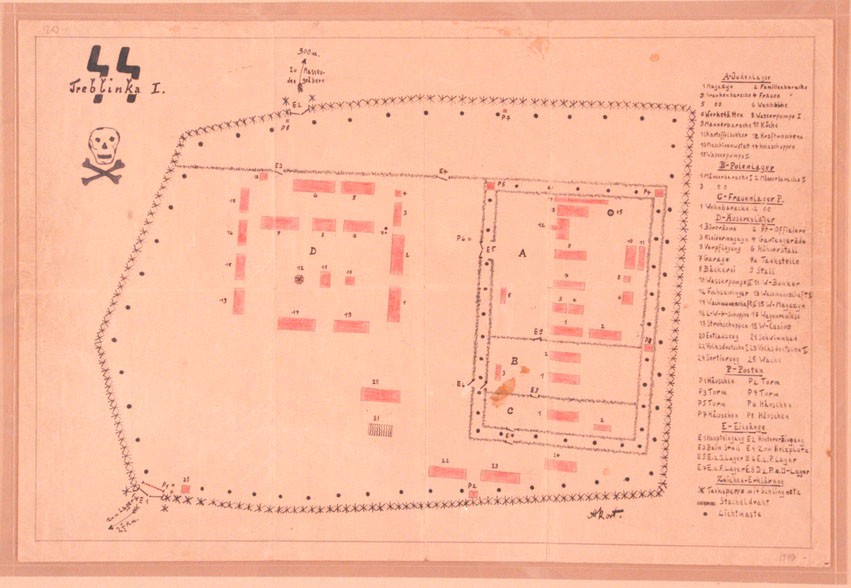
The evidentiary foundation of Holocaust history is vast and includes official documents, photographs, maps, registers, and architectural remains. Among the primary documents cited in the Museum’s materials is the Hartheim Register, discovered by US Army troops in 1945 in a locked filing cabinet at a killing site in Hartheim, Austria. This register was one of the key documents used to calculate deaths in the Nazi “euthanasia” program, which murdered disabled and mentally ill people. The right page details by month the number of patients who were “disinfected” in 1940, with a final column indicating that 35,224 persons had been put to death that year. Another powerful piece of evidence is a map titled “Jewish Executions Carried Out by Einsatzgruppen A,” which accompanied a secret undated German report on the mass murder of Jews by a mobile killing unit in the Baltic states and Belorussia. During the International Military Tribunal at Nuremberg, the map was introduced as evidence by both the American and British prosecution teams. Stamped “Secret Reich Matter,” the map uses coffin symbols to show the number of Jews executed by late 1941, and its legend states that the estimated number of Jews still on hand was 128,000. In addition, census cards issued by the Romanian government in 1942 reveal the bureaucratic mechanics of persecution. On December 17, 1941, Romania issued a decree requiring a census of all those with “Jewish blood,” ordering all persons with one or two Jewish parents or two Jewish grandparents to register at the Central Jewish Office. These documents are not ambiguous artifacts; they are traces of a systematic process of identification, exclusion, and murder.
Holocaust deniers often argue that because there is neither a single document that outlines the Holocaust nor a signed document from Hitler ordering the Holocaust, the genocide itself must be a hoax. To sustain this claim, they reject all the evidence submitted at Nuremberg and denounce as fabrications the genocidal intentions of the Nazi state and the thousands of orders, memos, notes, and other records that document the process of destruction. When they cannot sustain arguments that documents are forged, they shift ground and argue that the language in the documents has been deliberately misinterpreted. Some deniers further insist that the Allies tortured Nazi perpetrators into testifying about their role in the killing process and that survivors who testified about Nazi crimes against Jews were all lying out of self-interest. These accusations are not supported by historical evidence. The Nuremberg trials and subsequent proceedings were based on a vast collection of German documents and testimony, much of it voluntarily produced by the Nazi regime itself. The notion that an entire edifice of wartime records, captured archives, and eyewitness accounts was fabricated by the Allies and the Jews requires a conspiracy of impossible scale. Yet denial persists, often by adopting the outward appearance of scholarly method while discarding actual scholarship.
Another central claim of Holocaust deniers is that only a small number of Jews died during World War II and that these deaths were either from natural causes or resulted from legitimate executions carried out by the Nazi state for alleged criminal offenses. Deniers assert that Jews and the Allied powers deliberately inflated the number of Jews killed during the war to gain sympathy and financial compensation. In fact, Holocaust historians have placed the number of Jews killed at between 5.1 million and 6 million, based on legitimate available historical sources and demographic methods. Deniers seize on the uncertainty about the exact number within this accepted range as supposed proof that the entire history of the Holocaust has been fabricated and that the number of Jewish deaths has been grossly exaggerated. This is a distortion of how historical knowledge works. The fact that scholars refine estimates and debate precise figures does not mean that the event did not occur. The scale of the Nazi genocide is established by deportation records, concentration camp registries, Einsatzgruppen reports, railroad logs, and demographic studies of Jewish communities before and after the war. The range of 5.1 to 6 million represents careful scholarly consensus, not fraud.
Some Holocaust deniers specifically assert that the Nazis did not use gas chambers to kill Jews and deny that killing centers such as Auschwitz-Birkenau existed. They focus a great deal of attention on Auschwitz because they believe that if they could prove the gas chambers there were a myth, the entire history of the Holocaust would collapse. Aerial photographs of Auschwitz-Birkenau taken by Allied planes on August 25, 1944, for example, were rediscovered decades later in American records. The images show two of the gas chamber and crematorium complexes, specifically crematorium II and crematorium III, both of which had underground gas chambers and above-ground crematoria. The Nazis began murdering Jewish people in these gas chambers in 1943 and dismantled and demolished the buildings in the winter of 1944–1945, partly to hide evidence of their crimes. Deniers ignore such physical evidence, along with the testimony of SS members, camp survivors, and the detailed plans of the Nazi camp administration. Instead, they often mimic the forms and practices of genuine scholars to deceive the public: they footnote their writings by citing other Holocaust deniers, they hold pseudo-scholarly conventions, and they publish journals that appear academic but lack the standards of real peer review. This performance of scholarship is designed to give denial an air of credibility that it does not deserve.
Holocaust denial on the Internet has become especially widespread and dangerous because of the ease and speed with which misinformation can be disseminated. The World Wide Web allows deniers to reach audiences across borders, to recruit followers, and to frame their antisemitic falsehoods as alternative history. In the United States, the First Amendment to the Constitution ensures freedom of speech, and as a result, it is not against the law to deny the Holocaust or to propagate Nazi and antisemitic hate speech. European countries such as Germany and France, by contrast, have criminalized Holocaust denial and have banned Nazi and neo-Nazi publications. The Internet has now become the chief source of Holocaust denial and the chief means of recruiting for Holocaust denial organizations. The persistence of this phenomenon underscores the importance of historical memory and education. As the United States Holocaust Memorial Museum emphasizes, Holocaust denial and minimization are not merely offensive opinions; they are active forms of antisemitism that attack the truth of an unparalleled tragedy. Confronting denial means preserving the evidence, documenting the crimes, and teaching future generations that history must not be erased by lies and conspiracy theories.