









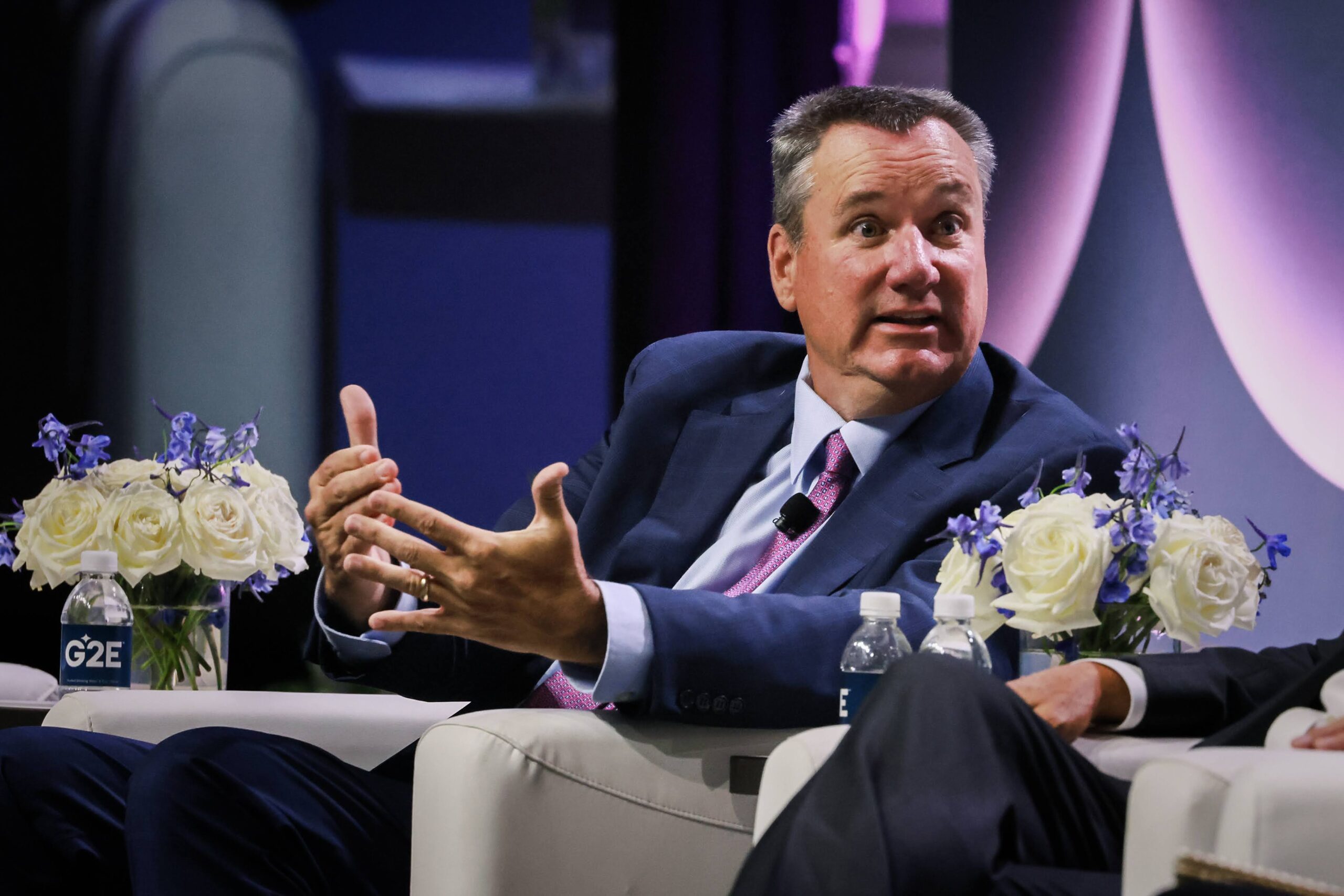
Las Vegas’ high-end gamblers have become the indispensable engine propping up Strip casino revenue, even as resort operators struggle to lure more cost-conscious leisure visitors. That central message emerged from the Global Gaming Expo keynote session at The Venetian Expo, where Caesars Entertainment CEO Tom Reeg, MGM Resorts International CEO Bill Hornbuckle and Wynn Resorts CEO Craig Billings discussed the industry’s prospects. Combined, the three companies operate 18 Strip resorts spanning every market segment, from luxury properties such as Wynn Las Vegas and Bellagio to more accessible hotels like Excalibur, Luxor and Harrah’s. Their comments were underscored by Nevada’s August gaming revenue report, released Wednesday by the Gaming Control Board, which provided fresh statistical evidence that without high-end baccarat play, the Strip’s less-than-1 percent revenue increase during the month would have been an overall loss. The Strip generated $684.1 million in gaming revenue in August, a modest increase that was essentially matched by a less-than-1 percent rise in slot machine revenue. The real driver was baccarat: wagering on the high-stakes card game totaled $848.8 million, a nearly 35 percent increase from a year earlier, and baccarat tables produced $155 million in revenue, up 34 percent. Meanwhile, non-baccarat table game revenue slumped more than 19 percent. Slot and non-baccarat table wagering each fell between 3 percent and 4 percent, revealing a stark divide between a small but growing pool of premium players and the broader mass-market customer base that has become more hesitant in recent months.
Reeg, whose company operates Caesars Palace and other Strip properties, acknowledged that the leisure customer is no longer delivering the kind of demand that powered Las Vegas through the pandemic recovery. “The leisure customer is not as strong as it has been,” he said during the G2E keynote. “We had a couple of summers here that were exceedingly strong,” he added, alluding to the record gaming revenue produced in the years after the health crisis. “We’ve kind of gone back to the normal seasonality in Las Vegas. For those of us who lived through the days when we were 98 percent occupancy in the summer, it’s jarring.” Hornbuckle echoed that assessment, saying the luxury segment on the Strip “continues to do exceptionally well.” Convention business, a key driver of midweek demand and high-end spending, is up almost 11 percent through August. But MGM has had to adjust at its more accessible properties, including Excalibur and Luxor. “Whether it’s all-inclusive packaging like we do at Luxor or other things that other competitors have done, there is real value in Las Vegas,” Hornbuckle said. He argued that Las Vegas remains a bargain relative to other major tourism destinations, noting that even with average hotel room rates having increased, “we’re still 40 percent lower than New York.” But he also cautioned that value alone will not protect the market from losing price-sensitive travelers. “Do we have expenses that continue to creep in all things? Absolutely. And so when people talk about parking and resort fees and water, they’re all part and parcel to a bigger mix,” he said. “We have to be careful that we have to pay attention to that segment, or we’re going to lose it.” His comments highlighted the tension casino operators face: costs keep rising, yet customers have become more sensitive to every add-on fee and price increase.
Statewide, Nevada gaming revenue told a mixed story in August. Total gaming revenue rose 3.1 percent to nearly $1.3 billion, but the growth was heavily concentrated in specific markets and segments. The Las Vegas locals market, which serves residents in suburban communities such as Summerlin, Henderson and North Las Vegas, delivered the strongest performance, with combined revenue up 9.5 percent to $261.1 million. That strength suggests that local consumers, who are less dependent on air travel and hotel stays, remain more willing to spend on gaming and entertainment. Reno also posted a strong month, climbing 15.7 percent to $79.4 million, as northern Nevada benefited from some of the same drivers and from a growing base of visitors seeking an alternative to the Strip. Downtown Las Vegas, a bellwether for more price-sensitive tourists and a growing entertainment district, saw gaming revenue fall 3 percent to $61.5 million. The divergent figures illustrate how much the Strip’s overall performance now depends on a relatively small number of high-stakes players. The Las Vegas Convention and Visitors Authority also reported that the average daily hotel room rate on the Strip fell 11.4 percent in August to $153.15 per night, compared with the same month in 2025. For the first eight months of the year, however, the Strip’s average daily rate was $196.11, up 2 percent from the prior year. That disparity suggests hotels had to discount rooms during August to cope with softer leisure demand, after enjoying a relatively strong winter and spring driven by conventions and premium travel. The August room-rate decline, combined with the gaming revenue data, reinforces the view that the middle of the Las Vegas market is under pressure even as the top end remains robust. It also explains why baccarat had to shoulder the load: when ordinary visitors pull back, the casinos increasingly rely on the high-rollers who remain willing to bet millions in a single session.
Billings, who runs Wynn Resorts, said his company has largely avoided the challenges of the value-customer market. Wynn Las Vegas and Encore, the company’s two Strip properties, cater to luxury travelers and have never been in the business of chasing volume through discounts. “We will always focus on what’s the most comfortable experience for the customer and where we can drive the highest possible [cash flow],” Billings said. “The reality is operating costs in Las Vegas are higher than they used to be, and so you really have to think about occupancy versus rate.” Wynn is also looking well beyond Las Vegas for growth. The company is building a $5.7 billion resort in the United Arab Emirates, a project that signals how the largest casino operators are following the money into international markets. Wynn already operates Encore Boston Harbor and two resorts in Macau, giving it a geographically diverse portfolio that can offset any softness in the domestic market. Billings’ remarks align with the broader industry’s growing reliance on premium customers, particularly baccarat players from Asia and other international sources. The August revenue report demonstrated that reliance starkly: baccarat revenue jumped 34 percent even as mass-market slots and non-baccarat table games struggled. That pattern is not new, but it has become more pronounced in recent months. As domestic leisure travel normalizes and budget-conscious Americans trim discretionary spending, the casino industry is leaning even harder on the high-end segment. For Wynn, that strategy has proven effective, but it also raises questions about the sustainability of the two-track recovery. If overseas travel remains below pre-pandemic levels—international passenger volume at Harry Reid International was still down 7.1 percent through August—then the premium segment alone may not be enough to sustain Las Vegas’ long-term growth. Billings nevertheless sounded confident, pointing to the company’s focus on “the most comfortable experience” as a way to maintain pricing power in a challenging cost environment.
Outside the casino floor, August’s softness was visible in visitor volume and airport traffic. The Las Vegas Convention and Visitors Authority said 3 million people visited Las Vegas in August, a 4.3 percent decline from the same month a year earlier. The LVCVA attributed part of the falloff to a reduced number of special events and to the absence of Labor Day weekend, which this year fell entirely in September, eliminating the usual end-of-summer travel spike. Over the first eight months of 2026, visitation was flat compared with the same period in 2025, meaning the destination has essentially stalled after years of rapid growth. The lone bright spot was convention attendance, which rose 6 percent in August and 10.5 percent for the eight-month period—a sign that business travel remains a sturdy foundation for the city’s economy and a key contributor to the premium spending that has helped casinos offset weaker leisure demand. Harry Reid International Airport, however, continued a troubling trend, posting its 19th consecutive monthly decline in passenger traffic. The airport has now seen passenger numbers fall in 23 of the past 24 months, an unprecedented stretch for a market that once seemed recession-proof. More than 4.1 million passengers came through the airport in August, a drop of 9.2 percent from a year earlier. International passengers provided a ray of hope: their numbers increased 3.9 percent, the second straight monthly jump. Still, international volume was down 7.1 percent for the year, largely because of a sharp pullback in Canadian travel. WestJet’s passenger count at the airport fell 23.8 percent in August, while Air Canada dropped 8.4 percent. The Canadian decline has been a persistent drag on international visitation, although the recent monthly gains suggest the worst may be over. Overall, the airport numbers paint a picture of a destination that is still attracting convention-goers and premium travelers but has yet to regain the broad mass-market appeal that drove back-to-back record years immediately after the pandemic.
Among domestic carriers, Frontier Airlines has stepped into the gap left by Spirit Airlines, which ceased operations in May. Frontier’s passenger volume at Harry Reid International soared 35 percent in August and was up 19 percent for the year, making it one of the few growth stories at the airport. Southwest Airlines, the airport’s busiest carrier, saw its passenger count fall 4.6 percent in August, though its decline for the first eight months was less than 1 percent. The airline data, combined with the gaming revenue figures, reinforces the picture of a two-track Las Vegas economy. On one side are wealthy baccarat players and convention-goers who continue to spend at a record pace. On the other are leisure travelers who are increasingly price-conscious, sensitive to resort fees, parking charges, airfare and every other component of the cost of a trip. The three executives at G2E did not predict a recession or a sharp downturn, but they made clear that the post-pandemic boom has faded into a more normal, segmented market. Reeg described the current environment as a return to seasonality; Hornbuckle stressed the need to defend the value proposition; Billings focused on maximizing yield from the most affluent customers. Hornbuckle put it bluntly when he said Las Vegas remains “an incredible value,” but he also warned that operators “have to pay attention to that segment, or we’re going to lose it.” Whether that combination is enough to sustain the Strip’s growth will depend on the resilience of the high-end segment and the ability of operators to manage costs without alienating the value-conscious customer. If baccarat continues to surge and international travel recovers further, Las Vegas may be able to thread the needle. But if the premium wave recedes, August’s numbers offer an early warning that the rest of the casino floor may not be strong enough to compensate.


