








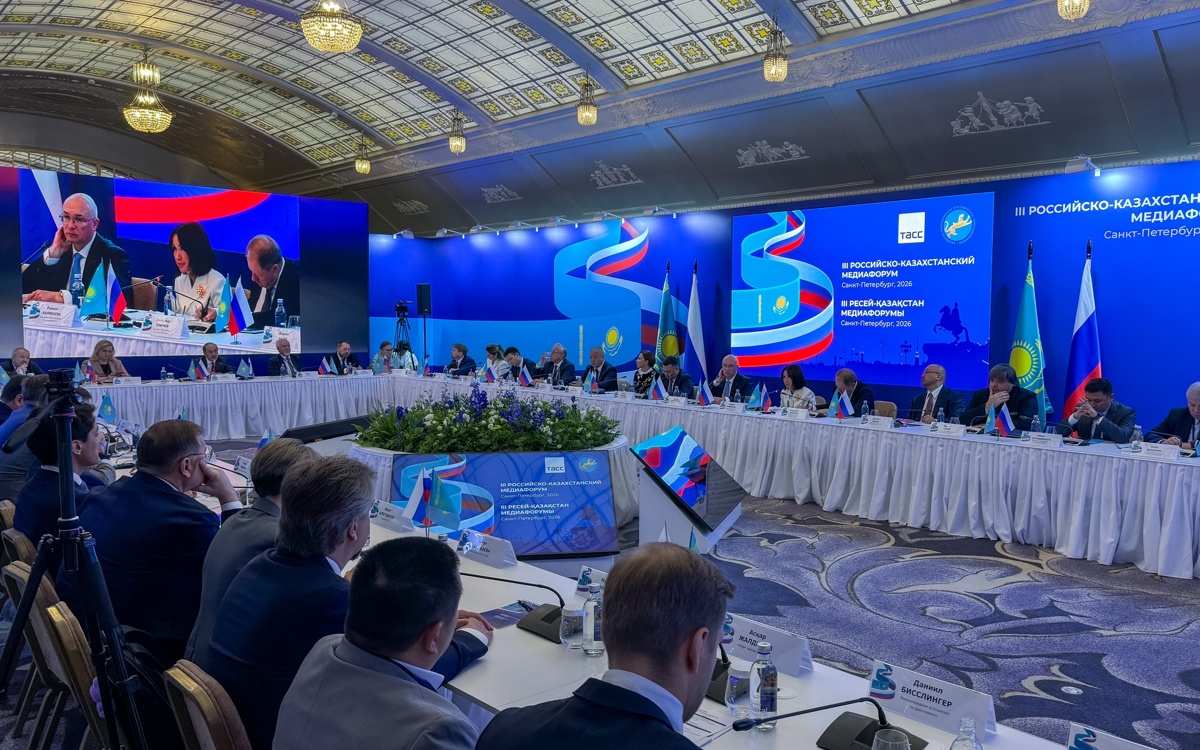
The third Kazakhstan–Russia Media Forum, recently held in St. Petersburg, brought together prominent media leaders and government officials to navigate the evolving landscape of global journalism. The discussions centered on the multifaceted challenges posed by the rapid integration of artificial intelligence, the complexities of managing information overload, and the urgent need to combat the spread of misinformation. As traditional newsrooms undergo a significant digital transformation, the forum served as a vital platform for professional exchange, emphasizing the importance of developing new media talent and adapting to modern technological realities.
Raushan Kazhibayeva, Director of the TV and Radio Complex of the President of Kazakhstan, opened the dialogue by highlighting the media’s indispensable role in fostering the strategic alliance between Kazakhstan and Russia. She noted that under the leadership of Presidents Kassym-Jomart Tokayev and Vladimir Putin, bilateral ties have reached a pinnacle of comprehensive strategic cooperation. Referencing the landmark “Seven Pillars of Friendship and Good-Neighborliness” signed earlier this year, Kazhibayeva underscored that this agreement provides a roadmap for long-term collaboration across economic, cultural, and educational spheres, with media serving as the connective tissue for these goals.
Central to the forum’s agenda was the establishment of a robust legal and ethical framework for digital journalism. Kazhibayeva pointed to Kazakhstan’s renewed constitutional reforms, which have integrated essential protections for intellectual property, digital rights, personal data, and cybersecurity. These legislative advancements, she argued, provide the necessary foundation for international information cooperation. Amidst a challenging global media climate, she urged that the integrity of the profession remains paramount, asserting that “the truth must always stay ahead of falsehood” to maintain public trust and societal stability.
Government representatives from Kazakhstan further emphasized that the future of bilateral media relations lies in tangible, collaborative action rather than mere discourse. First Vice Minister of Culture and Information Kanat Iskakov advocated for the joint production of media content, noting that shared storytelling is essential to reinforcing historical and cultural bonds. By maintaining direct channels of communication, media houses can bypass external noise to address regional issues more effectively. This sentiment was mirrored by Kanat Kulshmanov of the Presidential Administration, who outlined a strategic five-point plan to deepen media integration between the two nations.
The Russian delegation, represented by TASS Director General Andrey Kondrashov, echoed these sentiments, stressing that objective journalism is the primary antidote to the polarization currently affecting the international environment. Kondrashov praised Kazakhstan’s proactive approach to the digital era, particularly noting the country’s impressive strides in AI legislation and the ongoing development of a comprehensive Digital Code. He expressed significant interest in learning from Kazakhstan’s expansion of AI-focused education, suggesting that such advancements are crucial for the next generation of journalists who must navigate an increasingly automated information space.
Beyond the technical discussions, the forum functioned as a bridge for humanitarian and political cooperation, reinforcing the shared information space between Kazakhstan and Russia. The event served to bolster the mutual trust required for long-term diplomatic success, a theme reinforced by the concurrent photo exhibition titled “The Conquest of Space through the eyes of Russian and Kazakh Photographers.” By aligning on digital standards and cultural values, the two nations are positioning their media sectors not just as news conduits, but as fundamental pillars of their broader, enduring partnership.


