








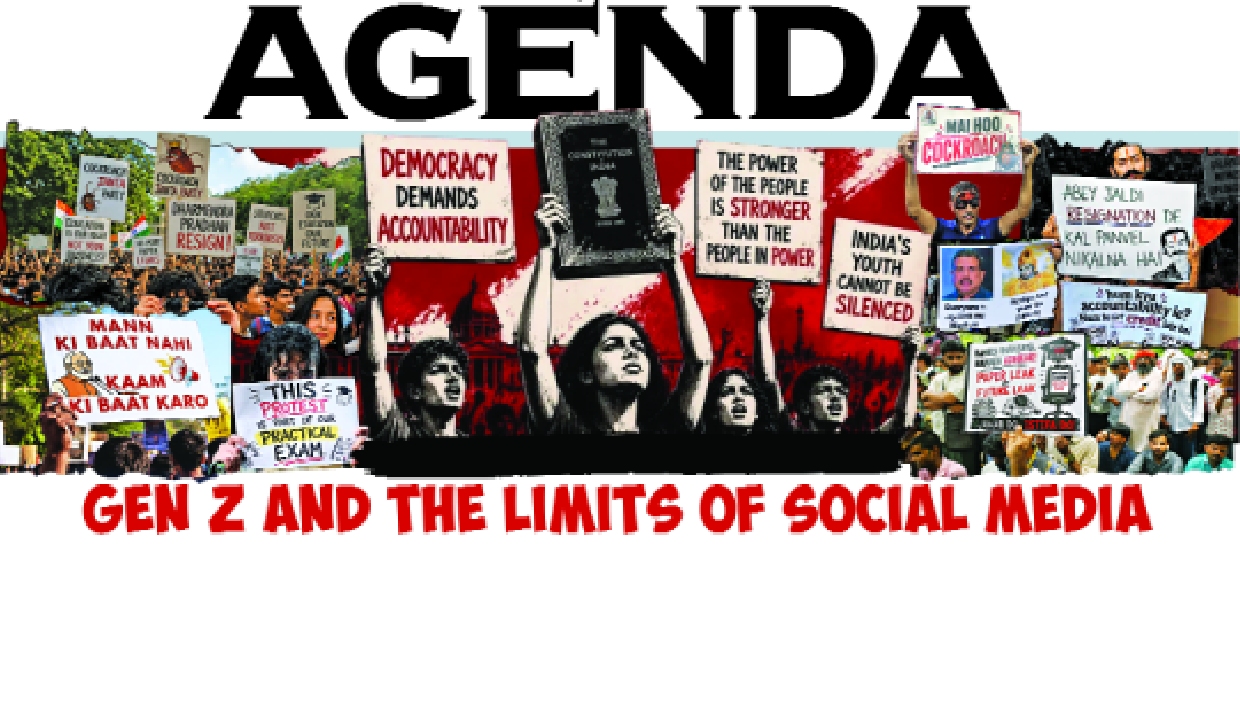
The recurring cycle of protests, riots, and election controversies often prompts impulsive calls to ban social media platforms. However, such measures are neither practical nor desirable in a world where these digital spaces serve as essential arteries for commerce, communication, and civic life. The central challenge of our era is not how to dismantle these platforms, but how to establish clear boundaries that hold tech companies accountable, protect the sanctity of free speech, and ensure that the digital landscape bolsters—rather than undermines—democratic stability.
The dangers of unchecked digital influence were recently laid bare during a series of intense protests sparked by a single, deliberately misconstrued quote. After the Chief Justice of India used the term “parasite” in a legal context to criticize individuals holding fraudulent degrees, the comment was stripped of its nuance and weaponized by online actors. Within 24 hours, a new political party was formed based on this false premise, and a movement was born. While the Chief Justice later clarified his remarks, the correction failed to gain traction, illustrating a fundamental asymmetry: falsehoods spread with viral speed, while the truth—and subsequent corrections—rarely achieve the same reach.
This phenomenon of digital manipulation reached a tipping point during the subsequent unrest, where online discourse devolved into chaos. Viral claims—ranging from fabricated reports of military tanks entering the capital to AI-generated deepfakes of high-ranking officials—were used to mobilize crowds and justify the breaching of barricades near Parliament. While police intervention was necessary to address physical threats to national institutions, the broader “protest” was fueled by a mixture of deep-seated anger and coordinated misinformation. The selective nature of the outrage, which ignored verified corruption scandals while hyper-focusing on inflammatory narratives, suggested a highly organized campaign rather than a spontaneous grassroots movement.
The author argues that the solution lies not in banning platforms, but in regulating the “amplifiers.” Currently, there is a dangerous regulatory vacuum: a traditional news channel with a million viewers is bound by strict ethical codes and oversight, yet an anonymous social media handle with the same reach operates with total impunity. To restore balance, digital accounts that cross a certain threshold of followers should be treated as publishers. These entities must be held to a duty of care, requiring them to disseminate corrections with the same vigor as their original claims and to maintain transparency regarding paid content.
Simultaneously, Big Tech companies must be compelled to implement robust safety measures. While X has introduced community-driven fact-checking, platforms like Instagram remain vulnerable to unchecked disinformation, particularly among younger demographics. As international oversight bodies have warned, community-based notes are an insufficient defense against organized misinformation during election cycles or periods of crisis. Therefore, both the government and the judiciary must mandate that companies like Meta implement effective, localized fact-checking systems before, rather than after, the next major flare-up.
Ultimately, the debate is not about silencing the Indian public, but about redefining the responsibilities of those who command vast digital audiences. The Prime Minister’s recent decision to show restraint and pardon those who abused him demonstrates a commitment to democratic tolerance, even when faced with extreme provocation. However, restraint from the state must be met with responsibility from the citizens. In the modern digital age, sharing unverified information is not a neutral act; it is a form of authorship. When an individual speaks to millions, they must accept the weight of the responsibility that comes with that influence.


