









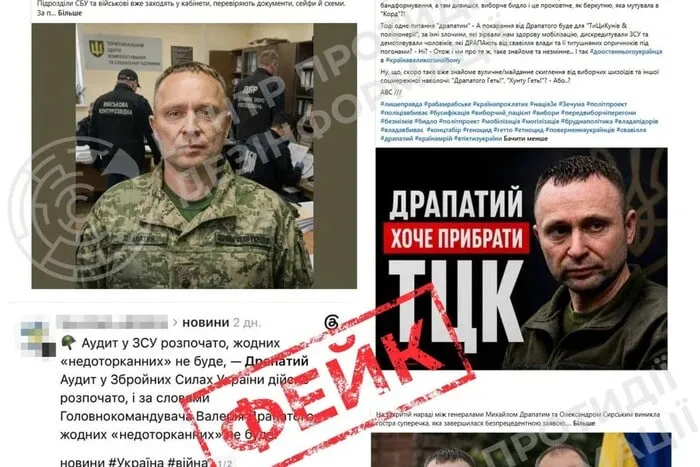
The Center for Countering Disinformation (CPD) has issued a formal warning regarding a sophisticated and large-scale Russian information warfare campaign specifically targeting Major General Mykhailo Drapaty, the Commander-in-Chief of the Armed Forces of Ukraine. According to the CPD, Russian state-aligned agents are actively disseminating fabricated statements, manufactured quotes, and malicious disinformation campaigns attributed to the General. The authorities warn that these digital operations are meticulously designed to manipulate public perception and erode trust in the leadership of the Ukrainian defense establishment.
The mechanism of this disinformation strategy relies heavily on the proliferation of false narratives across major social media platforms, including Facebook and Threads. Through the use of automated bot networks, propagandists are circulating inflammatory rumors regarding alleged internal conflicts among Ukrainian military leadership—ranging from fabricated reports of physical confrontations between generals to rumors concerning widespread, unverified audits and inspections within military units. These narratives are further bolstered by unfounded claims regarding the total disbandment of Territorial Recruitment Centers (TCC) or the forced deployment of all personnel to the front lines, creating a sense of instability within the Ukrainian interior.
Beyond simple rumor-mongering, the CPD highlights a deeper, more malicious intent behind these activities: the systematic attempt to sow discord and division within the Ukrainian Defense Forces. By attributing fake statements directly to Major General Drapaty, the hostile actors aim to manufacture disillusionment among the public. The objective is to create highly inflated, unrealistic expectations of military operations and subsequently frame the inevitable reality as a failure on the part of the commander, thereby using disinformation to force a decline in public morale and confidence in the military chain of command.
Compounding these domestic destabilization efforts, analysts also point to the increasingly blurred lines between the ongoing conflict in Ukraine and broader regional tensions, such as those in the Middle East. While the CPD has explicitly clarified that there is currently no official evidence or credible intelligence suggesting that Iran is preparing to launch a direct strike against Ukrainian territory, the synthesis of these geopolitical theaters remains a point of concern. The propagation of fear—especially regarding the potential reach of Iran’s medium-range ballistic missile arsenal—serves as a secondary tactic to keep the Ukrainian public in a state of constant anxiety and uncertainty.
Military analysts continue to monitor the capabilities of foreign missile systems, acknowledging that while Iran possesses hardware theoretically capable of long-range engagement, the current disinformation regarding such strikes is largely speculative and lacks empirical support. By interweaving these global confrontation narratives with local military scandals, Russian propagandists hope to trap the Ukrainian information space in a cycle of paranoia. The CPD emphasizes that these tactical maneuvers are not isolated incidents but represent a coordinated, broader strategic effort to weaken Ukraine from within by turning its citizens against their own military leadership.
In response to this surge in digital aggression, the Center for Countering Disinformation has issued a strong advisory to the public, urging extreme caution when encountering viral reports about the Armed Forces. Authorities stress the necessity of relying exclusively on official communication channels for updates regarding military command, personnel changes, or operational shifts. By verifying information through recognized, transparent sources and disregarding unvetted social media rumors, the public serves as the primary line of defense against the ongoing information war intended to undermine the national unity of Ukraine during this critical juncture.


