


New Research Reveals How Source Credibility and Intent Shape Reactions to Health Misinformation
The Dynamics of Trust and Correction
A recent study involving 789 U.S. adults has shed new light on how the public processes health-related misinformation, particularly when the source of that information is either a trusted medical professional or a political figure from the opposition. Conducted in April 2025, the research utilized a rigorous 2x2x3 experimental design to determine whether the perceived intent behind a false statement—whether it was accidental, intentional, or expressed with uncertainty—changes how individuals respond to subsequent corrections. The study, which mirrors previous psychological investigations into source credibility, sought to understand the “expectation violation” gap: the psychological friction that occurs when reliable sources share false information.
The Pre-Correction Landscape
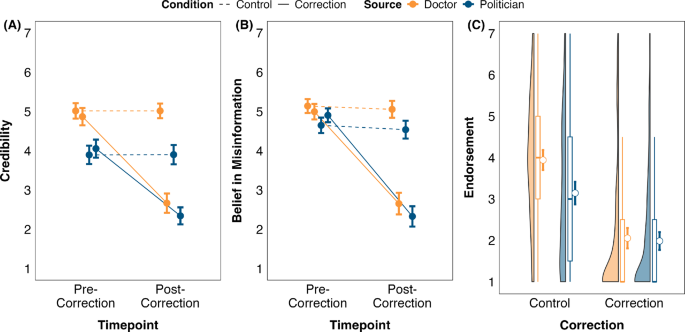
Before any corrections were issued, the study established a clear hierarchy of trust. Participants held doctors in significantly higher regard than politicians from their political out-group across all metrics. Prior to the correction, medical professionals were viewed as more credible and their claims were believed more readily. Interestingly, the study found that when a source expressed uncertainty about a claim, their initial credibility dropped significantly compared to those who presented information with certainty, regardless of whether that information ended up being true or false. This suggests that the public interprets “hedging” or doubt in a communication not as a sign of intellectual honesty, but as a lack of authority.
The Impact of Corrective Frames
Once the participants were presented with a correction, the researchers analyzed how the framing of the initial error influenced future trust. They found that credibility plummeted fastest when the error was revealed to be intentional—specifically, when the source was exposed as lying for personal financial gain. While this “intentional” frame caused the most significant drop in credibility, the study noted that the reduction in trust was largely universal; there was no statistically significant difference in how much credibility was lost between doctors and politicians. This implies that while doctors start with a “credibility buffer” that politicians lack, they are equally susceptible to sharp down-ratings once their accuracy is compromised.
Expectation Violations and the “Doctor Premium”
A recurring theme throughout the findings was the concept of “expectation violations.” When a politician shares inaccurate information, the public appears largely unsurprised, given the generally lower baseline expectations for political figures. However, when doctors share misinformation, they violate the public’s core expectations of the medical profession. This violation effect was consistent across all conditions, meaning the public’s disappointment when a doctor errs is significantly deeper than when a politician does. Despite this frustration and the subsequent correction, the study found that the “prestige” of the medical title remains sticky—people were still more likely to believe new, uncorrected misinformation coming from a doctor than from a politician, even after the initial correction.
Nuances in Belief Reduction
While the study found that corrections work in lowering belief in false claims, the results on “belief reduction” were more complex. While the “intentional” frame led to a larger reduction in belief than the “uncertain” frame, the results for the “unintentional” (accidental) frame were less clear-cut. Furthermore, the researchers noted that the differences in how participants adjusted their beliefs across these frames were subtle. Despite the emotional impact of learning that a source lied, the actual statistical shift in discarding false claims was modest, pointing to a persistent “belief echo” where the original misinformation continues to hold sway even after a formal correction has been issued.
Conclusion: The Resilience of Authority
The study concludes on a sobering note for public health communication: while corrective information is essential, it is often insufficient to fully repair the damage done when trusted authorities, particularly doctors, spread misinformation. The fact that participants continued to give credence to new claims from doctors—even after those doctors were revealed to be inaccurate—suggests that institutional trust is incredibly difficult to shed. Ultimately, the research underscores that while public perception is sensitive to the “intent” behind a lie, the initial perceived authority of the messenger acts as a persistent filter that shapes how information is processed, even in the light of correction.