








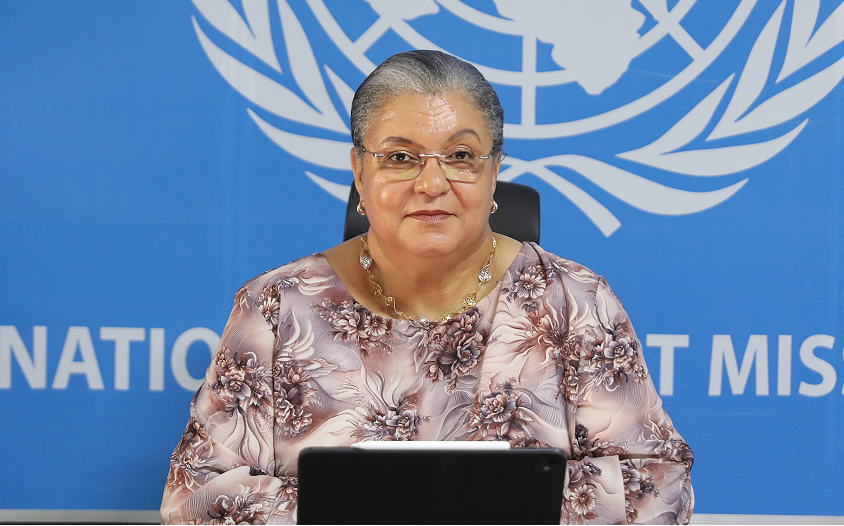
The UN Secretary-General’s Special Representative for Libya, Hanna Tetteh, has issued a grave warning to the UN Security Council regarding a dangerous surge in hate speech and coordinated disinformation campaigns directed at humanitarian workers and UN agencies within Libya. Tetteh categorically refuted malicious rumors alleging that the United Nations intends to resettle migrants or refugees in the country, noting that such fabrications have directly incited violence and vandalism against UN facilities in Tripoli. This hostile environment, she argued, not only misleads the public but also critically undermines the safety of those working to provide essential aid in an already fragmented nation.
Despite these volatility-driven challenges, Tetteh announced the successful conclusion of the six-month “Structured Dialogue” process, which brought together roughly 120 diverse Libyan participants from across the political spectrum. With 35 percent of the participants being women, the initiative yielded nearly 600 comprehensive recommendations. These proposals establish a roadmap for restoring unified state institutions, improving public resource management, and creating a stable legal framework for credible national elections. Tetteh emphasized that these recommendations are essential for bridging the divide between Tripoli and Benghazi and addressing the structural deficiencies that have long plagued the nation.
On the political and electoral front, Tetteh reported facilitating “4+4” meetings involving key military and political factions, including the Government of National Unity and General Haftar’s forces. These talks have yielded a preliminary accord on restructuring the High National Elections Commission and selecting its leadership, alongside the commencement of substantive negotiations regarding electoral laws. Tetteh nonetheless cautioned the Security Council that she is prepared to propose alternative measures should institutional paralysis persist. She asserted that the Libyan people’s right to self-determination through the ballot box cannot remain indefinitely held hostage by the stubbornness of the current political elite.
The economic outlook provided by the envoy was equally somber, as she highlighted how systemic corruption and fuel smuggling have severely eroded the purchasing power of ordinary Libyan citizens. Citing reports from the Audit Bureau and the Anti-Corruption Authority, Tetteh documented astronomical increases in fuel consumption by various forces—including a 621 percent surge in gasoline withdrawals by security agencies—which she attributed to large-scale illicit smuggling operations. Furthermore, she exposed deep-seated corruption within the pharmaceutical sector, where government officials have allegedly leveraged private ownership stakes to secure massive, unexplained increases in drug-import financing.
Security concerns remain a volatile flashpoint, with Tetteh condemning recent clashes in Zawiya that left 13 dead and forced the temporary closure of a critical oil refinery. She sharply criticized the use of heavy weaponry within residential zones, warning against the catastrophic risk to civilians. Conversely, she offered a note of optimism regarding the Joint Technical Border Security Coordination Team, which has made measurable strides in launching joint operations in southern border regions and activating security coordination hubs in both the east and west, signaling potential for state-level cooperation if security cooperation remains insulated from political friction.
In her final assessment of the human rights and judicial landscape, Tetteh highlighted the risks posed by divided constitutional institutions, which threaten to create parallel, competing legal systems. While she acknowledged the positive development of over 400 prisoner releases during Eid al-Adha, she remained critical of ongoing arbitrary detentions and the reported deaths of detainees in eastern Libya. Concluding her address, the envoy asserted that the primary obstacle to peace is no longer a lack of tools or viable political options, but an acute dearth of political will among Libya’s leaders to prioritize national stability over personal power.


