



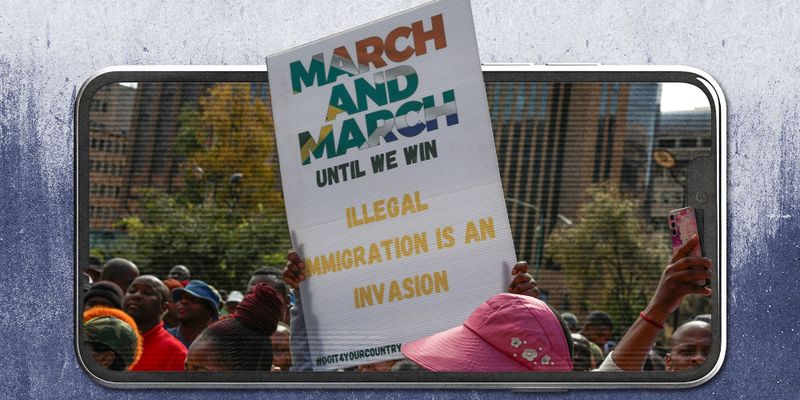
South Africa is currently navigating a precarious social climate as digital platforms witness a surge in content targeting foreign nationals. Ahead of a self-imposed “deadline” of 30 June 2026 promoted by anti-immigrant groups, social media has been flooded with misinformation, disinformation, and material inciting hostility. This trend is deeply concerning given the nation’s history of Afrophobic violence, including the deadly outbreaks of 2008, 2015, and 2019. Experts warn that the convergence of inflammatory rhetoric and systemic socio-economic frustration creates a dangerous environment whereScapegoating migrants becomes a volatile political tool, threatening to turn online narratives into tangible real-world harm.
The proliferation of harmful content includes fabrications attributed to state institutions, dehumanizing imagery, and veiled threats against migrants. While isolated posts may appear insignificant, they represent a coordinated effort to polarize society and mobilize communities against a specific group. By framing foreign nationals as the sole source of unemployment and crime, these narratives exploit genuine public grievances. Digital platforms, often prioritized by engagement metrics, have been slow or reluctant to remove such content, effectively allowing misinformation to flourish and blurring the line between protected speech and dangerous incitement.
South African law does not permit the advocacy of hatred that leads to incitement of violence, a principle reinforced by multiple Constitutional Court rulings, including the Qwelane and Kopanong judgments. These cases clarify that constitutional rights to free expression are not absolute and cannot be used to undermine rights to dignity, equality, or access to essential services like healthcare and education. The judiciary has explicitly recognized that social media can be a vehicle for inciting harm, yet a gap remains between this legal reality and the practical enforcement of safety standards on digital platforms, which continue to struggle with corporate accountability.
The role of leadership—both political and institutional—is vital in this volatile period. Silence from authorities often emboldens those stoking animosity, normalizing threats and suggesting that targeting marginalized groups will go unpunished. History shows that violence rarely erupts spontaneously; it is preceded by dehumanizing language and strategic scapegoating. Whether referencing the “alien” rhetoric of the 2008 media landscape or the recent misuse of digital platforms to incite unrest, the patterns of past conflicts serve as a stark warning. Media organizations also bear significant responsibility, as “juniorization” of newsrooms has led to a dangerous trend of parroting social media misinformation rather than upholding ethical, evidence-based journalism.
To mitigate the risk of looming violence, a concerted, multi-stakeholder effort is required. The government must provide clear communication regarding migration policies to dispel myths, while law enforcement must specifically monitor and investigate credible threats of violence. Digital platforms are urged to enforce their own community standards, and political actors must resist the temptation to exploit anti-migrant sentiment for electoral gain during the lead-up to the 2026 local government elections. Furthermore, initiatives such as the Social Media for Peace program are working to strengthen ethical reporting standards among journalists to ensure the media acts as a pillar of democracy rather than a transmitter of hate.
Ultimately, the safety of foreign nationals and the stability of South African democracy depend on resisting the politics of division. Public vigilance is essential; citizens are encouraged to report hate speech and disinformation to monitoring bodies like Real411 to help track and disable coordinated networks of toxicity. As South Africa faces this moment of heightened tension, it must recognize that scapegoating vulnerable groups offers no path to solving systemic economic challenges. The upcoming period will be a defining test of the nation’s commitment to its democratic values, revealing whether the country chooses to prioritize social cohesion or succumb to the narratives of fear.