








Here is the summary of the IBERIFIER project announcement, structured into six paragraphs:
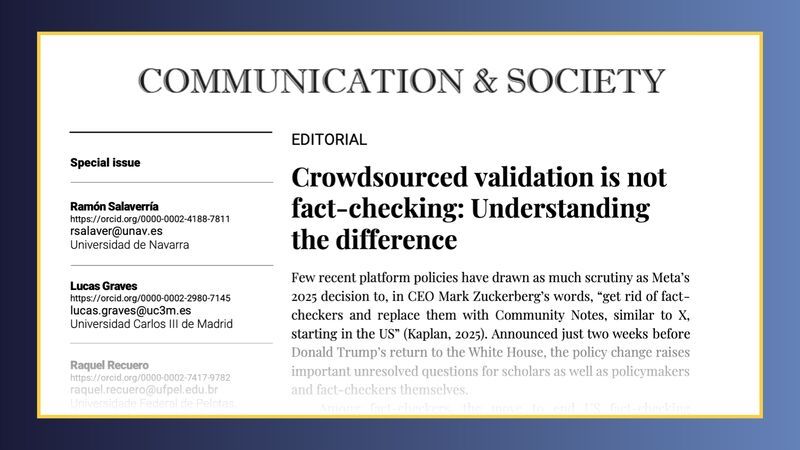
The scientific journal Communication & Society has officially released its highly anticipated special issue, “From Fact-Checking to Community Notes: Structural Changes in the Fight Against Disinformation on Social Media.” Published as Volume 39, Issue 1 (June 2026), this collection represents a critical milestone for the IBERIFIER Plus project, one of the fifteen regional hubs within the European Digital Media Observatory (EDMO) network. By making the entire issue available through Open Access, the editors aim to democratize access to academic insights regarding the rapidly evolving landscape of digital information governance and the ongoing struggle against sophisticated disinformation campaigns.
The editorial direction of this special issue was guided by a trio of distinguished scholars: Professor Ramón Salaverría of the University of Navarra, Professor Lucas Graves of the Carlos III University of Madrid, and Professor Raquel Recuero of the Federal University of Pelotas and the Federal University of Rio Grande do Sul. Their collective expertise has synthesized a series of international case studies that rigorously evaluate the effectiveness of contemporary policy shifts. The publication serves as both a retrospective analysis of past moderation hurdles and a forward-looking examination of the structural transformations currently reshaping the digital public sphere.
At the heart of the research lies a comprehensive investigation into the paradigm shift occurring across major social media platforms. For years, the industry relied heavily on professionalized, third-party fact-checking organizations to verify claims and label misleading content. However, the contributors to this issue highlight a decisive move toward user-driven models—most notably, the “Community Notes” feature. This evolution represents a fundamental change in how truth and consensus are negotiated online, moving away from centralized institutional authority and toward collective, crowdsourced assessment processes.
The studies contained within the volume contextualize these changes within a highly volatile geopolitical climate. The authors argue that the transition in moderation styles is not merely a technical update but a strategic response to unprecedented global pressures. From mounting legal scrutiny regarding potential foreign interference on platforms like TikTok, to the broader challenge of managing massive datasets in an era of geopolitical instability, the research underscores how platform architecture is increasingly entangled with the national interests and political agendas of sovereign states.
Furthermore, the special issue provides vital commentary on the impact of political turbulence on digital moderation policies. By analyzing the shifts in moderation strategies introduced following the start of Donald Trump’s second presidential term in January 2025, the researchers illustrate how political leadership directly dictates the boundaries of permissible speech and platform responsibility. The contributions reveal how administrative changes at the highest levels of government can force rapid, often precarious, pivots in how platforms define “misinformation,” leaving users to navigate a constantly shifting terrain of digital standards.
Ultimately, this edition of Communication & Society serves as a sobering assessment of the future of online discourse. By exploring the limitations and the potential of user-driven moderation, the IBERIFIER Plus project provides stakeholders, policymakers, and academics with a refined lens through which to view the next generation of social media oversight. As the industry continues to move away from professionalized fact-checking in favor of decentralized models, this research highlights the essential need for continued, evidence-based vigilance in protecting the integrity of the digital ecosystem.


