








Russia Escalates Disinformation Campaign to Justify Attacks on Kyiv’s Cultural and Civilian Infrastructure
Russian state-aligned media and intelligence-linked information channels have launched a coordinated, large-scale disinformation offensive designed to provide a veneer of legitimacy to ongoing aerial bombardments of Kyiv. According to an urgent report released by the Center for Countering Disinformation under Ukraine’s National Security and Defense Council (NSDC), Moscow is utilizing a standardized psychological warfare playbook to mask the targeting of non-combatant populations and historic landmarks. By reframing deliberate acts of terror as tactical strikes against legitimate military infrastructure, the Kremlin aims to insulate its command structure from international legal scrutiny while sowing discord within the Ukrainian public.
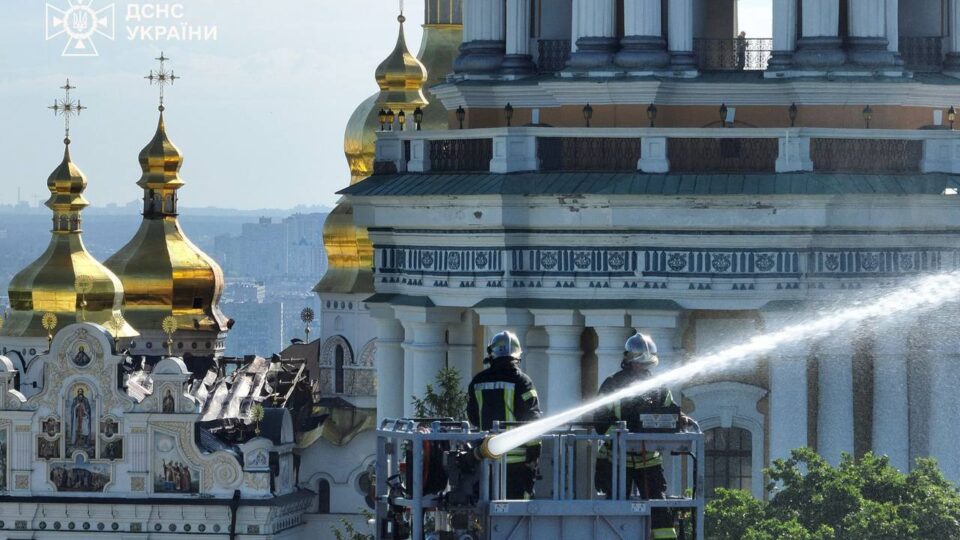
The core of this disinformation strategy relies on the strategic redirection of blame, often characterized by the rapid dissemination of conspiracy theories following major explosions in the capital. A primary example cited by the NSDC is the recent large-scale fire at the Kyiv Pechersk Lavra, a globally recognized UNESCO World Heritage site. Rather than acknowledging the potential impact of indiscriminate Russian missiles, state-controlled nodes have aggressively pushed a narrative that the destruction was a “Ukrainian provocation” or a case of “self-arson,” attempting to portray the Ukrainian government as an entity that would willingly incinerate its own most sacred cultural assets.
Similar patterns of deception have been deployed regarding the strike on the High Anti-Corruption Court building. In this instance, Russian propagandists have sought to distance their military from the resulting damage by crafting elaborate, unfounded theories of internal Ukrainian sabotage. By attributing the destruction of judicial and administrative nodes to the Ukrainian authorities themselves, these narratives seek to erode domestic and international trust in the security of the Ukrainian state apparatus, suggesting that the government is engaged in a clandestine war against its own foundational institutions.
Furthermore, the Russian propaganda machine has moved to widen the definition of what constitutes a “legitimate military target.” In a dangerous escalation of rhetoric, the historic Dovzhenko Film Studio has been publicly labeled as a “breeding ground for propaganda,” effectively attempting to strip the cultural institution of its protected civilian status. This campaign of reclassification is not limited to isolated sites; intelligence trackers have noted that Russian media outlets are increasingly characterizing virtually any building in Kyiv as a “military facility,” alleging that the city is saturated with hidden weapons-production sites. This broad-brush labeling serves the specific tactical purpose of preemptively justifying future strikes against civilian residential and commercial blocks.
The campaign also leans heavily on the recurring trope that Ukrainian air defense systems are the actual perpetrators of damage to civilian infrastructure. By frequently asserting that debris or failed interceptions are responsible for the destruction of apartment complexes and historic sites, Moscow attempts to mitigate the public relations fallout linked to its high-precision missile campaign. This narrative serves a dual purpose: it aims to convince the civilian population that their own defenses are their primary threat while simultaneously obfuscating the fact that the initial, illegal offensive acts were initiated by Russian forces.
In a definitive response, the NSDC’s Center for Countering Disinformation has issued a stern condemnation of these tactics, asserting that Russia bears sole culpability for every civilian death and every ruined cultural heritage site in Kyiv. The agency maintains that no amount of sophisticated narrative manipulation, conspiracy theory generation, or bureaucratic attempts to reclassify civilian assets can disguise the nature of these actions under international law. As the conflict intensifies, the Ukrainian authorities warn that these disinformation efforts are a vital component of Russia’s war strategy, intended to facilitate further war crimes by desensitizing the international community to the reality of the destruction occurring on the ground.


