






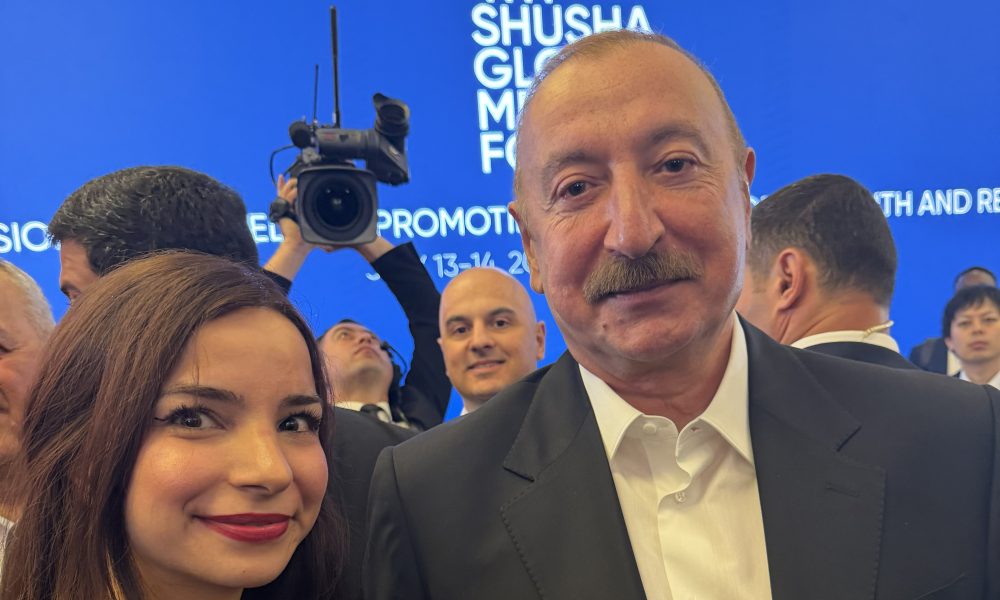
The 4th Shusha Global Media Forum, held from July 13–14 in the liberated city of Shusha, brought together 160 media leaders, experts, and officials from 53 countries to discuss the role of journalism in fostering peace and rebuilding trust. Hosted by the Azerbaijani government, the event underscored Azerbaijan’s commitment to transparency by granting international journalists unprecedented direct access to President Ilham Aliyev. Throughout the forum, discussions spanned a wide array of critical issues, including the reconstruction of Karabakh, post-war peace processes with Armenia, the influence of artificial intelligence, and Azerbaijan’s evolving identity as a burgeoning “middle power” on the global stage.
A central theme of the forum was the battle against misinformation, which the Azerbaijani government views as a lingering obstacle despite its military victory in the 44-Day War. Forum participants analyzed how international media—particularly outlets in France—have historically relied on Armenian lobbying to shape biased coverage, often ignoring the reality of the 20% of Azerbaijani territory occupied for decades. By hosting the event in Shusha, Baku aimed to contrast the destruction caused during the occupation with the rapid, systematic reconstruction efforts undertaken over the last five years, inviting global media to witness the transformation of the region firsthand.
The forum served as a poignant venue for historical reflection, featuring visits to the Khojaly Genocide Memorial and the Victory Park in Khankendi. The commemorative visit to the Khojaly site reminded attendees of the 1992 massacre, where 613 Azerbaijanis were killed, and highlighted the broader human cost of the conflict, which saw over one million people forcibly displaced and billions of dollars in infrastructure destroyed. Conversely, the inauguration of Victory Park in Khankendi offered a symbolic celebration of the 44-day military success, with 44 steps leading to a triumphal arch designed to represent the strength and resolve of the Azerbaijani armed forces.
President Ilham Aliyev used the platform to reiterate Azerbaijan’s desire for a lasting, peaceful resolution with Armenia. During his wide-ranging Q&A session, he emphasized that the objective of the Azerbaijani military was never to seize Armenian land, but exclusively to restore its own internationally recognized borders. By pointing to potential logistics corridors like the Zangezur route, the President signaled that regional development and cooperation remain the primary goals of his administration, characterizing the ongoing integration of the region as a benefit to, rather than a threat to, current neighbors.
A significant, implicit element of the forum was its focus on decolonialism and sovereignty. Responding to questions regarding media independence, President Aliyev drew parallels between his nation’s struggle for sovereignty following the collapse of the Soviet Union and the challenges faced by other nations combatting neo-colonial influence. The inclusion of attendees from French Polynesia during the gala, coupled with sharp critiques of Paris’s foreign policies, underscored Baku’s clear message: it views itself as a proactive supporter of international independence movements, positioning itself firmly against what it describes as the ongoing failures of colonial empires.
Ultimately, the 4th Shusha Global Media Forum succeeded in projecting a narrative of a nation actively transitioning from post-conflict reconstruction to a position of geopolitical influence. By facilitating rigorous debate, showcasing the modernization of Karabakh, and unapologetically addressing sensitive historical and diplomatic issues, Azerbaijan sought to redefine its image in the international consciousness. The event reinforced the country’s stance that the restoration of territorial integrity and the promotion of a factual, independent media discourse are the essential pillars upon which the future of the region—and its relations with the wider world—must be rebuilt.


