





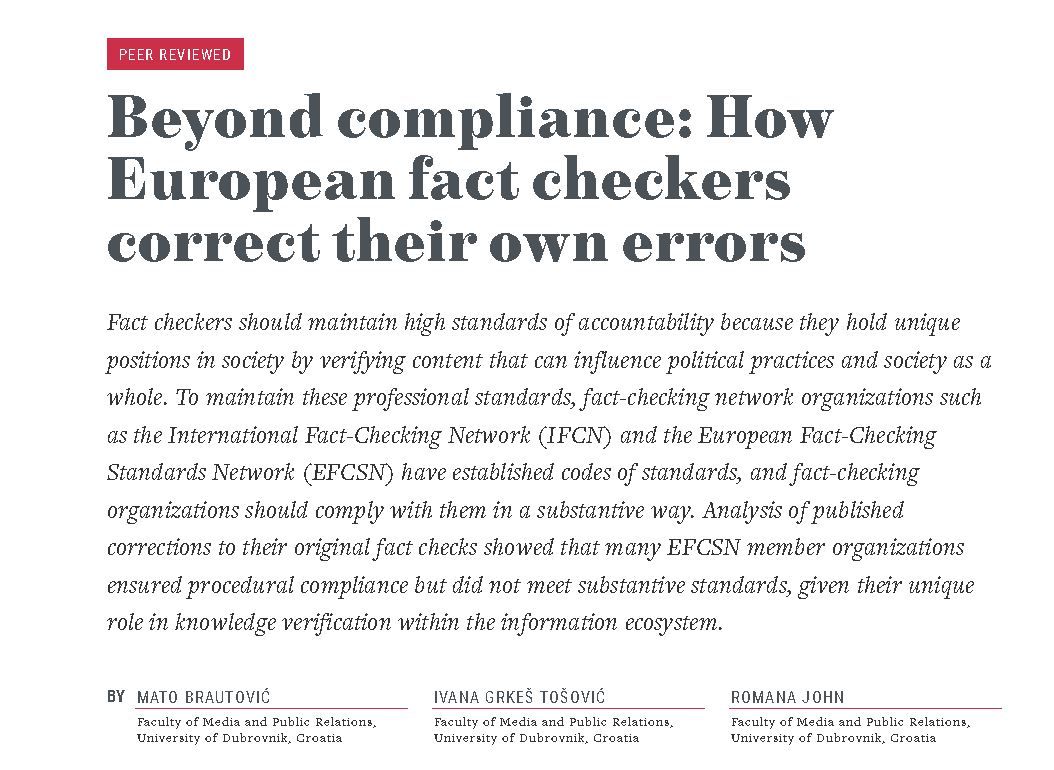
The University of Dubrovnik has unveiled a pioneering study titled “Beyond compliance: How European fact-checkers correct their own errors,” shedding new light on the self-regulatory mechanisms underpinning the modern media landscape. Authored by Mato Brautović, Ivana Grkeš Tošović, and Romana John, the research was recently featured in the prestigious Harvard Kennedy School Misinformation Review. This publication, affiliated with the Shorenstein Center on Media, Politics and Public Policy, provides a significant academic platform for exploring how organizations dedicated to truth-seeking maintain their own integrity when faced with the fallibility of their own processes.
The study serves as a critical exploration of the transparency efforts currently practiced by European fact-checking entities. As these organizations become the frontline defense against the rapid spread of disinformation, the accountability of their corrective procedures has come under intense academic scrutiny. The authors investigate whether these entities treat their own inaccuracies with the same rigorous standard applied to the misinformation they identify in the public sphere, moving beyond mere regulatory compliance to foster a culture of genuine institutional accountability and public trust.
Central to the research is the discovery that effective error correction within the fact-checking community is not just a procedural formality but a cornerstone of credibility. By analyzing the protocols of various European outlets, the team from the University of Dubrovnik highlights the challenges associated with acknowledging mistakes—a task that, if executed with transparency, can actually insulate organizations against accusations of bias. The article serves as a barometer for the maturity of the fact-checking industry, showing how these organizations navigate the delicate balance between maintaining authority and admitting human oversight.
The findings presented in the Harvard Kennedy School Misinformation Review hold profound implications for the broader EDMO (European Digital Media Observatory) network, of which the contributing researchers are a segment through ADMO. As fact-checking roles evolve alongside technological advancements like artificial intelligence, the standard for ethical journalism continues to shift. The study suggests that adopting standardized, accessible correction policies is a path forward for fact-checkers to reinforce their independence, even when their own content is flawed or incorrectly assessed.
Furthermore, the paper provides a roadmap for future institutional policy-making within the digital media sector. By highlighting best practices alongside identifying common pitfalls, Brautović, Grkeš Tošović, and John offer actionable insights that peer organizations can implement to enhance their editorial standards. This work is essential reading for journalists, media scholars, and policymakers interested in the structural integrity of independent information verification in an era where trust in traditional media is constantly under siege.
In conclusion, the publication of this research marks a significant milestone in the ongoing efforts to bolster truth-seeking efforts across Europe. By turning the magnifying glass onto the fact-checkers themselves, the authors from the University of Dubrovnik have contributed a vital piece of scholarship that advocates for radical transparency. As digital misinformation continues to threaten democratic processes, this study confirms that the most effective remedy is an unwavering commitment to self-correction, ensuring that those who monitor the truth are held to the highest possible standard.