









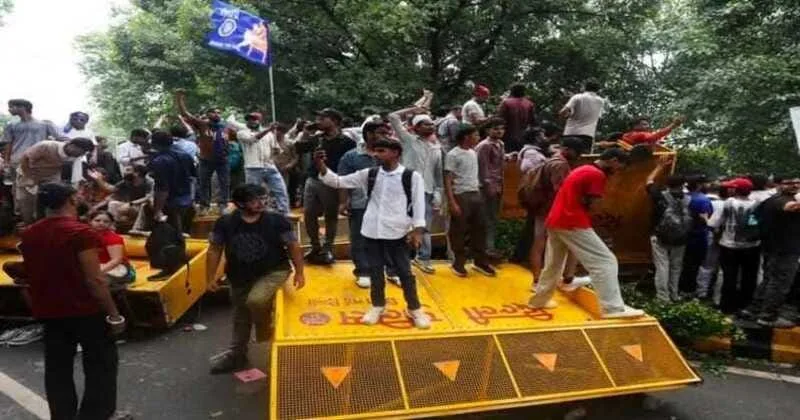
The recent protests surrounding the NEET paper leak, while rooted in a genuine and critical demand for accountability, have become a focal point for a troubling convergence of domestic misinformation and external interference. While the students’ right to protest is an essential pillar of Indian democracy, concerns have emerged regarding the exploitation of these demonstrations by actors seeking to distort the national discourse. The Delhi Police recently disclosed a coordinated campaign involving the use of doctored videos and AI-generated deepfakes, noting that over 400 social media accounts operating from within Pakistan were instrumental in spreading falsehoods. This revelation forces a difficult examination of why such malicious narratives find ready amplifiers within India, suggesting that a lack of digital discernment is undermining national interest.
Beyond the immediate scope of domestic agitation, the incident highlights a broader critique of how foreign narratives—described by some as a form of “cultural imperialism”—shape the global perception of India. Drawing on concepts from senior journalist Umesh Upadhyay, the argument is made that a one-sided global flow of information allows Western media to dominate the narrative concerning developing nations. This influence often manifests as a predefined lens through which India’s internal political developments are filtered. In the context of the recent protests, this has resulted in reporting that appears less interested in the specific grievances of students and more focused on characterizing India’s democratic processes as inherently unstable or politically fractured.
International outlets, including Reuters, The Guardian, and Al Jazeera, have been scrutinized for framing the NEET controversy primarily as a manifestation of Prime Minister Narendra Modi’s declining political appeal. By categorizing the protests—at times utilizing hyper-partisan terminology like the “Cockroach” movement—these reports often move beyond objective journalism into the realm of perception-building. Such framing intentionally or unintentionally feeds into a “Breaking India” narrative, portraying the government as fragile and the country as deeply divided. This pattern of reporting consistently prioritizes a specific political antagonism over the complex nuances of actual domestic policy debates.
The Associated Press and other prominent agencies have similarly been observed framing these student confrontations as significant challenges to the ruling government’s stability. This repetitive style of reporting raises fundamental questions about whether these outlets are documenting India’s democratic discourse or attempting to manipulate it to fit a predetermined international narrative. By amplifying episodes that serve to discredit the state, these media organizations risk becoming tools for interests that seek to weaken India’s global standing. Consequently, the distinction between legitimate investigative reporting and ideologically driven projection has become increasingly blurred.
This situation serves as a stark reminder of the vulnerability of internal domestic issues to external appropriation. While citizens are rightfully entitled to protest for justice and administrative transparency, the ease with which these movements can be hijacked by hostile propaganda chains should remain a matter of national concern. The convergence of domestic amplifiers and foreign media narratives creates an environment where a legitimate domestic grievance can quickly be morphed into a tool of strategic disparagement against the Indian state and its nationalist agenda.
Ultimately, navigating a mature democracy requires a balance between the right to dissent and the responsibility of guarded awareness. It is essential for the Indian public to exercise vigilance, ensuring that the pursuit of accountability for administrative failures does not inadvertently transform into an instrument for external actors seeking to undermine the nation. A, robust and self-aware democracy must be capable of correcting its internal course, but it must do so without losing sight of the geopolitical realities that seek to leverage internal unrest for external interests.


