









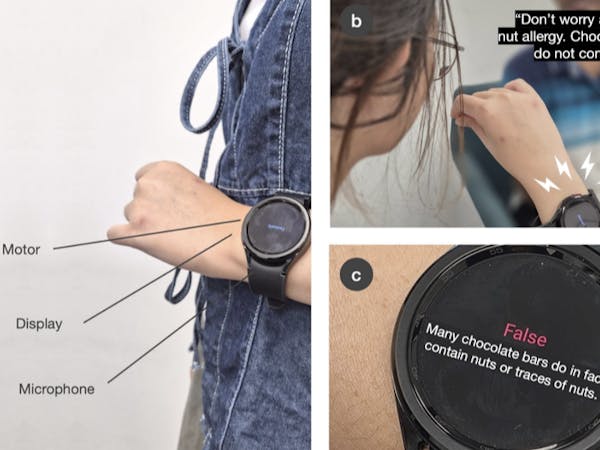
In an era defined by the rapid dissemination of falsehoods, misinformation has evolved far beyond the digital confines of social media feeds and unreliable blogs. Today, dubious claims are frequently woven into the fabric of our daily lives—emerging in casual water-cooler conversations, boardroom meetings, academic lectures, and popular podcasts. Because these interactions often occur in real-time, the window to verify the accuracy of a statement frequently closes before one has the chance to challenge it. Recognizing this challenge, researchers have developed “FactNudger,” a cutting-edge wearable system designed to act as a discreet personal fact-checker that monitors live speech and provides instant, haptic feedback when it detects potentially misleading information.
The architecture of FactNudger is built upon the Android and Wear OS platforms, utilizing a sophisticated pipeline that listens to surrounding audio and transcribes it in real-time. As the conversation progresses, the system identifies verifiable claims and cross-references them against web-based data. To avoid the constant annoyance of interruptions, the device is programmed to exercise discretion; it determines whether a piece of information requires immediate action, needs further context to be fully understood, or is best ignored. This intelligent filtering ensures that the user is not overwhelmed by the device’s underlying analytical processes but remains informed during critical discussions.
When the system encounters a claim directly contradicted by credible sources—particularly regarding sensitive topics like health, finance, or physical safety—it delivers a gentle vibration to the wearer’s wrist. A brief, explanatory summary appears on the smartwatch display, while a linked smartphone offers a deeper dive into the supporting evidence for those who wish to verify the data further. In rigorous testing using 125 previously fact-checked claims, the system achieved a 77% success rate in providing accurate verdicts. Furthermore, when presented with 50 complex conversational scenarios involving jokes, sarcasm, or fragmented sentences, the device accurately handled 80% of these cases, responding within an average of 3.5 seconds.
Beyond its technical performance, the research team sought to understand how such a device might fundamentally reshape human cognitive processes. In a controlled study involving 34 participants, researchers found that the FactNudger significantly decreased the users’ tendency to believe misinformation without inducing cynicism toward factual information. Those equipped with the device reported higher levels of confidence when rejecting false claims and initiated twice as many independent verification activities—such as conducting web searches or pausing videos—compared to the control group. Notably, this increase in critical thinking did not correlate with an increased sense of mental exhaustion, suggesting the device effectively lightens the burden of information processing.
However, the study also unveiled a critical psychological phenomenon: the “trust trap.” When the AI incorrectly flagged a true statement as false, participants became disproportionately skeptical of accurate information thereafter. Conversely, when the device failed to catch a lie, the impact on user perception was notably minor. This indicates that users may be prone to over-relying on the device when it provides an active warning, highlighting the danger of what researchers call “automation bias.” If a technology is perceived to be an authority, human users may suspend their own critical judgment, creating a risk where machine errors become the new source of misinformation.
As the development of FactNudger moves into the next phase, the research team aims to test the technology in real-world, unscripted environments. Moving from controlled labs to busy rooms will introduce significant hurdles, including high levels of background noise, regional dialects, and inevitable transcription errors. Should these engineers successfully navigate these complexities, the smartwatch of the future may transcend its current role as a mere pedometer or notification hub. Instead, it could become an essential augmented-reality tool, offering a quiet tap on the wrist as an early warning system against the erosion of truth in our daily interactions.


