









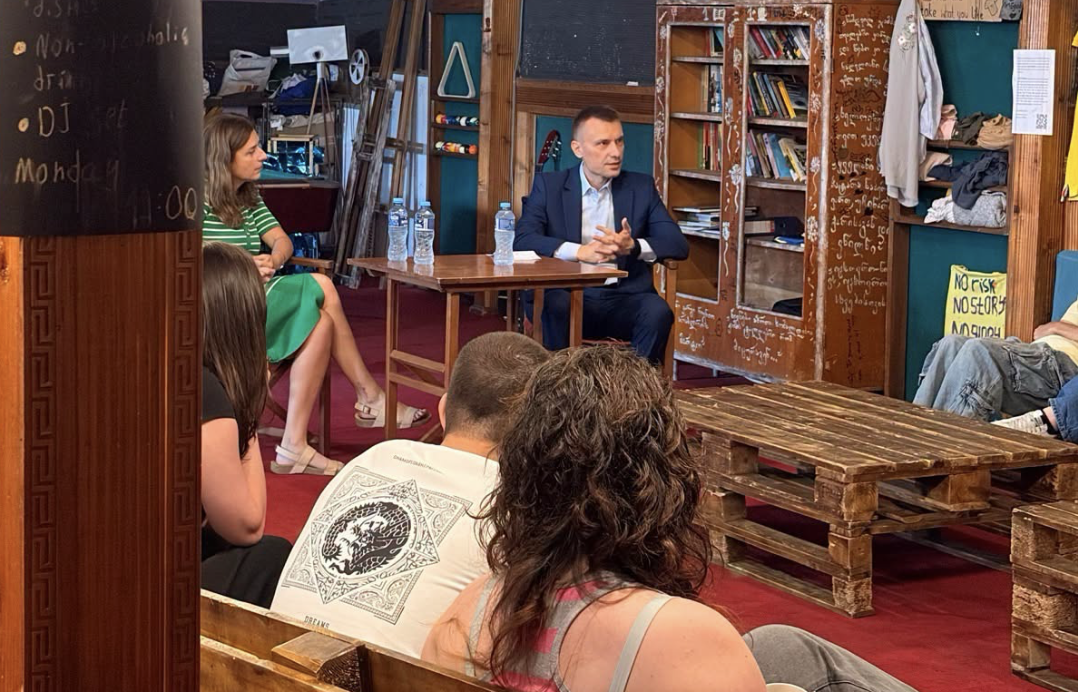
The Polish Embassy in Tbilisi has intensified its strategic communications and outreach initiatives within Georgia, launching a targeted campaign to counteract hostile disinformation campaigns that seek to undermine both Polish interests and broader European Union integration. By focusing on regional hubs outside the capital, the embassy is working to address the susceptibility of local populations to foreign influence operations. This latest effort culminated on June 26 in Zugdidi, where diplomatic representatives facilitated a high-level educational engagement designed to fortify the civil society foundations necessary for national resilience.
The event, which served as a dedicated assembly for local students and youth activists, featured a collaborative panel between Poland’s Head of Mission, Artur Gębal, and senior analysts from the Georgian Strategic Analysis Center (GSAC). The primary objective of the session was to unpack the complex mechanics of Russian information warfare, a phenomenon that has increasingly permeated the regional media landscape. By providing granular insights into these tactics, the organizers aimed to equip the next generation of Georgian leaders with the analytical tools required to distinguish between objective information and state-sponsored propaganda.
Central to the discussion was the concept of “societal resilience,” a pillar of defense that requires active participation from the citizenry. Participants engaged in a robust exchange regarding how information cycles are weaponized to destabilize democratic institutions and polarize public opinion in both Poland and Georgia. Experts from GSAC shared localized case studies, contrasting them with international experiences, to demonstrate that the challenges faced by Georgia are part of a broader, systemic threat that necessitates cross-border solidarity and a unified democratic response.
Beyond the immediate concerns of digital security and media literacy, the engagement served as a platform for discussing the procedural and geopolitical markers of institutional growth. Ambassador Gębal leveraged his country’s diplomatic experience to walk participants through the historical trajectory of Poland’s own path toward European Union membership. He highlighted the rigorous administrative, legal, and economic reforms that were essential to Poland’s transition, offering them as a practical roadmap for Georgia’s current efforts to align its domestic structures with EU standards and expectations.
The discourse underscored that the democratic process is not merely a political destination but a continuous engagement with European values. Gębal emphasized that Poland’s participation in the European project has provided it with unprecedented security and prosperity, outcomes that the government of Georgia is striving to achieve through its ongoing integration efforts. By contextualizing Poland’s historical successes in the context of the current Georgian landscape, the embassy provided a tangible example of how structural alignment with the EU can serve as a primary defense against external political coercion.
Looking forward, the success of the Zugdidi event signals a potential shift in how the Polish Embassy intends to conduct its outreach, favoring grassroots engagement over purely formal diplomatic channels. By fostering direct communication with the Georgian youth, the mission is effectively bypassing partisan rhetoric to build long-term, people-to-people ties. As disinformation continues to pose a significant hurdle to regional stability, such initiatives are expected to remain a centerpiece of the Polish-Georgian partnership, reinforcing a shared commitment to a democratic and European-anchored future.


