








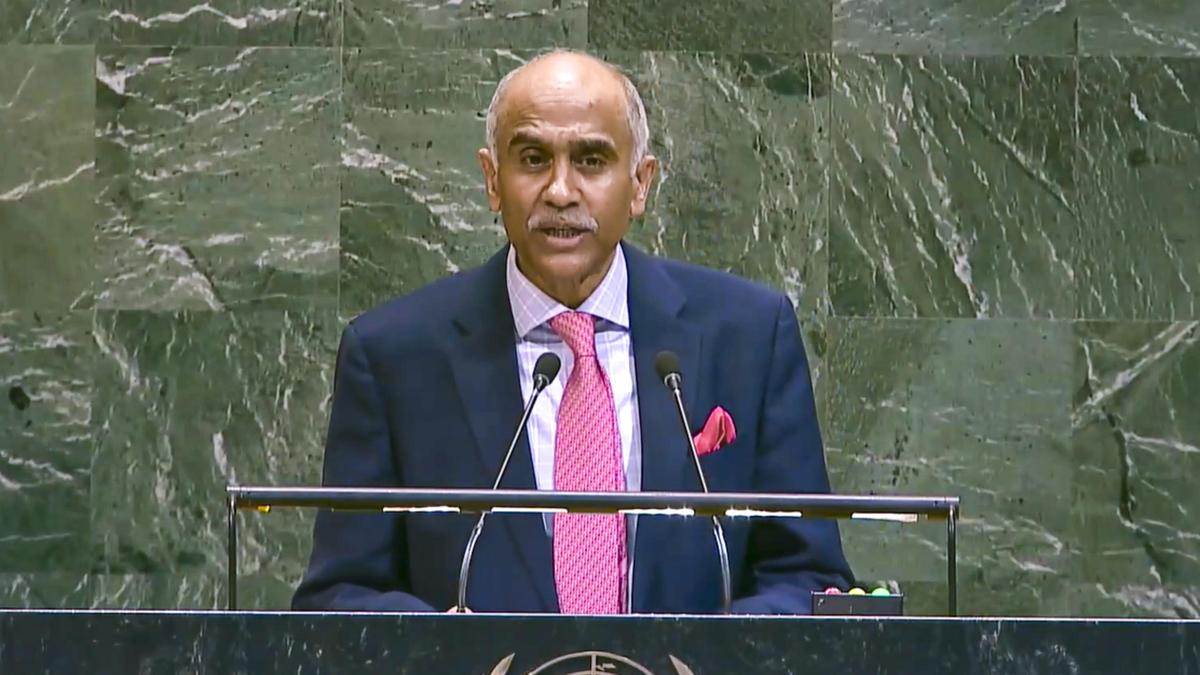
In a sharp diplomatic confrontation at the United Nations, India’s Permanent Representative to the UN, Ambassador Harish Parvathaneni, launched a scathing critique of Pakistan during a Security Council meeting focused on the humanitarian and security landscape of Afghanistan. The address served as a direct rebuke of Islamabad’s recent efforts to leverage religious terminology to deflect from internal instability, marking a significant intensification in the rhetorical battle between the two South Asian neighbors. At the heart of the dispute is Pakistan’s recent administrative branding of insurgent groups within its borders—particularly those in the Balochistan province—as “Fitna al-Hindustan.”
Ambassador Parvathaneni characterized Pakistan’s decision to label domestic militant outfits with this specific religious term as an instance of “officially sponsored misinformation and disinformation.” The Pakistani government’s internal directive, which alleges without evidence that these groups are acting as proxies for India, was described by the Indian envoy as a calculated attempt to scapegoat New Delhi. Parvathaneni argued that by dressing these claims in religious rhetoric, Islamabad is attempting to sanitize its domestic failures while baselessly maligning its neighbor on the international stage.
The Indian envoy further alleged that the propagation of these narratives is the result of an “organized factory of hate” engineered by the Pakistani “deep state.” According to Parvathaneni, this strategy is designed to maintain a state of permanent hostility toward India, thereby allowing security elites to retain control over national resources and consolidate political power. He suggested that such diversionary tactics are essential for the ruling establishment to prevent the Pakistani citizenry from focusing on the deepening political and economic crises currently paralyzing the nation.
Drawing attention to recent structural changes within Pakistan’s political and military hierarchy, the Ambassador pointed to the enactment of the 27th Constitutional Amendment as evidence of a “de facto coup” by the military establishment. This amendment, which facilitated the creation of the position of Chief of Defence Forces (CDF) and the subsequent appointment of Field Marshal Asim Munir, was cited by India as proof of the military’s tightening grip on state apparatuses. New Delhi views this centralization of power as a move that further erodes democratic norms while shielding military actions from civilian oversight.
Beyond the internal issues of the Pakistani state, the Indian delegation also voiced strong condemnation of Pakistan’s military airstrikes against targets in Afghanistan. Ambassador Parvathaneni rejected Islamabad’s characterization of these actions as counter-terrorism, labeling them instead as a “massacre” that indiscriminately results in the killing and maiming of Afghan civilians. He emphasized that the international community must not be fooled by attempts to legitimize such violence as military necessity, asserting that the suffering inflicted upon the Afghan population is a gross violation of international humanitarian standards.
In his concluding remarks, the Ambassador accused Islamabad of extraordinary hypocrisy, noting that the country frequently espouses high principles of international law and Islamic solidarity while simultaneously executing lethal airstrikes during the sacred month of Ramadan. Dismissing these tactics as a habitual attempt to blame neighbors for self-inflicted failures, Parvathaneni warned that Pakistan’s campaign to hoodwink the global community will ultimately prove unsuccessful. This exchange at the UN Security Council underscores the persistent volatility in India-Pakistan relations and reflects Delhi’s intent to aggressively challenge Islamabad’s narratives on regional security.


