







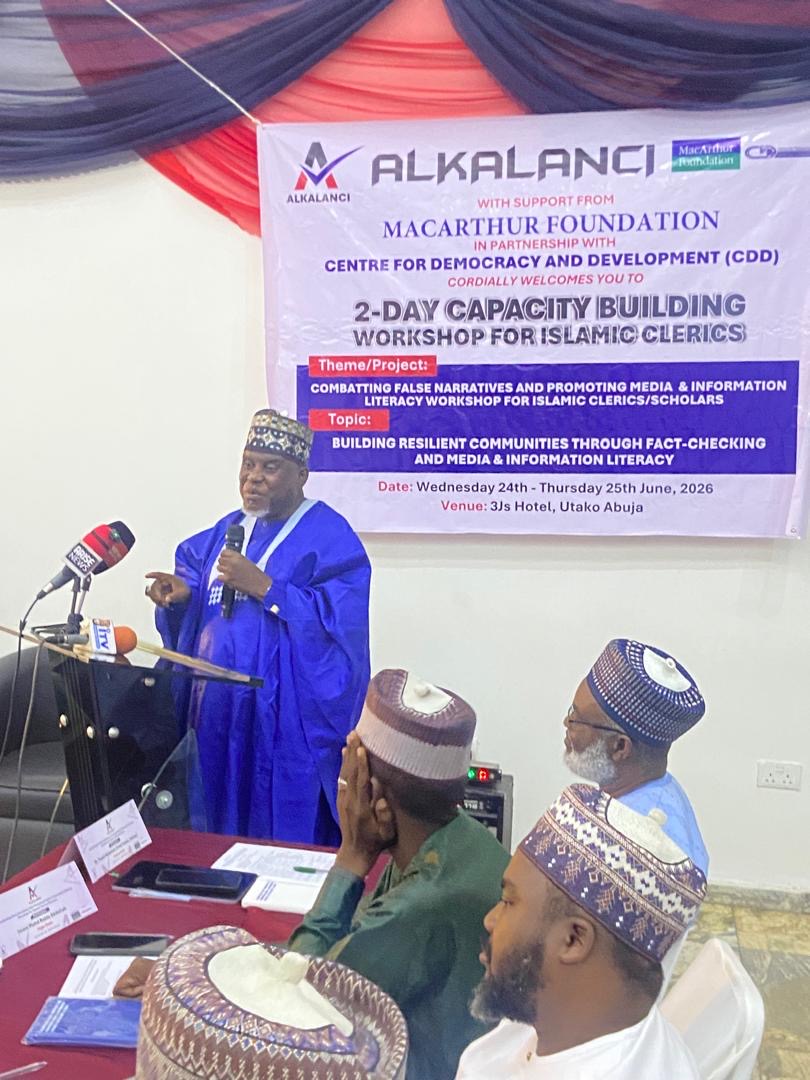
The Nigerian Supreme Council for Islamic Affairs (NSCIA) and Jama’atu Nasril Islam (JNI) have issued a stern directive to Islamic clerics across Northern Nigeria, urging them to strictly abstain from political partisanship, hate speech, and the propagation of misinformation. This call to action was the focal point of a capacity-building workshop in Abuja titled, “Building resilient communities through fact-checking and media information literacy.” Organized by Alkalanci, the event aimed to equip religious leaders with the necessary tools to navigate an increasingly complex information ecosystem where rumors often outpace the truth.
Speaking on behalf of the NSCIA, Secretary-General Prof. Is-haq Oloyede emphasized that religious leaders hold a position of immense influence, with millions of Nigerians looking to them for guidance each week. He noted that in the current climate, misinformation and disinformation serve as catalysts for communal clashes, religious tension, and social mistrust. By exploiting common identities and deeply held beliefs, malicious actors have successfully used false narratives to incite violence and undermine public stability. Consequently, Prof. Oloyede challenged clerics to transform from passive transmitters of information into vigilant guardians of the truth.
The framework for this responsibility, according to the NSCIA, is already deeply embedded in Islamic tenets. Prof. Oloyede highlighted Surah Al-Hujurat, Verse 6 of the Holy Qur’an, which explicitly instructs believers to verify reports before acting upon them. By adopting rigorous fact-checking and critical thinking, religious leaders can promote social harmony and national unity. The NSCIA underscored that these leaders must actively encourage their congregants to pause and seek evidence before sharing information or forming judgments, thereby mitigating the real-world harms often triggered by digital falsehoods.
Echoing these sentiments, the Secretary-General of JNI and Imam of the National Mosque, Prof. Khalid Aliyu, urged clerics to maintain a strictly apolitical stance to preserve their spiritual integrity. He cautioned that becoming entangled in partisan politics diminishes the authority and objectivity of religious leadership. Furthermore, Professor Aliyu issued a direct appeal to the political class, warning them against the practice of enticing or lobbying clerics, which he argued effectively “boxes them into a corner” and compromises their role as neutral, spiritual guides for the entire nation.
The urgency of this workshop was further contextualized by the project convener and Editor of Alkalanci, Alhassan Bala, who pointed out the looming 2027 general elections. Research indicates that as election cycles approach, there is an inevitable surge in misinformation propagated by both local actors and foreign entities with vested interests in the Nigerian political landscape. Mr. Bala stressed that religious leaders are often targets for manipulation; therefore, being equipped with the skills to identify propaganda is essential for maintaining the peace and stability of their respective communities.
A significant portion of the workshop was dedicated to addressing the rise of sophisticated digital threats, specifically Artificial Intelligence-generated content such as “deepfake” audio, video, and imagery. With the line between truth and fabrication becoming increasingly blurred, the organizers emphasized that community leaders must become technologically literate to protect themselves and their followers from manipulation. By mastering these contemporary tools of media literacy, the participating clerics are better prepared to serve as a bulwark against the rising tide of digital misinformation, ensuring that their influence remains a force for national development and sustainable peace.


