









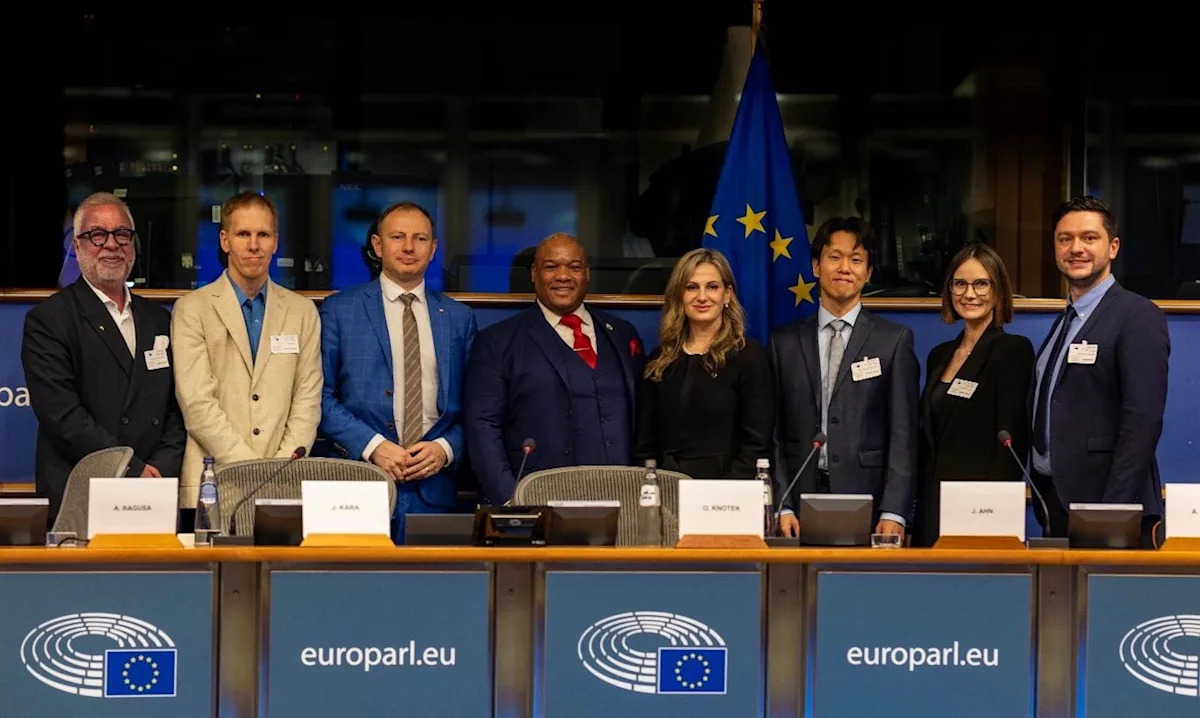
A recent scientific conference held within the halls of the European Parliament has sparked significant controversy following revelations that its co-organizers are allegedly linked to a fringe religious group known as AllatRa. The event, titled “Nanoplastics: Hidden connections and emerging risks,” was hosted by Czech lawmaker Ondřej Knotek in February, but subsequent investigative reporting by openDemocracy suggests the forum served as a veil for a broader agenda. AllatRa, a group that has faced accusations of being a dangerous cult, reportedly promotes apocalyptic theories, including the assertion that humanity faces extinction by 2036. By securing a high-profile venue, the group gained a veneer of institutional legitimacy that has left observers and European officials alarmed.
The investigation uncovered that AllatRa’s involvement went beyond mere logistics, as the group utilized the platform to propagate pseudoscience. The organization posits that global climate change is not primarily a result of anthropogenic activities, but rather a combination of nanoplastic pollution and a cyclical cosmic phenomenon that occurs every 12,000 years. These claims stand in stark contradiction to established scientific consensus as presented by the Intergovernmental Panel on Climate Change (IPCC), which unequivocally identifies human-caused greenhouse gas emissions as the driving force behind global warming. By presenting these fringe theories alongside legitimate scientific discourse, critics argue the event facilitated the dangerous mainstreaming of disinformation.
Central to the controversy is the group’s deceptive handling of expert testimony. The investigation revealed that AllatRa frequently co-opted the work of reputable scientists, splicing their research findings to support conclusions that the authors themselves explicitly reject. Several academics, including marine biology professor Richard Thompson of the University of Plymouth, expressed their frustration, noting that the group manipulated their remarks to imply a level of endorsement that never existed. Similarly, Turkish marine biologist Sedat Gündoğdu, who formally requested the removal of his interview from an AllatRa-produced documentary, characterized the group’s effort to link nanoplastics to “intellectual extinction” as complete nonsense.
The infiltration of such groups into legislative spaces highlights a growing concern among environmental experts: the deliberate distraction from effective climate policy. While microplastics represent a genuine ecological and health crisis, researchers warn that exaggerating their role in climate instability serves to shift focus away from the urgent necessity of cutting fossil fuel consumption. By muddling the narrative with alarmist, non-scientific theories, groups like AllatRa complicate the public’s understanding of the climate crisis. This targeted misinformation can inhibit the implementation of substantive environmental laws by creating confusion regarding the most effective solutions available to policymakers.
The ability of an esoteric group to access the European Parliament has prompted severe scrutiny regarding security and vetting protocols. Security researcher Petra Mlejnková told openDemocracy, “To the casual observer, it seems bizarre that an organisation with roots in esotericism and impending apocalypse would knock on the doors of the European Parliament.” Experts suggest that these tactics are a calculated strategy to secure “mainstream validation,” which acts as a protective shield against the scrutiny of watchdog groups and the charge of being labelled as a sectarian entity. The event highlights how easily the prestige of legislative bodies can be weaponized to legitimize radical or fringe agendas.
Ultimately, the event serves as a cautionary tale about the vulnerability of public institutions to the rise of sophisticated disinformation campaigns. As the threat of climate change grows, the need for accurate, evidence-based policy becomes paramount, yet the rise of groups that exploit the nuanced nature of scientific inquiry threatens to undermine that progress. The backlash following the conference serves as a signal to lawmakers to adopt more rigorous vetting processes for the entities granted space in political arenas. Without such protections, legitimate science risks being drowned out by the increasingly creative, yet fundamentally dangerous, narratives concocted by groups pursuing agendas far removed from environmental stewardship.


